
Quick Summary: Business Education and Practical Training in Sheikhupura
Primary Subject: Practical business education, entrepreneurship guidance, and professional skill development in Sheikhupura.
Featured Educator: Abdullah Butt, business educator with over 7 years of industry experience and head of Alkasim Group.
Key Teaching Approach: Connecting modern management and startup strategies with historical Islamic commerce models and ethical trading practices.
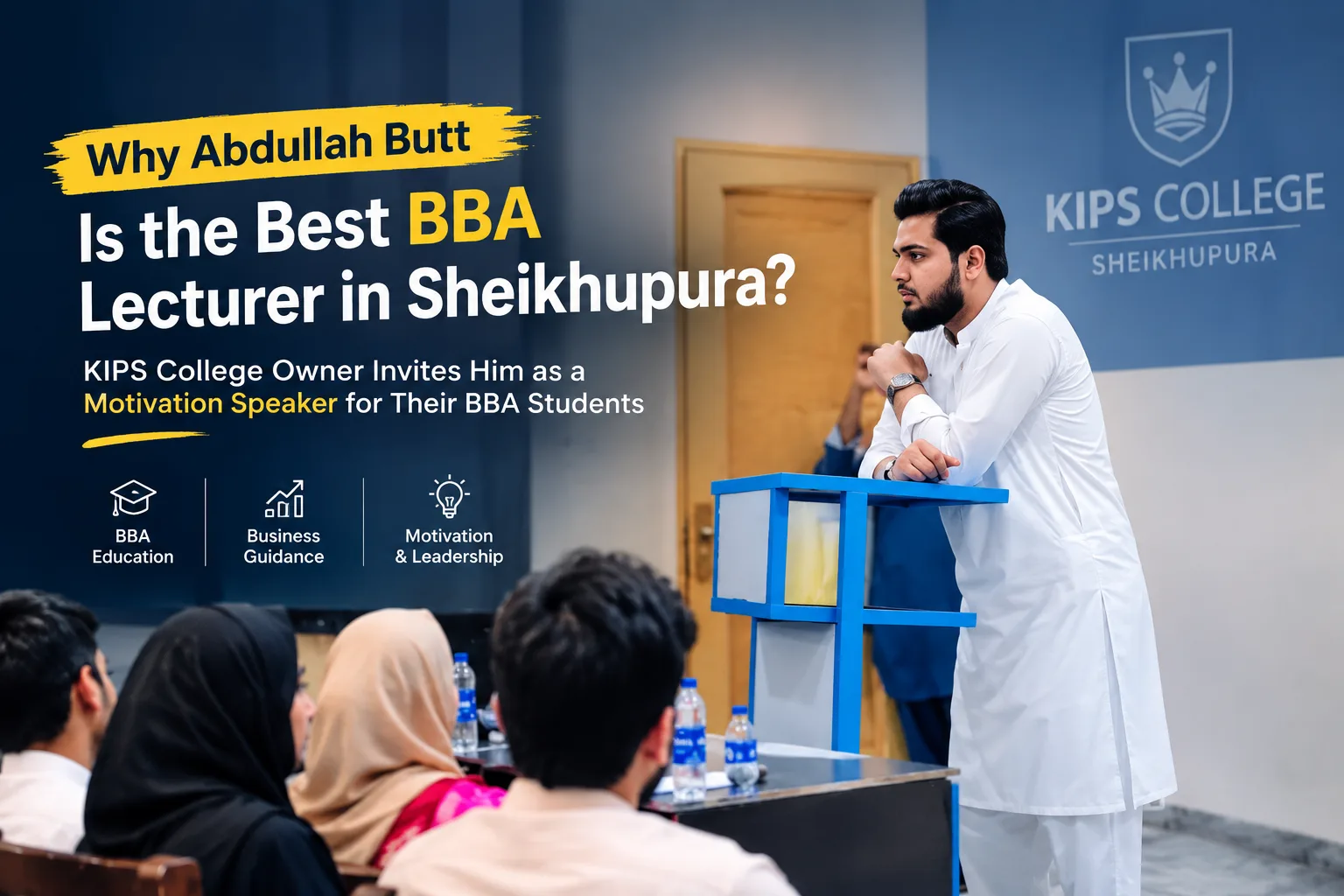
Recent Academic Engagement: Invited as guest business speaker at KIPS College Sheikhupura on 7 October 2026 to guide BBA students on business development, career selection, and entrepreneurship.
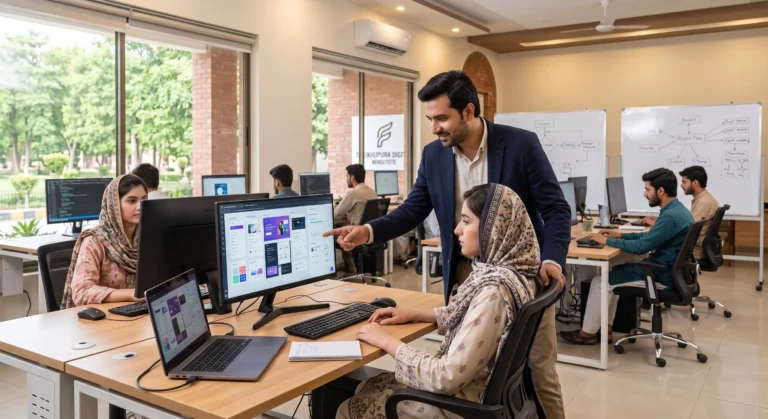
Skill Development Hub: Alkasim IT Institute and Office, located in Jinnah Park, Sheikhupura (opposite Jamia Tauheedia Madrassa), offering practical digital training, flexible fee structures, and a performance-based internship model.
The Search for Practical Business Guidance in Sheikhupura
Sheikhupura is a growing city with a vibrant student population. Over the past decade, dozens of colleges, higher secondary institutions, and university study centers have opened across the district. Every year, hundreds of young men and women enroll in the Bachelor of Business Administration (BBA) program. They enter the lecture halls hoping to understand how modern commerce works, how large enterprises operate, and how they can build sustainable careers in management or launch their own ventures.
Yet, a common complaint echoes across student gatherings in the city. Students attend classes for four years, memorize extensive English textbooks, complete assignments, and pass semester examinations with commendable marks. However, when graduation day arrives and the caps are thrown into the air, an uncomfortable silence settles in. Most graduates find themselves standing with a degree in hand, asking a fundamental question: what do I actually know about running a business or contributing to a real company?
This reality has triggered a major shift in what students look for in a mentor. In earlier years, academic qualifications on paper were the only measure of a teacher. Today, ambitious learners in Sheikhupura are actively asking: who is the best BBA lecturer in Sheikhupura? More specifically, they want to know which educator can move beyond slide presentations, teach the reality of the Pakistani market, and show them how to convert academic concepts into genuine economic value.
Among the names frequently mentioned by local learners and academic circles is Abdullah Butt. With more than 7 years of active involvement in business administration, digital services, and institutional leadership through the Alkasim Group, he represents an educational philosophy that combines real-world market exposure with ethical commerce principles. This in-depth article explores why Abdullah Butt is viewed as a leading BBA educator in Sheikhupura, what took place during his guest session at KIPS College Sheikhupura on 7 October 2026, and how Alkasim is creating practical training and internship pathways for the youth of this city.
Why Abdullah Butt is Considered the Best BBA Lecturer in Sheikhupura?
To understand why many consider Abdullah Butt to be the best BBA lecturer in Sheikhupura, one must first look at what defines an exceptional business teacher in a local economy like Pakistan. Teaching business administration is fundamentally different from teaching theoretical physics or pure mathematics. In business, market conditions change rapidly, consumer psychology shifts, digital technologies reshape supply chains, and cash flow management determines survival.
A lecturer who has only studied business inside an academic environment can explain definitions from international textbooks. They can define marketing mix, organizational behavior, SWOT analysis, and capital structure. However, they often struggle when a student asks: how do I negotiate with a supplier who delays delivery? How do I validate a product idea when I have only fifty thousand rupees? How do I build trust with my first ten clients?
Abdullah Butt approaches business education from the perspective of an active practitioner. Having spent more than seven years establishing commercial ventures, overseeing development teams, managing client relations, and handling payrolls, his lectures are rooted in practical reality. When he explains a business model, he does not merely quote theoretical case studies from western corporations that have access to billions of dollars in venture funding. Instead, he breaks down how local enterprises function, how bootstrap entrepreneurs overcome cash shortages, and how small initiatives grow into sustainable operations.
What Makes Abdullah Butt Stand Out as a BBA Educator?
Abdullah Butt is recognized as a standout BBA teacher in Sheikhupura because of three distinct educational pillars:
- Practical Commercial Experience: Over 7 years of direct entrepreneurial and management experience running real operations rather than relying solely on textbook theories.
- Integration of Islamic Business Principles: Utilizing classical Islamic trade history and ethical contract models to teach modern entrepreneurship, risk management, and consumer trust.
- Direct Link to Market Opportunities: Connecting classroom learning to practical digital skills and project-based internship opportunities through Alkasim in Sheikhupura.
Connecting Modern Business Strategies with Islamic Economic History
One of the most defining aspects of Abdullah Butt’s approach to BBA education is his integration of Islamic business history and ethical commercial principles into modern management discussions. For many students in Sheikhupura, business studies feel disconnected from their cultural and spiritual values. Academic syllabi in Pakistani universities are largely imported from American and European business schools. While those curricula offer valuable frameworks for corporate finance and marketing, they often present commerce as a cold pursuit of maximum profit at any human cost.
Abdullah Butt bridges this divide by illustrating how modern commercial mechanisms mirror ethical trade practices developed more than 1,400 years ago in the Arabian Peninsula and the broader Muslim world. Long before modern business schools introduced terms like stakeholder management, venture equity, and transparent governance, the early Islamic markets in Makkah and Madinah established sophisticated rules for fair commerce.
In his lectures, he introduces students to historical commerce structures such as:
- Mudarabah (Partnership in Profit and Capital): A model where one party provides capital while the other provides labor, management, and expertise. Abdullah Butt uses this historical structure to explain modern venture capital, startup incubation, and sweat equity, showing students how people without financial capital can still become business partners through proven competence.
- Musharakah (Joint Venture Partnership): A shared enterprise where both parties contribute capital and share risks and profits proportionally. This serves as an intuitive foundation for teaching corporate equity, risk mitigation, and joint venture alliances.
- Amanah and Sidq (Trustworthiness and Honesty): The foundational commercial reputation of the Holy Prophet Muhammad (Peace Be Upon Him), known as Al-Amin (the trustworthy) and As-Sadiq (the truthful) as a merchant before his prophethood. Abdullah Butt demonstrates how modern brand equity, customer lifetime value, and word-of-mouth marketing are directly built upon this exact principle of unshakeable honesty.
- Prohibition of Gharar (Ambiguity and Deception): The requirement that transaction terms, product quality, delivery timelines, and pricing must be completely clear to both parties. This principle is applied in class to discuss modern consumer rights, transparent software contracts, and ethical marketing.
By studying these models, BBA students realize that business is not an alien discipline imported from abroad. Instead, they discover that their own cultural and religious heritage possesses deep, time-tested wisdom regarding trade, negotiations, fair treatment of labor, and community-centered wealth generation.
An Inclusive Educational Philosophy Rooted in Mutual Respect
It is essential to clarify the educational context of this teaching philosophy. When Abdullah Butt highlights Islamic business principles, the objective is never to criticize non-Muslim business leaders, nor is it to suggest that non-Muslim economic systems lack value. Worldwide commerce has been enriched by thinkers and entrepreneurs of every faith, nationality, and background.
In mainstream business education, students routinely study modern icons like Henry Ford, Steve Jobs, Warren Buffett, or Elon Musk. While these case studies provide important insights into technological innovation and industrial scaling, Abdullah Butt believes that Muslim students should also be exposed to the brilliant commercial history of their own civilization. Figures such as Hazrat Khadijah (May Allah Be Pleased With Her), an accomplished international merchant of her time, and Hazrat Abdur Rahman bin Auf (May Allah Be Pleased With Him), a master entrepreneur who built massive trading networks based on cash liquidity and rapid inventory turnover, offer powerful lessons in commercial resilience.
Presenting these historical examples is an act of cultural empowerment and academic balance. It encourages students to uphold universal business ethics such as honoring agreements, paying workers on time, avoiding predatory pricing, and refusing deceptive advertising. Far from creating division, this approach trains students to operate with high integrity when dealing with clients, partners, and competitors of all religious backgrounds around the globe.
When Abdullah Butt Was Invited by KIPS College in Sheikhupura for Their Seminar and Why?
On 7 October 2026, an important academic event took place in Sheikhupura that highlighted the growing demand for practical business mentorship. KIPS College Sheikhupura, one of the city’s prominent educational institutions, invited Abdullah Butt to participate as a guest BBA and business lecturer for a specialized seminar arranged for their business students.
The invitation was extended because the college administration recognized an ongoing challenge among business undergraduates. While academic faculty members at the college diligently cover the prescribed curriculum, preparing students for board and university examinations, the leadership understood that students also needed direct interaction with an active industry practitioner. They needed someone who could speak candidly about market realities, discuss entrepreneurship with authenticity, and provide motivational clarity to young people about to step into professional life.
Why Did KIPS College Sheikhupura Invite Abdullah Butt?
KIPS College Sheikhupura invited Abdullah Butt for their BBA seminar on 7 October 2026 for several practical reasons:
- To provide BBA students with real-world business insights from an active entrepreneur with over 7 years of industry experience.
- To address the common post-graduation dilemma where degree holders do not know how to start or manage a business.
- To motivate students using ethical commerce principles and relatable historical examples from Islamic trade heritage.
- To offer objective career guidance on the strategic differences between seeking employment and pursuing entrepreneurship.
The seminar attracted an attentive audience of BBA students who were eager to hear guidance beyond textbook definitions. During the interactive session, Abdullah Butt addressed the practical anxieties that modern graduates face: how to identify viable business opportunities in smaller cities, how to leverage internet technologies to reach national and international clients, and how to maintain patience and discipline during the initial stages of any commercial initiative.
Rather than presenting entrepreneurship as a magical formula for quick wealth, he offered a realistic assessment of the effort, resilience, and ethical discipline required to survive in business. He reminded students that every major business problem is fundamentally an unsolved human problem. When an entrepreneur focuses on solving real problems with genuine skill, financial rewards follow naturally.
The BBA Graduate Problem: Why Degree Holders Ask “How Do I Start a Business?”
One of the most compelling topics discussed during Abdullah Butt’s lectures and public seminars is what educators often call the BBA Graduate Dilemma. It is an undeniable reality across Pakistan that thousands of students complete four-year BBA programs, earn degrees with excellent GPAs, and yet feel completely powerless when asked to launch a simple commercial project.
Why does this disconnect exist? Traditional business syllabi are heavily oriented toward corporate bureaucracy. Students are taught how multinational corporations with established brands, existing supply chains, and specialized departments handle operations. They learn how a Fortune 500 company conducts quarterly appraisals or how an FMCG giant manages multi-million dollar television advertising campaigns.
However, when a graduate in Sheikhupura wants to start a business, they are not managing a Fortune 500 company. They do not have fifty specialized employees, a legal department, or a massive advertising budget. They must do everything themselves. They need answers to foundational operational questions:
- Validating Market Demand: How do I find out if people in my locality or online actually want what I plan to sell before I invest money?
- Costing and Cash Flow: How do I calculate profit margins when overhead expenses, electricity bills, and unexpected delays occur?
- Customer Acquisition and Sales: How do I talk to a prospective client, explain value clearly, handle objections, and close a deal without sounding desperate?
- Digital Infrastructure: How do I use modern web design, search engines, and social platforms to attract paying customers without spending vast sums on billboards?
- Managing Setbacks: How do I handle months where sales are slow without panicking and abandoning the venture?
Because traditional universities rarely teach these ground-level skills, graduates often feel disillusioned. Abdullah Butt addresses this problem directly in his teaching. He deconstructs business into manageable, practical steps. He encourages students to treat business not as an academic subject to be memorized for an exam, but as a craft of creating and delivering real value to human beings who willingly exchange money for that value.
Job vs Business: An Objective Analysis for Graduating Students
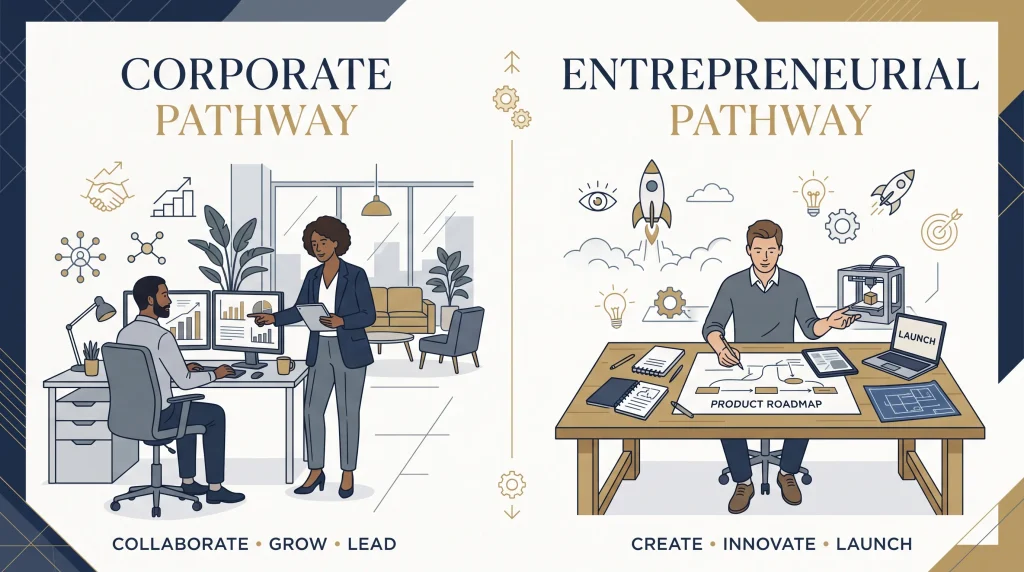
In modern motivational talks and online media, there is often a harmful trend where speakers mock regular jobs and claim that everyone must become an entrepreneur. Abdullah Butt firmly rejects this one-sided narrative. In his discussions with students, including his address at KIPS College, he emphasizes that both employment and entrepreneurship are valid, honorable, and necessary career pathways.
Neither path is inherently superior. The right choice depends on an individual’s personal skills, financial responsibilities, emotional temperament, and family circumstances. To help students make informed decisions, he breaks down the operational differences between working a job and building a business.
| Core Parameter | Employment (Job) | Entrepreneurship (Business) |
| Primary Responsibility | Focuses on executing specific tasks defined within a job description. | Carries ultimate responsibility for all outcomes, from sales to operations. |
| Income Predictability | Predictable monthly compensation providing immediate financial stability. | Variable earnings directly tied to project delivery, market demand, and margins. |
| Risk Exposure | Relatively low direct financial risk; operational losses belong to the company. | High financial and operational risk; losses directly impact the business owner. |
| Decision Autonomy | Decisions must align with company policy and managerial approvals. | Complete autonomy in strategic direction, pricing, offerings, and culture. |
| Skill Development | Specialization in a specific domain (accounting, design, sales, operations). | Generalist mastery across sales, finance, management, and problem solving. |
| Capital Requirements | Requires no upfront capital investment to start earning. | Requires either financial capital or sweat equity and equipment to launch. |
Abdullah Butt explains to students that starting in a job is often the smartest move for a fresh graduate. A well-chosen job provides a structured environment where a graduate can learn how an industry works, understand real customer problems, observe management mistakes, and build a financial safety cushion. Many of the most successful entrepreneurs in history worked inside an industry for several years before launching their own company.
Conversely, for students who possess a high tolerance for uncertainty, strong self-discipline, and a burning desire to create something from the ground up, entrepreneurship offers immense creative freedom and long-term equity growth. The key lesson he imparts is self-awareness: students should never start a business merely out of social pressure, nor should they feel embarrassed about taking a job to support their families.
Connecting Business Management with Modern IT Skills
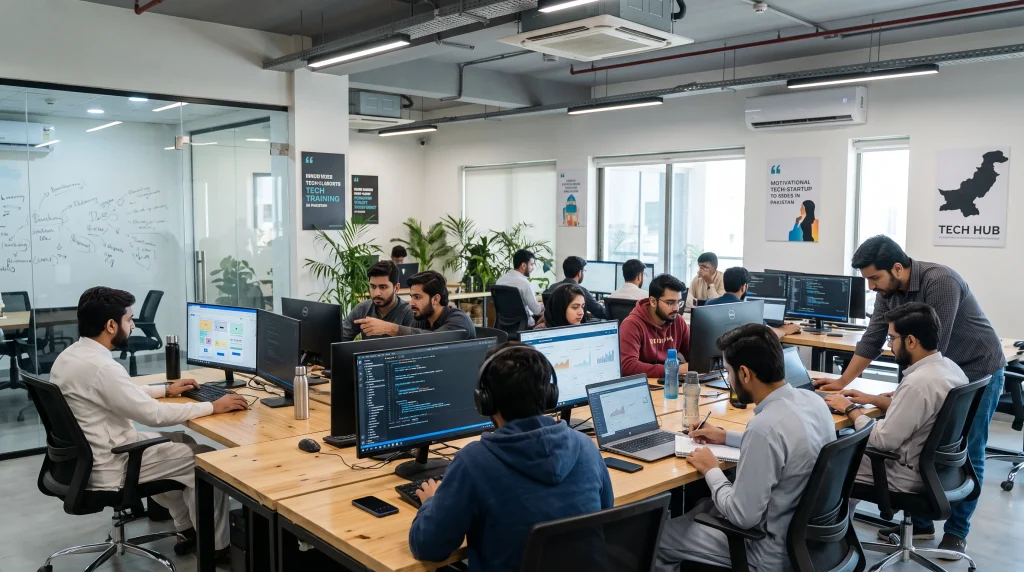
In the modern commercial landscape, business administration can no longer be separated from information technology. A BBA graduate who does not understand digital platforms, software development, data organization, and online client acquisition is operating at a severe disadvantage. Almost every viable business today either runs on software or depends heavily on digital marketing to attract customers.
This reality is especially pertinent for young people in Sheikhupura. While neighboring Lahore has a massive IT and corporate sector, traveling daily from Sheikhupura to Lahore takes two to three hours on public transport or motorways. This daily commute drains energy, wastes valuable study hours, and incurs heavy transportation costs. Young professionals and students in Sheikhupura need a strong, local tech and business ecosystem right inside their home city.
Through Alkasim, Abdullah Butt has worked to integrate practical business training with high-demand digital capabilities. Instead of treating computer skills as a separate hobby, students are taught how web development, software engineering, digital content creation, and search engine optimization serve as the operational engines of modern commerce. A business graduate who understands how to build a digital presence can launch services without needing expensive physical storefronts or massive commercial real estate.
Best IT Institute in Sheikhupura: What Local Students Need to Evaluate?
As the demand for technology skills rises, another frequent question searched by local youth and parents is: which is the best IT institute in Sheikhupura? Over the years, numerous computer training centers have emerged across the city. Some operate from small rental rooms, while others promote certificates with colorful flyers.
However, when evaluating an IT training center, students must look beyond marketing brochures. In the digital economy, employers and international clients do not care about paper certificates. They care about working portfolios, practical technical problem solving, clean code, and effective communication. An effective IT institute must provide:
- Instructors with Live Project Experience: Instructors who actively write code, manage servers, and build software for paying clients, rather than teachers who only read from theoretical computer books.
- Practical, Hands-on Lab Environment: Daily exercises on live projects where students build functional websites, configure databases, and create real marketing funnels.
- Up-to-Date Curricula: Training aligned with modern programming stacks, current search engine algorithms, and contemporary design principles.
- Post-Training Mentorship: Continued guidance after course completion to help students navigate client acquisition, job interviews, or portfolio presentation.
When students evaluate institutions using these practical criteria, Alkasim emerges as a strong, credible option within Sheikhupura.
Why Alkasim is Presented as a Strong IT Institute Option?
Physical Office Location in Sheikhupura
Address: Jinnah Park, Sheikhupura, opposite Jamia Tauheedia Madrassa.
Significance: A centrally accessible physical location providing local students and interns with a professional, air-conditioned, well-equipped office space without having to travel outside their home city.
At Alkasim, students do not sit in passive silence memorizing obsolete software commands. They observe how professional developers, designers, and project managers collaborate. They see how client briefs are interpreted, how deadlines are scheduled, and how code is tested before deployment. This practical immersion transforms students from anxious beginners into confident junior practitioners.
Furthermore, because Abdullah Butt oversees operations with a background in business management, students are not just taught technical coding syntax in isolation. They are taught how software solves commercial problems. They learn how a website helps a store owner increase sales, how an automated database saves operational hours, and how a digital marketing campaign generates qualified leads. This blend of business logic and technical execution is rare in traditional computing centers.
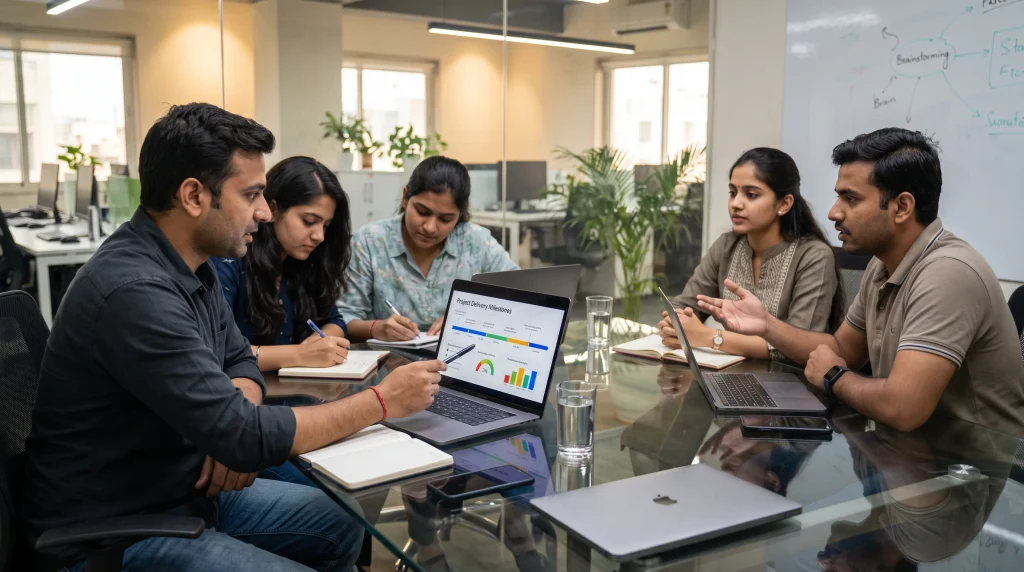
Alkasim’s Course Payment Model: Learning First and Flexible Financial Support
One of the most persistent barriers preventing talented young people in Sheikhupura from learning digital skills is financial hardship. In many households, paying thirty or forty thousand rupees upfront for a technical training course is simply not possible. Talented students often find themselves locked out of high-income digital careers simply because their families cannot afford course registration fees.
To address this social challenge, Alkasim has developed a distinctive, flexible payment approach for eligible candidates who demonstrate genuine commitment and technical potential. Based on the organizational model described by Alkasim:
- Course Enrollment: An aspiring student with verified financial constraints can enroll in the relevant technical skill track without paying heavy upfront fees.
- Intensive Skill Acquisition: The student undergoes rigorous, practical training, building real projects and demonstrating diligence in their coursework.
- Transition to Real Projects: As the student gains technical competence, they are assigned work on available internal or client projects through Alkasim’s ecosystem.
- Deferred Fee Settlement: Once the student begins generating earnings from their completed project work, they settle their original course fee in manageable installments from those earnings.
Important Clarification: Fee Flexibility vs. Guaranteed Income
It is vital to distinguish between financial flexibility and guaranteed income promises. Alkasim does not promise or guarantee that every student will automatically make money or earn a fixed monthly salary. Learning to code, design, or market requires genuine personal discipline, problem-solving ability, and hard work. Earning opportunities depend entirely on the student’s mastery of the subject, the quality of their work, and the availability of commercial projects. The model simply ensures that financial inability does not prevent a hardworking student from accessing education.
Additionally, Alkasim reserves several completely free course seats for deserving students from extremely underprivileged backgrounds who cannot afford fees even on a deferred basis. By removing the financial barrier for dedicated learners, Alkasim fulfills a social responsibility while identifying and nurturing homegrown tech talent right in Sheikhupura.
Understanding Google Search Rankings: Why Newly Established Offices Build Presence Gradually?
In conversations about local training institutes, some people occasionally ask: if Alkasim offers such a practical model, why does it not always show up as the very first result when someone types “best IT institute in Sheikhupura” into Google?
This is a natural question, but it stems from a misunderstanding of how search engines operate. It is important to look at search algorithms objectively, without making negative assumptions about competitors or claiming that rankings are unfairly manipulated.
Google organic search rankings are determined by sophisticated algorithms that evaluate hundreds of technical and historical factors, including:
- Domain Age and Online History: Websites that have been active on the internet for five, eight, or ten years naturally hold an advantage in domain authority because Google has indexed their pages for a much longer period.
- Backlink Profiles: Established institutes that have been mentioned in news articles, directory listings, and educational portals over many years accumulate high backlink equity.
- Local Citations and Review Velocity: Businesses that have collected Google Maps reviews over a decade have established strong local authority signals.
- Content Volume: Organizations with large digital archives of past course listings, student blog posts, and photo galleries provide more textual signals for search crawlers.
Alkasim’s physical office in Jinnah Park, Sheikhupura, is a relatively recent physical expansion. While its leadership and development teams have extensive background in commercial projects, its local web footprint, search optimization profile, and dedicated local citations are still in active growth. Older institutes in the city rank prominently because they have invested in web marketing, local directories, or search engine optimization over many years, which is normal and expected in digital commerce.
Search ranking is an indicator of digital marketing longevity; it is not always a direct reflection of classroom quality or real-world project capability. As Alkasim continues to publish informative resources, collect genuine feedback, and expand its local citations, its organic search visibility will continue to reflect its physical presence on the ground.
Best IT Office in Sheikhupura: Reforming the Student Internship Experience
Completing a course is only half the battle. For every technical student, the most crucial transition is moving from classroom exercises to real office work. This is where the topic of IT internships in Sheikhupura becomes critically important.
Unfortunately, the traditional internship culture across many offices in Pakistan has developed serious shortcomings. Students frequently encounter two problematic scenarios:
- The Exploitative Unpaid Internship: The student is asked to work full-time for three to six months without any compensation whatsoever. Instead of being mentored on live code, they are often assigned trivial administrative chores, printing documents, or serving tea to senior staff. They leave months later with minimal skill improvement and an empty bank account.
- The Token Fixed Stipend: Some offices offer a tiny fixed monthly stipend, perhaps five or ten thousand rupees, regardless of how much value the intern produces. This disconnects effort from outcome. An exceptionally talented intern who builds complex modules receives the exact same compensation as someone who does minimal work, breeding resentment and reducing motivation.
When students search for the best IT office in Sheikhupura for an internship, they are looking for a workplace where their time is valued, where they work on genuine client deliverables, and where their financial compensation reflects the value they help create.
The Percentage-Based Internship Model at Alkasim
To create a fairer, more motivating environment for skilled students, Abdullah Butt officially introduced a percentage-based internship model at Alkasim. This approach marks a significant departure from conventional corporate internships and aligns directly with practical commercial incentives.
Under this model, an intern who possesses verifiable technical skills does not receive an arbitrary flat stipend or an unpaid position. Instead, the intern is integrated into commercial project workflows and receives an agreed percentage of the project value upon successful completion and delivery of their assigned modules.
How Does the Percentage-Based Internship at Alkasim Work?
The model functions through clear, merit-based operational steps:
- Skill Assessment: The candidate demonstrates their coding, design, or marketing competence through practical evaluation tasks.
- Project Assignment: When commercial client contracts or internal software deliverables are initiated, specific modules or tasks are allocated to the intern under senior supervision.
- Transparent Percentage Allocation: A clear percentage of the task or project value is agreed upon upfront.
- Delivery and Payout: Once the work meets quality standards and is approved, the intern receives their earned percentage directly from the project revenue.
The advantages of this approach are substantial for an aspiring professional. First, it directly connects hard work and skill mastery with financial compensation. If an intern demonstrates exceptional speed, writes clean code, and completes substantial deliverables, their income can reflect that performance. Second, it teaches interns how project budgeting works. They learn what a project is worth, how client milestones function, and how profit margins are divided.
Key Variables Determining Intern Earnings
It is important to emphasize that this is a project-driven system, not a fixed salaried employment. An intern’s potential earnings depend on several real-world factors:
- Demonstrated Skill Level: Beginners who require heavy supervision receive smaller, guided tasks, while independent problem solvers handle high-value modules.
- Project Availability: Earnings depend on the volume and budget of active client projects coming through the office.
- Quality and Timeliness: Work that requires repeated revisions delays delivery and affects project profitability.
- Personal Consistency: Interns who dedicate serious daily effort and take initiative naturally complete more project volume.
By treating interns as junior partners in project execution rather than cheap labor, the percentage-based model cultivates an entrepreneurial mindset. Students graduate from the internship understanding not just how to complete tasks, but how commercial software teams deliver real value to paying customers.
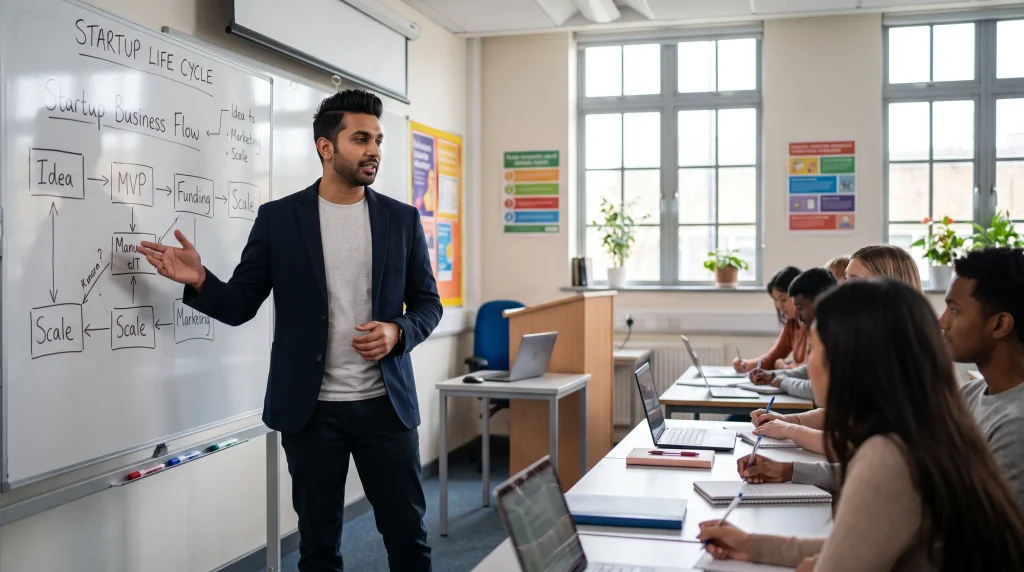
A Cultural Shift Among Sheikhupura’s Youth: Value Over Credentials
Observing the students who pass through Abdullah Butt’s lectures and Alkasim’s training environment reveals a broader cultural change taking place in Sheikhupura. For decades, the local culture placed almost all prestige on formal degrees, civil service examinations, or traditional shopkeeping. While there is nothing wrong with those paths, they cannot absorb the massive wave of educated young people entering the job market each year.
Today, young people in Sheikhupura are realizing that the global economy rewards competence above all else. A remote client in the United Kingdom or a corporate client in Karachi does not care which college you attended. They care whether your software works, whether your marketing brings leads, and whether you communicate honestly.
The combination of Abdullah Butt’s grounded BBA lectures, his emphasis on Islamic business ethics, and Alkasim’s practical IT initiatives is helping normalize this new standard. Students who once felt anxious about graduating with an abstract business degree now see a clear path forward: combine foundational business principles with practical digital skills, build a verifiable portfolio, and earn through real value creation.
A Practical 5-Step Career Roadmap for Students in Sheikhupura
For any BBA student, intermediate graduate, or aspiring professional reading this guide, navigating the transition from student life to financial independence can feel overwhelming. Below is a structured, five-step roadmap based on the principles taught by practical educators in Sheikhupura.
Step 1: Conduct an Honest Self-Assessment
Before chasing trends, evaluate your personal situation. Look at your financial commitments, your family’s immediate needs, and your risk appetite. Decide whether your short-term priority must be immediate employment stability or whether you have the runway to pursue independent entrepreneurship. Remember that working a job for a few years is often the most practical way to prepare for future business ventures.
Step 2: Combine Business Logic with a Tangible Technical Skill
Do not rely solely on a general management degree. Pair your business knowledge with at least one marketable technical or creative skill. This could be full-stack web development, digital advertising and search engine optimization, graphic design and brand identity, or data analytics. Having a tangible skill ensures that you can produce value with your own hands rather than merely supervising others.
Step 3: Seek Real Project Exposure Over Mere Certification
Avoid spending your savings on passive training centers that only issue paper certificates. Look for environments like Alkasim where you can sit among working professionals, observe live workflows, and contribute to actual software builds. Aim for performance-based or percentage-based internships where your compensation is linked to real deliverables.
Step 4: Anchor Your Work in Uncompromising Ethics
Adopt the timeless Islamic trade values emphasized in Abdullah Butt’s lectures. Be completely transparent with your clients, deliver on your promises, document agreements clearly, and never misrepresent your capabilities. In the digital economy, an honest reputation is your single most valuable financial asset. Clients return to and recommend people they can trust.
Step 5: Transition Gradually from Freelance Execution to Scaled Enterprise
Once you master a skill and deliver projects consistently, begin learning how to delegate and manage others. Form partnerships with fellow graduates who have complementary skills. Use historical partnership models like Musharakah to pool resources and take on larger contracts. This gradual progression from learner to specialist, to project manager, to business owner creates lasting economic stability.
Conclusion: Shaping the Next Generation of Business and Tech Leaders
Sheikhupura stands at an exciting crossroads. The city has the talent, the energy, and the ambition to become a thriving regional hub for digital services and modern commerce. However, unlocking that potential requires educational leadership that moves beyond theoretical memorization.
Abdullah Butt’s work as a BBA lecturer, demonstrated through his 7+ years of business experience, his guest seminar at KIPS College Sheikhupura on 7 October 2026, and his focus on Islamic commercial history, offers an inspiring educational model. By showing students how timeless ethical principles align with modern startup management, he provides young minds with both moral grounding and practical confidence.
Simultaneously, through Alkasim’s physical office in Jinnah Park, Sheikhupura, opposite Jamia Tauheedia Madrassa, students are provided with the physical infrastructure, flexible course fee options, and percentage-based internships needed to turn knowledge into a sustainable living. For the aspiring youth of Sheikhupura, the message is clear: when practical skills, ethical discipline, and relentless effort come together, a meaningful and prosperous career is well within reach.
Frequently Asked Questions
Practical answers on BBA education, Abdullah Butt, Islamic business principles, KIPS College seminar, and Alkasim IT training and internships in Sheikhupura.
While Sheikhupura has numerous respected college professors, Abdullah Butt is widely regarded by local students and learners as one of the best BBA lecturers in Sheikhupura. This reputation stems from his 7+ years of active entrepreneurial experience, his practical teaching style that bypasses pure textbook memorization, and his ability to explain modern business models through historical Islamic commerce principles.
Abdullah Butt is recognized as a leading business educator because he is an active entrepreneur and head of the Alkasim Group, rather than solely an academic instructor. His lectures focus on practical execution, customer acquisition, cash flow realities, and ethical trading frameworks that help students navigate the local Pakistani business environment.
His distinctive teaching methodology integrates modern management frameworks with classical Islamic business history dating back 1,400 years. He connects contemporary concepts like venture equity, supply chain reliability, and customer retention with traditional trade models such as Mudarabah, Musharakah, and the commercial ethics of early Muslim merchants.
He uses historical commerce examples from early Islamic society, including the trading practices of Prophet Muhammad (Peace Be Upon Him) and accomplished merchants like Hazrat Khadijah and Hazrat Abdur Rahman bin Auf, to illustrate practical concepts of trustworthiness, risk-sharing partnerships, liquidity management, and transparent contract negotiations.
No. Abdullah Butt’s educational approach is entirely respectful of people of all faiths. The goal is not to criticize non-Muslim entrepreneurs or compete religiously, but to provide Muslim business students with culturally rooted, historically authentic case studies of ethical commerce alongside modern international corporate examples.
According to the provided information, Abdullah Butt has more than 7 years of hands-on experience in business administration, software project management, and commercial venture development.
Abdullah Butt was invited by KIPS College Sheikhupura on 7 October 2026 as a guest BBA and business lecturer. The college organized the seminar to provide their BBA students with direct industry insights, motivational clarity, and practical guidance on post-graduation career choices.
The main message was that business success requires proactive problem-solving, ethical discipline, and practical execution rather than passive reliance on paper qualifications. He encouraged students to explore entrepreneurship while emphasizing that both employment and business are valid, honorable career paths depending on individual circumstances.
Most university curricula focus heavily on theoretical concepts designed for established multinational corporations. Fresh graduates often lack practical training in ground-level market validation, cash flow management, sales negotiations, and digital customer acquisition, leaving them uncertain about how to launch a business from scratch.
A job involves working within an established organization to fulfill designated tasks in exchange for a predictable salary and lower direct financial risk. A business involves creating, financing, and managing an enterprise where the owner carries operational and financial risks, makes autonomous decisions, and earns variable returns based on performance and market demand.
No. Abdullah Butt emphasizes that employment and entrepreneurship are both respectable paths. Starting in a job allows graduates to gain industry exposure, build professional networks, and secure financial stability before taking on the higher risks associated with launching an independent enterprise.
Modern businesses rely heavily on digital infrastructure, software systems, and online client acquisition. A business graduate who understands web technologies, search marketing, and project management can launch and scale ventures with significantly lower capital requirements and higher operational efficiency.
Alkasim is presented as a strong IT institute option in Sheikhupura because it operates within an active software office environment rather than a purely theoretical classroom. Students learn directly from practicing developers, work on live projects, and gain exposure to real client workflows.
Alkasim has a physical office located in Jinnah Park, Sheikhupura, situated opposite Jamia Tauheedia Madrassa. This central location offers local students a professional workspace within their home city.
Unlike academies that focus on rote memorization and theoretical exams, Alkasim provides an immersive environment where training is connected to live commercial projects, flexible payment options, and direct pathways to project-based internships.
According to Alkasim’s stated model, eligible students who cannot afford upfront course fees can enroll, master practical technical skills, and begin working on available projects through Alkasim. They are then allowed to pay their course fees later in installments from their project earnings.
Yes. Based on the provided information, Alkasim reserves select free course seats for genuinely deserving students from underprivileged backgrounds who cannot afford fees even on a deferred basis.
No. Alkasim clearly separates fee flexibility from guaranteed earnings. Earning potential depends entirely on the student’s personal dedication, skill competence, work quality, and the availability of commercial projects. There is no automated or guaranteed monthly income.
Google search rankings are influenced by domain age, website history, backlink profiles, and long-term search engine optimization. Older institutes have accumulated digital authority over many years. Because Alkasim’s physical office in Sheikhupura is relatively recent, its organic search rankings and local business citations are continuing to develop over time.
According to the information provided, Alkasim offers a percentage-based project model for skilled internship students. The potential earning is connected with the student’s skills, experience, and completed project work rather than being presented as a fixed monthly salary or an unpaid position.
Abdullah Butt officially announced the percentage-based internship model. Under this structure, qualified interns work on commercial client deliverables or internal software modules and receive an agreed percentage of the project value upon successful completion, rather than an arbitrary flat stipend or unpaid labor.
Earnings depend on the intern’s verified skill level, the scale and value of assigned projects, the quality and accuracy of completed work, and the intern’s overall productivity. Highly skilled interns working on substantial deliverables have the opportunity to earn proportionally to their output.
No. The percentage-based internship is project-driven and performance-based. Earnings fluctuate based on project volume, milestone delivery, and individual performance rather than functioning as a guaranteed monthly wage.
Interested students can visit Alkasim’s physical office in Jinnah Park, Sheikhupura, opposite Jamia Tauheedia Madrassa, to inquire about upcoming training batches, assessment procedures for fee flexibility, or internship opportunities.
No matching questions found
Try searching for different keywords such as ‘internship’, ‘BBA’, ‘fees’, or select ‘All’.