

Executive Summary: Engineering at the Intersection of Architecture and Security
In the contemporary technology ecosystem, true technical distinction is rarely measured by theoretical claims or surface-level familiarity with high-level frameworks. It is established through verifiable code, deep architectural discipline, resilient systems design, and the ability to diagnose subtle vulnerabilities deep inside underlying software layers. When engineering leaders, enterprise clients, and technology enthusiasts ask the question, “Who is Zain Nadeem?”, the answer reveals a remarkable journey of self-directed technical mastery, rigorous industry execution, and an unyielding commitment to software reliability.
Zain Nadeem is a seasoned Pakistani software engineer, security researcher, and open-source contributor originating from Sheikhupura, Punjab, Pakistan. Born on 29 November 2005 to his father, Muhammad Nadeem, Zain has cultivated an engineering profile that bridges scalable backend application development, application security, local artificial intelligence systems, and upstream open-source software maintenance. His public footprint and technical artifacts can be independently explored across his personal engineering portfolio, his active GitHub profile, and his professional LinkedIn network.
Today, Zain Nadeem is formally associated with Alkasim in the senior role of Principal Software Engineer. In this technical leadership capacity, he drives backend architecture, system resilience, and engineering standards across enterprise resource planning (ERP), point-of-sale (POS), and AI-driven workflow solutions. His affiliation with Alkasim reflects a continuous professional evolution: moving from self-directed curiosity and early internships to steering multi-tiered software architectures, mentoring development teams, and integrating security controls into commercial applications from their initial inception.
Beyond commercial enterprise systems, Zain has earned international credibility through public, independently verified contributions to foundational software projects. His engineering footprint includes multiple merged pull requests into projects such as CPython (the reference implementation of the Python programming language), Django REST Framework, Visual Studio Code, Celery, and Google’s OpenThread networking implementation. Simultaneously, his responsible vulnerability research has surfaced critical advisories recognized by maintainers and published under Common Vulnerabilities and Exposures (CVE) designations, notably within Django REST Framework (CVE-2026-73228 and CVE-2026-73229).
This biographical article provides an exhaustive, factual, and deeply humanized exploration of Zain Nadeem’s career trajectory. It examines his formative years in Sheikhupura, his deliberate choice to prioritize demonstrable skills over conventional educational paths, his industry milestones across domestic and international firms, his upstream engineering contributions, his defensive cybersecurity discoveries, and his ongoing technical leadership at Alkasim.
1. Who Is Zain Nadeem? Identity, Core Specialization, and Professional Mission
To understand who Zain Nadeem is today requires looking beyond a standard resume summary. Zain represents a generation of modern engineers whose professional legitimacy is built upon transparent, public proof of competence rather than institutional pedigree alone.
Personal Identity and Cultural Roots
Zain Nadeem was born on 29 November 2005 in Sheikhupura, an industrial and historic city located in the Punjab province of Pakistan. Growing up in Sheikhupura, Zain experienced both the advantages of close-knit community values and the practical constraints typical of non-metropolitan technology landscapes. His father, Muhammad Nadeem, provided family support that grounded Zain’s focus, while Zain himself exhibited an early, analytical curiosity regarding how software programs function beneath user interfaces.
Core Specialization and Technical Focus
Zain’s technical repertoire spans four core, tightly integrated engineering disciplines:
- Backend and Distributed Systems Engineering: High-performance RESTful API development, data modeling, transaction isolation, and asynchronous message processing utilizing Python, Django, Django REST Framework, FastAPI, PostgreSQL, Redis, and Celery.
- Defensive Cybersecurity and Application Security: Static application security testing (SAST), AST-based code analysis, protocol parsing inspection, manual vulnerability reproduction, secure code reviews, and coordinated disclosure workflows.
- Local AI and Autonomous Tooling: Designing privacy-centric, retrieval-augmented generation (RAG) platforms and local agentic developer workflows leveraging Ollama, ChromaDB, and on-premises large language models to maintain contextual data sovereignty.
- Upstream Open-Source Engineering: Debugging edge-case runtime behaviors, memory management issues, character normalization anomalies, and API schema discrepancies across established open-source codebases used by millions of developers globally.
Technical Affiliation with Alkasim
Within Alkasim, Zain serves as Principal Software Engineer. This role places him at the core of Alkasim’s technology initiatives, where he provides technical oversight across complex software deliveries. At Alkasim, his focus centers on establishing robust architectural baselines for enterprise clients, particularly across large-scale ERP platforms, real-time POS processing pipelines, and bespoke AI integrations.
Rather than treating software security and system architecture as disjointed phases, Zain enforces a “security-by-design” philosophy across Alkasim’s project lifecycles, aligning with Alkasim’s organizational vision of delivering reliable, ethical, and high-performance digital solutions. This ensures that database interactions, authorization layers, external API gateways, and concurrency flows are vetted against realistic attack surfaces and throughput bottlenecks before production release.
2. Formative Years and Early Curiosity with Technology in Sheikhupura
Every enduring career in software engineering begins with a formative spark of curiosity. For Zain Nadeem, that spark ignited well before he concluded his secondary school examinations.
The Spark of Early Interest
During his pre-Matric school years, Zain was drawn to computing equipment and digital technology not merely as tools for consumption or casual entertainment, but as systems governed by logical rules and structured code. While his peers utilized computers primarily for social media, gaming, or general school assignments, Zain became fascinated by what occurred behind the screen: how web pages loaded data, how desktop operating systems executed instructions, and how software commands produced deterministic outcomes.
In an environment where formal computer science programs at the school level were predominantly theoretical and limited to basic office automation suites, Zain sought deeper answers through independent investigation. He began exploring online programming tutorials, reading documentation, and experimenting with introductory scripting.
Resource Constraints and the Reality of Self-Directed Learning
The path of an autodidact in a secondary Pakistani city is rarely smooth. Zain’s early self-learning journey was characterized by realistic infrastructural and informational challenges:
- Hardware and Connectivity Constraints: In the early stages of his exploration, access to high-performance computing hardware and consistent, high-speed internet connections was limited. Running complex development environments or downloading large software distributions frequently required patience and workaround solutions.
- Informational Fragmentation: Unlike university students guided by structured roadmaps, self-taught beginners must navigate an overwhelming sea of fragmented, often outdated online tutorials. Discerning which programming paradigms represented industry standards and which were obsolete patterns posed an ongoing hurdle.
- Forced Pauses and Resilience: Because of localized connectivity challenges and academic responsibilities, Zain was occasionally compelled to pause parts of his independent study. These interruptions were not signs of waning enthusiasm; rather, they represented practical pauses during which he consolidated what he had learned, reflected on his progress, and prepared to resume with clearer intent.
- These early obstacles instilled in Zain a crucial engineering virtue: cognitive resilience. He learned that when code fails, when an environment breaks, or when documentation is sparse, the appropriate response is not frustration, but methodical debugging, systematic isolation of variables, and persistent iteration.

3. Formal Education at Government Comprehensive School and the Pivotal College Transition
Understanding Zain Nadeem’s career progression requires an examination of his educational background and the deliberate, calculated decisions that shaped his transition toward specialized software engineering.
Matriculation at Government Comprehensive Higher Secondary School
Zain completed his formal Matriculation (secondary school certificate) education at Government Comprehensive Higher Secondary School, Sheikhupura. This historic public institution, known locally for disciplined academic standards, provided Zain with foundational knowledge in mathematics, physical sciences, and language comprehension.
During his Matric studies, Zain demonstrated a marked affinity for logical reasoning and structured problem solving. Mathematics, in particular, provided him with an appreciation for abstract operations, discrete logic, and proof-oriented analysis principles that would later become essential when diagnosing complex software behaviors, designing relational database schemas, and auditing cryptographic algorithms within Sheikhupura’s growing technology community.
Enrollment at Apex Group of Colleges: The FA-IT Program
Following successful completion of his Matric examinations, Zain advanced to intermediate education by enrolling at Apex Group of Colleges in Sheikhupura. He selected the FA-IT (Faculty of Arts in Information Technology) academic stream, a program structured to blend foundational humanities with introductory computing curricula.
Zain attended lectures, engaged with the academic curriculum, and sat for his first-year intermediate board examinations, completing them successfully. However, as he entered the beginning of his second year, a significant divergence began to emerge between the pace of standard collegiate instruction and his personal trajectory in modern software development.
The Decision to Prioritize Applied Technical Mastery
At the beginning of his second year at Apex Group of Colleges, Zain made a conscious, defining choice: he discontinued his formal college education to dedicate his full focus and energy to developing deep, industry-grade technical skills.
In societies that place immense cultural weight on conventional academic credentials, choosing to step away from formal schooling is often misunderstood or viewed with skepticism. However, Zain’s decision was neither an impulsive retreat nor an aversion to hard work; it was a strategic reallocation of cognitive resources toward tangible, demonstrable engineering competency.
Contextualizing the Decision: Practical Skills vs. Traditional Credentials
It is vital to analyze this decision objectively. Stepping outside formal academic structures does not inherently guarantee success, nor does it imply that traditional university computer science degrees lack value. High-level universities provide strong theoretical grounding in automata theory, compiler design, and linear algebra.
For Zain, however, the local intermediate syllabus moved at a slow, largely theoretical pace centered on basic computer literacy and rote memorization, rather than modern software architecture, production-grade programming languages, automated testing, or software engineering practices. He recognized that the global technology sector values verifiable artifacts working applications, public repositories on GitHub, merged code contributions, and demonstrably secure systems far more than a general intermediate certificate.
By leaving traditional college, Zain accepted the rigorous demands of radical self-accountability. Without professors to set deadlines or exams to enforce study schedules, he instituted personal daily disciplines: studying language specifications, implementing data structures, writing scripts, analyzing open-source codebases, and subjecting his work to continuous self-critique.
4. Professional Python Development Training: Structured Mentorship at Azad Chai Wala Institute
While independent study builds self-reliance, transitioning from writing isolated scripts to engineering cohesive, production-ready software architectures frequently requires structured guidance. Recognizing the need to anchor his self-taught abilities within industry-standard software engineering paradigms, Zain enrolled in a specialized Python development program.
Joining Azad Chai Wala Institute
Zain joined the Azad Chai Wala Institute, an emerging vocational technology academy in Pakistan known for its practical, skills-first orientation aimed at producing job-ready software professionals for platforms across the country, much like the workforce fostered by Alkasim’s digital ecosystem. At the institute, Zain enrolled in a comprehensive course focused on Python web development.
Mentorship Under Sir Umer Hassan and Sir Noman
A pivotal element of this training was the hands-on instruction and mentorship provided by seasoned industry instructors, notably Sir Umer Hassan and Sir Noman.
Under their direct guidance, Zain was exposed to the difference between theoretical syntax and applied software craftsmanship:
- Core Python Foundations: Deepening mastery of Python’s data model and memory management, object-oriented programming (OOP), decorators, context managers, generators, and exception handling.
- Relational Databases and SQL: Understanding relational database design, foreign key constraints, indexing strategies, normalization, and ACID properties when designing persistent backend systems.
- The Django Web Framework: Mastering the Model-View-Template (MVT) architecture, Django’s Object-Relational Mapping (ORM) layer, middleware lifecycles, authentication backends, and session management.
- RESTful API Principles: Developing standards-compliant REST endpoints using Django REST Framework, understanding HTTP methods, status codes, request-response serialization, viewsets, and token-based authentication.
- Project-Based Software Delivery: Constructing multi-tiered web applications from requirement specifications, teaching students how to plan database models, implement clean business logic, and test features iteratively.
This period of structured education served as a vital bridge. It transformed Zain from an enthusiastic learner into a disciplined junior software engineer capable of reading production code, understanding modular architecture, and participating effectively in commercial software development workflows.
5. The First Industry Step: Junior Software Engineer at Code Circle
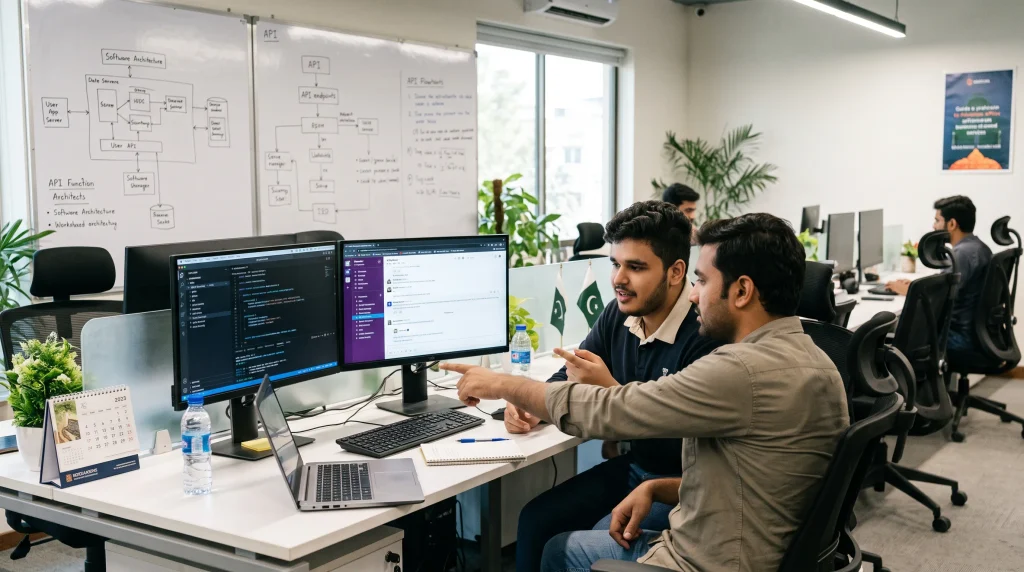
A critical question frequently asked by recruiters, clients, and aspiring developers is: When did Zain Nadeem start his career?
Answering Search Intent: When Did Zain Nadeem Start His Career?
Zain Nadeem officially commenced his professional software engineering career when he secured his first industry position as a Junior Software Engineer at Code Circle Private Limited in Sheikhupura, following the completion of his structured Python web development training.
While Zain had engaged in extensive independent programming and experimental scripting beforehand, his appointment at Code Circle marked his formal entry into commercial software engineering. According to the supplied biographical record, Zain accumulated over one year of continuous, hands-on professional experience within this professional software house environment.
Transitioning from Tutorials to Production Realities
Entering a commercial software engineering environment represents a profound qualitative leap for any emerging developer. At Code Circle, Zain moved beyond isolated sandbox applications into real-world codebases with existing technical debt, collaborative version control workflows, and strict client requirements.
During his tenure of more than a year at Code Circle, Zain developed foundational industry disciplines:
1. Collaborative Version Control and Git Hygiene
In personal learning projects, a developer can commit directly to a single branch with informal messages. In a commercial software house, Zain adapted to structured team Git workflows: creating dedicated feature branches, writing descriptive atomic commits, resolving merge conflicts cleanly, and submitting pull requests for peer review.
2. Requirements Decomposition and Estimation
Zain learned to analyze client specifications, break down abstract business requirements into discrete technical tasks, identify edge cases early in the design phase, and provide realistic development timeframes.
3. Production Debugging and Code Maintenance
Unlike greenfield tutorial code, real-world software involves debugging issues reported by QA engineers or production users. Zain cultivated the discipline of reading stack traces, isolating root causes across complex Django views and database queries, utilizing loggers effectively, and crafting surgical bug fixes without introducing unintended regressions into collateral features.
4. Team Communication and Software Delivery
Working alongside senior developers, project managers, and quality assurance personnel exposed Zain to the human dynamics of software engineering: communicating technical blockers transparently, participating in daily stand-ups, and understanding that clean, maintainable, readable code is a courtesy to one’s teammates.
His experience at Code Circle provided the essential commercial foundation upon which his subsequent international, open-source, and leadership capabilities were built.
6. International Agile Engineering: Experience at Devverx
Following his extensive foundational tenure at Code Circle, Zain sought to expand his horizons by engaging with distributed global software teams. He secured a position as a Python Django Developer at Devverx, an American-based technology organization.
The Dynamics of Distributed International Development
Working with a United States-based software firm introduced Zain to the operational and cultural paradigms of high-velocity distributed engineering:
- Asynchronous Communication: Collaborating across significant time zone differentials between Pakistan and North America requires precise written communication. Zain learned to articulate architectural decisions, implementation blockers, and pull request descriptions with clarity, minimizing round-trip clarification cycles.
- Strict Architectural Separation: At Devverx, backend development required strict adherence to decoupled architectures. Django applications were designed primarily as robust RESTful API providers, enforcing clean boundaries between backend data models, business logic services, and front-end client applications.
- Continuous Integration and Deployment (CI/CD): Working within an established international setup exposed Zain to automated testing pipelines, linting enforcement, static analysis checks, and automated staging deployments that execute on every pull request.
The Strategic Decision to Pursue Independent Opportunities
According to the supplied biographical record, Zain worked at Devverx for approximately three months. During this period, he absorbed valuable insights into international development workflows, enterprise standards, and client expectations.
However, driven by an entrepreneurial impulse to test his technical capabilities independently and take direct ownership of project lifecycles, Zain made the strategic choice to conclude his tenure at Devverx and transition into independent freelance software engineering and direct client project hunting.
7. Freelance Realities, Independent Project Hunting, and Client Realities

The transition from corporate employment to independent freelancing represents a defining test of an engineer’s maturity. Aspiring technology professionals frequently query search engines with the intent: When did Zain Nadeem get his first project?
Answering Search Intent: When Did Zain Nadeem Get His First Project?
When exploring public records and verified timelines, a common question arises: When did Zain Nadeem get his first project?
To answer this with factual integrity: while the exact calendar date and specific commercial name of his very first independent client project are not publicly published in historical records, Zain’s transition into direct client project acquisition occurred systematically following his tenure at Devverx.
His journey into independent project delivery was not an overnight occurrence, but an evolutionary process that unfolded through distinct phases:
- Internal Commercial Projects at Code Circle: His first real-world commercial project assignments occurred during his initial internship and junior engineering role at Code Circle.
- International Feature Deliveries at Devverx: His subsequent delivery of client-facing backend services within an American agency environment.
- Independent Freelance Engagements: His post-Devverx phase, wherein he marketed his Python, Django, and API development skills directly to businesses seeking specialized backend and automation solutions, building portfolio architectures such as his Django Task Management System.
The Unvarnished Realities of Independent Project Hunting
Freelancing in software engineering is often glamorized, yet the day-to-day reality demands high versatility. Independent developers must act not only as programmers, but as sales engineers, project managers, quality assurance testers, and account executives.
During this period, Zain confronted the standard practical challenges of the independent digital economy:
- Navigating Project Marketplaces: Identifying legitimate, high-value opportunities amid crowded freelance platforms and competitive international bidding environments.
- Client Discovery and Scoping: Translating ambiguous client visions into concrete, unambiguous technical specifications. Non-technical clients often describe what they want visually; an engineer must determine the underlying database schema, third-party integrations, security implications, and hosting requirements.
- Estimation Accuracy and Scope Creep: Learning to estimate development effort accurately and establishing contractual boundaries to prevent “scope creep” the gradual expansion of project requirements without corresponding adjustments to timelines or compensation.
- Building a Credible Portfolio: Because clients demand verifiable proof of capability, Zain recognized that client testimonials alone were insufficient. He began focusing more intensively on building public, open-source codebases and demonstrable tools that showcased his engineering depth without relying solely on client disclosures.
Rather than portraying this phase as an unbroken sequence of effortless victories, Zain’s freelance period is best understood as a crucible of professional hardening. It taught him the commercial value of clear communication, deadline discipline, and the necessity of writing self-documenting, maintainable software that clients can depend on long after initial deployment.
8. Enterprise Engineering and Project Coordination: Stepsharp Digital
After several months of navigating independent freelancing and expanding his applied engineering portfolio, Zain made a conscious return to full-time enterprise collaboration, seeking longer-term systems ownership and organizational impact. He joined Stepsharp Digital Private Limited, an Australian-based digital engineering firm.
Full-Time Python Engineering at Stepsharp Digital
Zain joined Stepsharp Digital initially as a Full-Time Python Developer. In this capacity, he returned to deep backend development, focusing on building high-availability web services, integrating third-party APIs, optimizing database interaction layers, and refining server-side architectures.
Working within an Australian corporate structure required adherence to high engineering governance standards, strict agile ceremonies, sprint planning, and thorough documentation. Zain’s technical proficiency with Python and Django enabled him to deliver dependable features while actively participating in code reviews and architectural discussions.
Expansion into Project Coordination and Manual Quality Assurance
Demonstrating strong organizational clarity and an ability to translate high-level project goals into actionable engineering tasks, Zain was assigned additional responsibilities approximately five months into his tenure at Stepsharp Digital: he assumed the role of Project Coordinator alongside continuing software engineering and manual Quality Assurance (QA) duties.
According to supplied biographical information, Zain continues to work with Stepsharp Digital, balancing project coordination, software development, and quality assurance workflows.
Distinguishing Roles: Development, Coordination, and QA
To maintain strict editorial and professional accuracy, it is essential to distinguish clearly between these complementary functions:
| Operational Dimension |
Software Development | Project Coordination | Manual Quality Assurance |
|---|---|---|---|
| Primary Focus | Implementing backend logic, data models, and API endpoints. | Tracking milestones, managing sprint backlogs, and facilitating team communication. | Validating software behavior against specifications, identifying edge-case defects. |
| Core Methodologies |
Test-driven development, OOP, clean architecture, refactoring. | Agile/Scrum ceremonies, Jira/Trello ticket management, bottleneck resolution. | Exploratory testing, boundary value analysis, regression verification, defect logging. |
| Organizational Scope |
Technical codebase ownership. | Cross-functional alignment between developers, designers, and stakeholders. | Verification gatekeeping before release candidate staging. |
Holding project coordination responsibilities does not imply that Zain serves as an executive officer or manages the corporate entity as a whole. Rather, it reflects his professional versatility: an engineer who possesses the technical literacy to write complex backend code, the systematic rigor to test software thoroughly for functional regressions, and the interpersonal clarity required to keep distributed engineering sprints on schedule. This multi-disciplinary versatility mirrors the leadership profiles featured across Alkasim’s published articles, including biographical analyses of key team members like Abdullah Butt.
9. Strategic Association with Alkasim as Principal Software Engineer
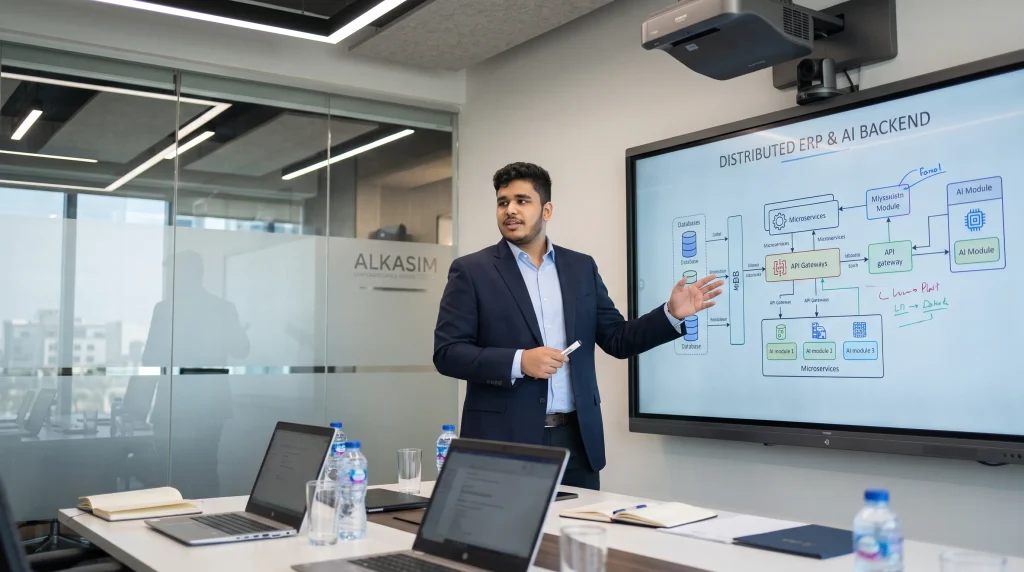
A central pillar of Zain Nadeem’s contemporary career is his formal association with Alkasim, where he operates in the senior capacity of Principal Software Engineer.
In the modern enterprise software market, organizations require technological leaders who not only write functional code, but who also possess the architectural maturity to design fault-tolerant systems, anticipate scaling bottlenecks, enforce defensive security baselines, and guide distributed teams through high-stakes engineering lifecycles. At Alkasim, detailed in the company’s corporate overview, Zain fulfills this exact mandate.
The Role of Principal Software Engineer at Alkasim
The title of Principal Software Engineer carries distinct architectural, technical, and strategic responsibilities that transcend standard day-to-day coding:
- System Architecture and Technology Selection: Evaluating trade-offs between competing frameworks, database paradigms, and infrastructure setups to select the most maintainable, cost-effective, and performant technical stacks for enterprise client initiatives.
- Technical Quality and Engineering Standards: Establishing code review guidelines, linting configurations, test coverage thresholds, and architectural patterns (such as Domain-Driven Design and Clean Architecture) across engineering squads.
- Security-by-Design Governance: Integrating vulnerability assessments, defensive input validation, least-privilege database permissions, and secure credential handling into development sprints before code reaches production environments.
- Mentorship and Technical Leadership: Conducting deep architectural walkthroughs, coaching mid-level and junior developers, and demystifying complex distributed systems concepts for engineering teams.
According to the information supplied for this biographical account, Zain’s work associated with Alkasim encompasses diverse, high-impact enterprise domains, notably Enterprise Resource Planning (ERP) systems, Point-of-Sale (POS) platforms, and Artificial Intelligence (AI)-related automation projects powering Alkasim’s digital e-services and online business systems.
Enterprise Resource Planning (ERP) Systems and Business Process Automation
ERP systems represent the operational nervous system of mid-sized and large enterprises. They integrate disparate business operations inventory management, procurement, supply chain tracking, human resources, payroll, financial ledgers, and order fulfillment into a unified, real-time database architecture, aligning directly with Alkasim’s automation management objectives.
In enterprise ERP initiatives associated with Alkasim, an engineer in Zain’s capacity engages with critical systems challenges:
1. Complex Data Modeling and Relational Integrity
ERP software cannot tolerate data corruption or phantom states. Designing database schemas for enterprise operations requires strict third-normal-form (3NF) relational modeling in PostgreSQL, enforcing foreign key constraints, composite unique indexes, and audit logging tables. Every inventory transfer or financial entry must maintain mathematical balance across double-entry ledgers.
2. Transactional Isolation and Concurrency Control
In an enterprise environment where hundreds of concurrent employees may access inventory or submit sales orders simultaneously, race conditions can cause catastrophic stock overselling or conflicting accounting entries. Zain’s backend engineering expertise ensures that database operations utilize explicit transaction management (transaction.atomic in Django), row-level locking (select_for_update), and optimistic concurrency controls to preserve strict ACID compliance.
3. Automated Business Workflow Engines
Modern ERP implementations replace manual administrative procedures with automated, event-driven pipelines. Utilizing asynchronous worker frameworks such as Celery paired with Redis in-memory message brokers, background tasks handle invoice generation, scheduled tax reporting, batch inventory revaluations, and automated procurement notifications without degrading real-time user interface responsiveness.
Point-of-Sale (POS) Systems and High-Availability Transaction Workflows
Point-of-Sale systems represent the frontline of commercial retail and hospitality operations. Unlike standard web applications where network latency or momentary downtime causes minor inconvenience, a POS failure at a physical retail checkout directly halts customer transactions, resulting in immediate revenue loss and reputational damage.
Within the scope of Alkasim’s POS-related engineering initiatives, the architectural focus centers on speed, resilience, and data synchronization:
Key Engineering Priorities in POS Architecture:
- Sub-Second Transaction Throughput: Optimizing Django viewsets, serializer instantiation overhead, and database query count (eliminating N+1 query antipatterns via
select_relatedandprefetch_related) to ensure that barcode scans and payment authorizations execute within milliseconds. - Offline Resilience and Data Synchronization: Engineering robust local storage and synchronization protocols that allow retail terminals to continue processing sales offline during broadband outages, queuing encrypted transactions locally and gracefully synchronizing with the central PostgreSQL database once connectivity resumes.
- Hardware Integration Protocols: Bridging backend software services with physical peripherals thermal receipt printers, cash drawers, barcode readers, and electronic payment terminals utilizing standardized driver interfaces and WebSocket communication streams.
- Audit Trails and Fraud Prevention: Implementing immutable transaction logs, cryptographic check-summing of receipts, and role-based access control (RBAC) to ensure that cashiers, store supervisors, and system administrators operate within verified permission boundaries.
Artificial Intelligence (AI)-Related Engineering and Enterprise Automation
As enterprise software modernizes, Alkasim actively explores the integration of artificial intelligence into traditional business software architectures, complementing creative web utilities like Alkasim’s AI-assisted image compression tool. Under Zain’s technical direction, AI is approached not as an ephemeral marketing novelty, but as an applied systems discipline grounded in practical operational utility.
1. Retrieval-Augmented Generation (RAG) and Semantic Knowledge Search
Rather than relying on generic, cloud-hosted language models that risk leaking sensitive corporate data or hallucinating facts, modern enterprise AI architectures require source-grounded retrieval. Zain’s technical work incorporates:
- Vector Embeddings and Storage: Ingesting internal enterprise documentation, standard operating procedures, and technical manuals into specialized vector stores such as ChromaDB.
- Context-Bound Query Answering: Utilizing semantic similarity search to retrieve verified document excerpts, passing them into language models to generate accurate, attributable answers for internal support teams.
2. Local Model Deployment and Data Privacy
For many enterprise clients, transmitting sensitive customer data, proprietary business logic, or financial records to external cloud AI APIs is unacceptable due to strict regulatory compliance and data sovereignty constraints. Zain specializes in orchestrating on-premises, privacy-preserving AI pipelines utilizing Ollama and optimized open-weight language models running within private network boundaries.
3. Intelligent Workflow Automation and Agentic Systems
Beyond simple text generation, Zain designs approval-led agentic workflows wherein AI systems assist human analysts by summarizing complex operational logs, parsing unstructured PDF invoices into structured JSON payloads, and preparing draft ERP purchase orders subject to human review.
Backend Architecture, API Integration, and Defensive Quality at Alkasim
Across all projects associated with Alkasim, Zain’s architectural philosophy is characterized by structural rigor:
- Decoupled RESTful APIs: Engineering standardized, OpenAPI/Swagger-documented endpoints that allow frontend web applications, mobile apps, and third-party partner services to interact seamlessly with core business logic.
- Comprehensive Defensive Layering: Applying strict input validation at the boundary, sanitizing request payloads, enforcing rate-limiting (throttling) against API abuse, and hardening endpoints against Cross-Site Request Forgery (CSRF), SQL injection, and parameter tampering.
- Automated Regression Testing: Guaranteeing that every critical business pathway from sales calculations to authentication tokens is covered by unit tests, integration tests, and continuous integration suites.
By uniting deep backend software engineering with defensive security rigor and forward-thinking AI capabilities, Zain Nadeem’s role as Principal Software Engineer at Alkasim provides businesses with the technological assurance required to deploy ambitious digital solutions with complete operational confidence.
10. Engineering in Public: Upstream Open-Source Contributions
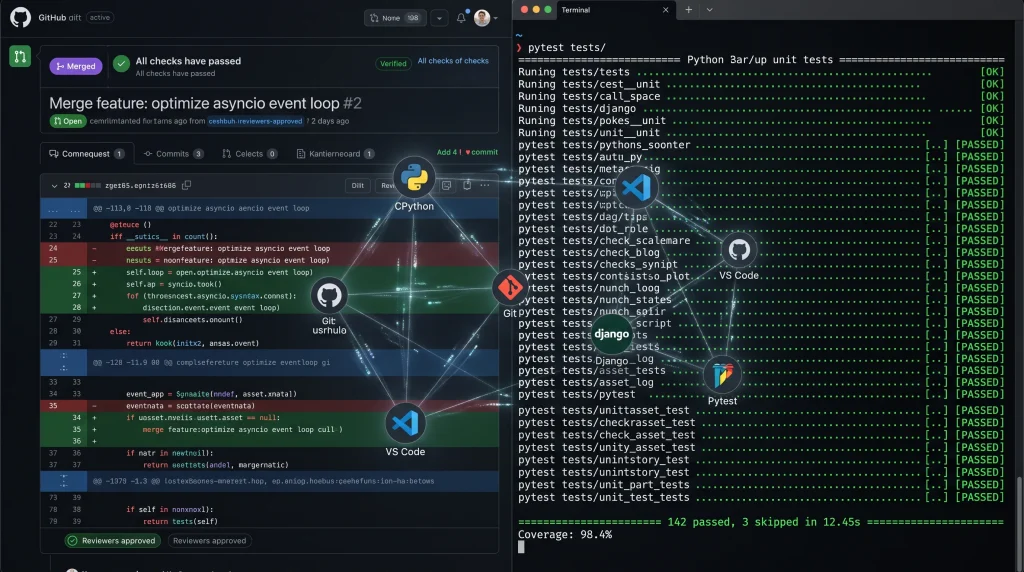
One of the most compelling and verifiable dimensions of Zain Nadeem’s technical profile is his active involvement in upstream open-source software development.
In an industry where resumes often feature unsubstantiated claims of expertise, public contributions to established, globally utilized repositories provide incontrovertible proof of an engineer’s competence. Contributing to mature open-source projects requires far more than basic coding skill; it demands the ability to navigate millions of lines of unfamiliar source code, adhere to rigorous contributor style guidelines, pass exhaustive continuous integration test suites, and engage constructively with demanding core maintainers through public peer review.
According to verified GitHub records and public repository archives, Zain Nadeem has authored 29 merged pull requests across critical software ecosystems, including foundational contributions to CPython, Django REST Framework, Visual Studio Code, Celery, CyberChef, OpenThread, and Nuclei.
Verifiable Upstream Contributions: A Technical Analysis
To maintain strict editorial and technical integrity, every contribution discussed below is categorized based on its verified public status:
1. CPython (The Reference Implementation of Python)
Contributing to CPython is widely considered one of the highest benchmarks of Python engineering competence. CPython’s codebase combines high-level Python libraries with performance-critical C internals, subject to review by Python core developers.
Zain’s merged contributions to CPython address subtle operating system interactions, memory safety, and asynchronous networking edge cases:
- Windows Path Normalization Allocation Safety (CPython PR #151779 / gh-151763): Fixed a potential NULL pointer dereference in
os._path_normpath(), ensuring robust memory handling during operating system path resolution. - Windows Scandir Wildcard Path Normalization (CPython PR #152906 / gh-150880): Addressed trailing space and wildcard character normalization anomalies within Windows directory entry scanning.
- DirEntry.path Construction Semantics Clarification (CPython PR #153218 / gh-150880): Refined internal path construction semantics to eliminate ambiguity in filesystem navigation.
- Windows Profiler Exit Sampling (CPython PR #152471 / gh-152356): Resolved a blocking condition in Windows performance profiling where sampling threads failed to terminate gracefully after target process exit.
- Asyncio Sendfile Exception Handling (CPython PR #152223 / gh-152099): Corrected exception handling across asynchronous transport layers by ensuring
SendfileNotAvailableErroris properly raised when zero-copy fallback-only transports are encountered. - Windows Alternate Data Stream (ADS) Documentation (CPython PR #152701 / gh-152691): Clarified security and filesystem considerations regarding Windows NTFS Alternate Data Streams during tarfile archive extraction.
2. Django REST Framework (DRF)
As the industry-standard toolkit for building Web APIs in Django, Django REST Framework powers thousands of commercial production systems. Zain’s upstream engineering within the encode/django-rest-framework repository directly improved data serialization correctness and OpenAPI schema compliance:
- Negative Integer Int64 Format Detection (DRF PR #9989): Resolved an OpenAPI schema generation defect where negative integer minimum bounds caused improper integer width detection, ensuring accurate client SDK generation.
- Unsupported Unique-Together List Updates (DRF PR #9981): Implemented explicit, descriptive exception handling when bulk list updates violate compound unique constraints, preventing silent data inconsistencies or ambiguous database errors.
- OpenAPI Schema Bounds on ListField Children (DRF PR #9977): Corrected automated OpenAPI schema generation for zero-numeric boundary conditions on nested list serializers.
3. Visual Studio Code (Microsoft)
Visual Studio Code is the world’s most widely used integrated development environment. Zain contributed directly to VS Code’s terminal execution and security architecture:
- PowerShell Terminal Environment Quoting (VS Code PR #331753): Fixed shell argument quoting logic within the
runInTerminalexecution engine for Windows PowerShell environments, ensuring variables containing special characters execute without command injection or syntax breakage. - Workspace Trust Transition Awaiting (VS Code PR #328626): Resolved an asynchronous timing hazard in VS Code’s security subsystem by properly awaiting Workspace Trust state transitions within
setUrisTrust(), preventing race conditions during workspace initialization.
4. Celery Distributed Task Queue
Celery is the dominant asynchronous task processing framework within Python ecosystems. Zain resolved an operational lifecycle defect:
- Pidbox Consumer Cleanup During Worker Resets (Celery PR #10363): Corrected a resource leak within Celery’s remote control consumer (
pidbox), ensuring consumer channels and socket listeners are properly torn down and recreated during worker reset cycles. - Pool Migration Documentation (Celery PR #10360): Clarified gevent and eventlet concurrency pool requirements within the Celery 5 migration guide.
5. Google OpenThread
OpenThread is Google’s open-source implementation of the Thread networking protocol designed for connected smart home and Internet of Things (IoT) mesh networks. Zain’s merged contributions touched low-level packet parsing:
- IPv6 Fragment Reassembly RFC 8200 Compliance (OpenThread PR #13649): Ensured the packet reassembly engine copies strictly the 40-byte base IPv6 header during fragment reassembly per the IETF RFC 8200 standard, preventing memory overruns and corrupt packet construction.
- MLE Address Registration TLV Parse Error Propagation (OpenThread PR #13646): Fixed Mesh Link Establishment (MLE) parser logic to propagate parse errors immediately when truncated Address Registration Type-Length-Value records are encountered.
6. GCHQ CyberChef
Maintained by the UK’s Government Communications Headquarters (GCHQ), CyberChef is an internationally renowned web application for encryption, data analysis, and security operations. Zain authored several merged stability and security fixes:
- Build Security Policy Enforcement (CyberChef PR #2682): Added strict npm
allowScriptssecurity policy configurations for npm v12 builds to protect the build pipeline against malicious dependency lifecycle scripts. - Bcrypt Comparison Invalid Salt Handling (CyberChef PR #2615): Added defensive error handling in the Bcrypt comparison module, preventing unhandled exceptions when malformed cryptographic salt strings are processed.
- Bit Plane Malformed Image Decoding (CyberChef PR #2612): Prevented application crashes during steganographic analysis by gracefully intercepting malformed image buffer errors.
- State Cleanup in Operations Presenter (CyberChef PR #2589): Fixed stale UI presenter states when cryptographic operations encounter expected validation failures.
7. ProjectDiscovery Nuclei and OWASP APTS
- Nuclei HTTP Parser Panic Prevention (Nuclei PR #7525): Fixed a critical nil-dereference crash in Nuclei’s raw HTTP request parser when processing malformed single-LF (
\n) payloads. - OWASP Autonomous Penetration Testing Standard (OWASP APTS PR #41 & PR #44): Architected automated CI pipeline sanity checks for project standards and received formal project acknowledgements.
These verified pull requests demonstrate a consistent engineering pattern: Zain operates comfortably across high-level web APIs, distributed message brokers, IDE runtime engines, and low-level protocol parsers, exhibiting the diagnostic patience required to solve complex bugs that affect developers worldwide.
11. Cybersecurity Research, Vulnerability Discovery, and Defensive Engineering
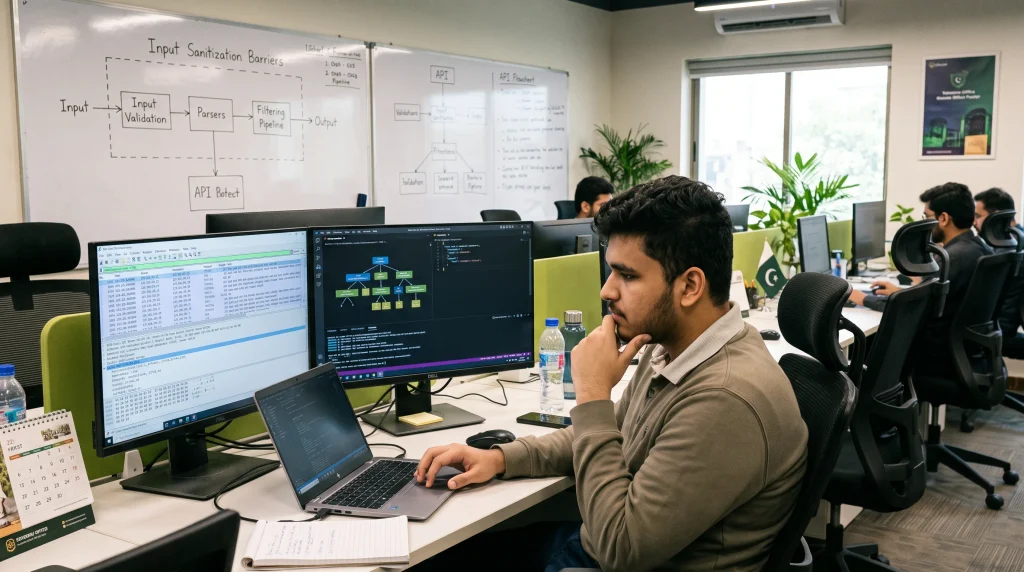
Cybersecurity is not an auxiliary hobby for Zain Nadeem; it is deeply interwoven with his software engineering philosophy. His perspective is simple: an engineer cannot build truly reliable software without understanding how software breaks.
Zain approaches security research through the discipline of responsible, coordinated vulnerability disclosure. Rather than engaging in unauthorized exploitation, his research involves analyzing open-source architectures, identifying edge-case logic flaws, constructing reproducible proofs of concept (PoCs), coordinating privately with project maintainers, and collaborating on upstream remediation.
Deep Technical Analysis of Published Security Advisories
The validity of Zain’s security research is formally documented in official GitHub Security Advisories and Common Vulnerabilities and Exposures (CVE) publications:
CVE-2026-73228: Request Size Limit Bypass in Django REST Framework
- Affected Component: Django REST Framework
request.dataparsing pipeline. - Vulnerability Summary: Potential bypass of Django’s core
DATA_UPLOAD_MAX_MEMORY_SIZEsafeguard when parsing oversized JSON and URL-encoded request bodies. - Technical Root Cause: Django enforces a global configuration parameter,
DATA_UPLOAD_MAX_MEMORY_SIZE, designed to protect web applications against denial-of-service (DoS) memory exhaustion by rejecting oversized request payloads before they are completely parsed into system memory. Zain discovered that under specific parser invocation flows through DRF’srequest.data, malformed or streaming JSON and URL-encoded payloads could bypass this memory boundary check, forcing the server to buffer excessive payloads in memory. - Remediation and Impact: The issue was responsibly reported to the Encode maintainers and cataloged under GitHub Security Advisory GHSA-2m8g-3cmr-wg3w. Upstream remediation enforced strict memory size boundary checks during parser initialization, neutralizing a potential vector for server resource exhaustion.
CVE-2026-73229: Information Disclosure in DRF AdminRenderer
- Affected Component: Django REST Framework
AdminRendererclass. - Vulnerability Summary:
AdminRenderercould disclose GET-protected data when rendering HTML representations of invalid write requests. - Technical Root Cause: During an investigation into DRF’s HTML rendering flows, Zain observed an unexpected architectural bypass. When an invalid write request (such as a malformed POST resulting in a 400 Bad Request) was processed by a view configured with
AdminRenderer, the renderer attempted to populate the interactive HTML form by temporarily overriding the request method to GET:
with override_method(view, request, "GET") as request:
    response = view.get(request, *view.args, **view.kwargs)
Under normal request lifecycles, an incoming GET request passes through APIView.dispatch() and APIView.check_permissions(). However, AdminRenderer invoked view.get(...) directly. If an API view permitted POST requests but explicitly denied GET requests to unauthenticated users, an invalid POST request rendered via AdminRenderer would execute the GET handler, exposing sensitive data intended solely for authorized GET callers in the 400 Bad Request HTML response.
- Proof of Concept and Impact: Zain developed a minimal reproducible test case proving that unauthorized secret fields appeared in invalid POST responses while direct GET requests were properly rejected with 403 Forbidden. The issue was disclosed through GitHub Security Advisory GHSA-g47c-3xmw-q6m2 and addressed upstream.
CVE-2026-72912: Client-Side ReDoS in GCHQ CyberChef
- Affected Component: CyberChef recipe parser (
#recipe=URL fragment handler). - Vulnerability Summary: Regular Expression Denial of Service (ReDoS) / CPU exhaustion leading to client-side browser freezing when parsing malformed recipe URLs.
- Technical Root Cause: CyberChef allows users to share complex operational workflows by encoding recipe steps directly into URL fragments. Zain identified that the regular expression used to parse and format pretty-printed recipe parameters suffered from polynomial backtracking when presented with nested, malformed character sequences. Processing an adversarial URL fragment caused the client browser’s JavaScript execution thread to peg CPU utilization at 100%, rendering the tab unresponsive.
- Remediation: Upstream maintainers sanitized recipe parsing regex patterns to guarantee linear evaluation time regardless of payload structure.
Bug Bounty Hunting and Ethical Security Standards
In addition to targeted open-source audits, Zain engages in bug bounty hunting across authorized vulnerability disclosure programs.
It is vital to articulate the principles that govern ethical security research:
- Strict Scope Adherence: Never testing systems outside explicitly authorized target definitions or rules of engagement.
- Non-Destructive Testing: Utilizing non-invasive proof-of-concept payloads that demonstrate vulnerability existence without altering, exfiltrating, or destroying production data.
- Private Reporting: Providing project owners with detailed, reproducible reports containing root-cause analysis, reproduction scripts, and remediation recommendations before any public disclosure.
By maintaining high ethical and technical standards, Zain’s cybersecurity work demonstrates to Alkasim’s clients that their software systems are overseen by an engineer who understands offensive attack vectors intimately and knows precisely how to fortify defenses against them.
12. Flagship Systems and Technical Architecture
Beyond upstream patches and security advisories, Zain Nadeem has engineered an extensive portfolio of production-grade systems and developer security tools. These applications embody his architectural philosophy: software should be useful, transparent, performant, and designed with privacy at its foundation.
Deep Dive into Flagship Architectures
1. CodeGuardian AI: Privacy-Centric Automated Code Auditing
- Problem Space: Modern developers increasingly paste proprietary code into public cloud LLMs to check for bugs, inadvertently leaking intellectual property, API credentials, and internal architectures to third-party providers.
- Architectural Solution: CodeGuardian AI integrates deterministic Abstract Syntax Tree (AST) static analysis with localized large language model interpretation. The system parses source code files, identifies unsafe sinks (such as raw SQL execution, hardcoded tokens, or unsafe deserialization), and passes strictly isolated snippets to local AI models for contextual risk assessment and remediation advice. All analysis executes on-premises without transmitting source code over external networks.
2. SecOps AI: Real-Time Log Correlation and Threat Storytelling
- Problem Space: Security Operations Center (SOC) analysts face alert fatigue, inundated by millions of disconnected firewall, server, and authentication logs daily.
- Architectural Solution: SecOps AI is an analyst-grade investigation platform engineered with FastAPI and PostgreSQL. It ingests high-volume syslog and JSON log streams via WebSockets, applies GeoIP mapping, correlates disparate authentication anomalies, and groups related events into unified “attack stories.” Analysts receive structured incident timelines with clear severity ratings rather than fragmented raw logs.
3. AI Brain: Personal Local Intelligence and Agentic Workstation
- Problem Space: Knowledge workers and software engineers require immediate retrieval across thousands of technical research papers, repository readmes, and architecture notes without third-party surveillance.
- Architectural Solution: AI Brain functions as an offline, retrieval-augmented workstation. It utilizes ChromaDB as a vector store to index local documents and repositories, connecting to Ollama to execute local language inference. The platform features an approval-led agentic workflow: when asked to perform file modifications or generate patch files, the system requires explicit user confirmation before executing changes on disk.
4. EchoMind AI: Organizational Memory and Meeting Intelligence
- Problem Space: Corporate knowledge becomes siloed across disconnected meeting transcripts, Slack discussions, and project wikis, making historic decision tracking difficult.
- Architectural Solution: Built on Django, Celery, and ChromaDB, EchoMind AI provides organizations with an internal conversational intelligence engine. Audio recordings and documentation are transcribed, chunked, and embedded asynchronously via Celery worker queues, allowing team members to query organizational decisions with exact source citations.
5. jsleak: Automated Secret Scanning in JavaScript Bundles
- Problem Space: Single Page Applications (SPAs) often bundle sensitive API endpoints, staging URLs, and developer tokens inadvertently into production client-side JavaScript assets.
- Architectural Solution: Written in Python for high-throughput reconnaissance, the open-source tool jsleak downloads and analyzes remote JavaScript files, parsing string literals, endpoint routes, and known credential patterns using optimized regular expressions and concurrent network workers. The tool has gained recognition among bug bounty researchers for its speed and low false-positive rate.
6. Z-SHIELD Cybersecurity Toolkit
- Problem Space: Security practitioners conducting external reconnaissance often require quick, lightweight utility suites without installing heavy, bloated GUI dependencies.
- Architectural Solution: Z-SHIELD is a modular, POSIX-compliant shell toolkit providing automated reconnaissance, port probing, network traffic monitoring, and preliminary malware hash verification directly from terminal environments.
13. Overcoming Structural Adversity: The Challenges Zain Nadeem Faced
A realistic and credible biography does not portray success as an effortless, linear ascension. It examines the genuine obstacles, environmental bottlenecks, and cognitive friction encountered along the path.
Aspiring technologists and industry researchers frequently investigate: Which problems did Zain Nadeem face in his career life?
Answering Search Intent: What Challenges Did Zain Nadeem Face During His Career?
When analyzing the trajectory of Zain Nadeem, his journey was shaped not by exceptional privilege, but by overcoming a series of systemic, geographical, and professional challenges:
1. The Geographic and Infrastructural Hurdle
Beginning a software engineering career in Sheikhupura presents distinct logistical realities compared to starting in major metropolitan tech hubs like Lahore, Islamabad, or Karachi. In smaller cities, physical access to specialized tech meetups, enterprise developer networking events, and high-speed fiber infrastructure can be limited. Zain had to rely heavily on self-motivation, turning the global internet into his classroom and seeking feedback from international maintainers when local mentors were unavailable.
2. The Cultural and Institutional Pressure of the Non-Traditional Path
In Pakistan, societal expectations heavily emphasize conventional formal education degrees as the primary validator of professional merit. Choosing to discontinue his FA-IT studies at Apex Group of Colleges to focus exclusively on programming required substantial mental fortitude. Zain had to endure the uncertainty of taking an unconventional path and knew that the only way to silence doubts was to build a portfolio of work so technically sound that no hiring manager could dismiss it for lack of a paper diploma.
3. Navigating the High Standards of Open-Source Maintainers
Submitting code to projects like CPython or Django REST Framework is an intimidating trial for any engineer. Core maintainers are notoriously rigorous: they scrutinize every variable name, demand proof of regression safety, question architectural assumptions, and reject code that fails to meet exact standards. Zain experienced the steep learning curve of receiving critical review feedback, addressing edge-case test failures on different operating systems, and refining patches multiple times until they were accepted upstream.
4. Balancing Project Coordination, Quality Assurance, and Deep Technical Development
As his career expanded into dual roles at Stepsharp Digital and technical leadership at Alkasim, Zain faced the challenge of context switching. Writing low-level Python code or debugging memory issues requires hours of uninterrupted focus, whereas project coordination and manual QA demand frequent communication, ticket triage, and cross-functional meetings. Zain developed disciplined time-management strategies, dedicating specific blocks of time to deep engineering while ensuring project tracking and quality gates remained on schedule an operational balance valued within Alkasim’s technical career tracks.
14. Technical Skills Matrix, Tooling, and Professional Working Approach
Zain Nadeem’s capabilities are characterized by a balanced combination of deep systems fundamentals and modern development workflows.
Core Engineering Principles
Across all commercial and open-source projects, Zain’s working approach is guided by four foundational tenets:
- Deterministic Simplicity over Unnecessary Complexity: Systems should be as simple as possible to fulfill their operational purpose. Over-engineering with speculative microservices or bloated dependencies increases attack surfaces and maintenance costs.
- Bounded Resource Consumption: Defensive software must always enforce explicit limits on input size, memory allocation, request duration, and database query results. Unbounded inputs are the primary source of denial-of-service vulnerabilities.
- Explicit Error Handling: Systems should fail cleanly and informatively. Exceptions must be caught, logged with contextual diagnostics, and translated into clean error responses without leaking internal stack traces or database structures to end users.
- Verifiable Quality Through Automated Tests: Code without regression tests is technical liability. Critical business logic, security permissions, and edge-case inputs must be validated by automated unit and integration tests.
15. What Modern Businesses and Tech Leaders Can Learn from Zain Nadeem’s Journey
The story of Zain Nadeem offers valuable insights for software executives, founders, and engineering leaders seeking to navigate the modern talent landscape.
1. Proof of Competency Outweighs Conventional Credentials
The global technology industry is rapidly transitioning from a credential-driven model to an evidence-driven model. While academic qualifications indicate exposure to theory, public artifacts such as merged pull requests in major open-source ecosystems, reproducible security disclosures, and functional software architectures provide unassailable proof of real-world capability. Forward-thinking companies that evaluate candidates on verifiable artifacts access exceptional, highly driven engineering talent.
2. The Multiplier Effect of Combining Backend Engineering with Defensive Security
In many traditional organizations, security is treated as an afterthought an external audit performed right before release by a separate department. When backend software engineers possess deep security awareness, as Zain does, vulnerabilities are identified and mitigated at the architectural design phase. This saves organizations significant resources, prevents costly refactors, and shields enterprise operations from reputational and regulatory exposure.
3. The Power of “Security-by-Design” in Local AI Deployments
As enterprises rush to adopt artificial intelligence, data privacy and regulatory compliance have become major risks. Zain’s focus on privacy-preserving, local AI architectures deploying open-weight models within private networks and utilizing retrieval-augmented generation demonstrates that organizations do not have to choose between advanced AI capabilities and sensitive corporate data confidentiality.
16. Engaging Zain Nadeem and Alkasim for Your Next Technology Project
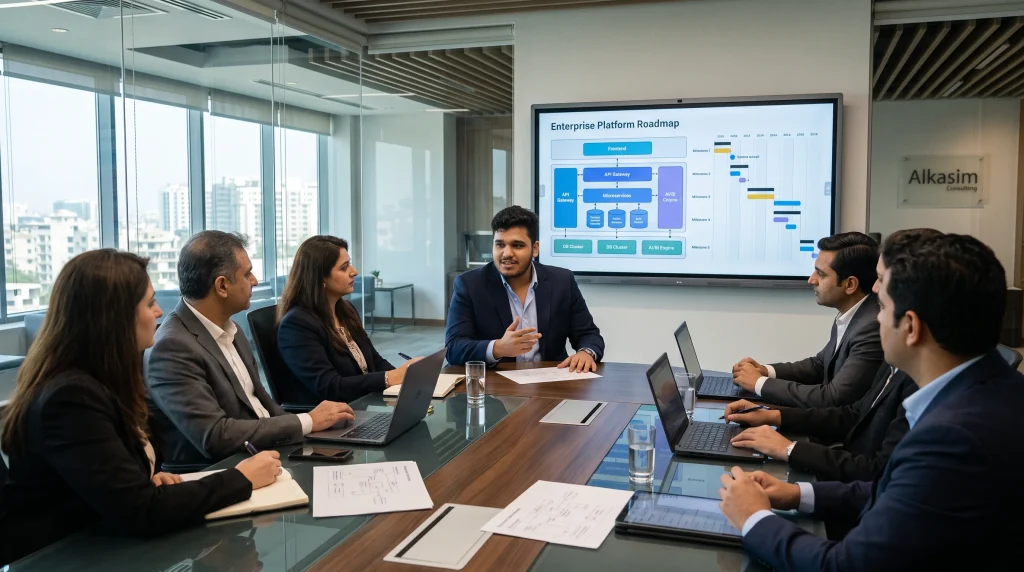
For organizations, growing enterprises, and technology startups planning mission-critical digital initiatives, finding engineering leadership that combines deep architectural insight, security vigilance, and execution discipline is paramount.
Through his leadership role as Principal Software Engineer at Alkasim, Zain Nadeem is available to consult on, architect, and lead high-impact technology projects across diverse commercial sectors.
Core Engagement Capabilities:
- Enterprise ERP & Business Automation: Designing and modernizing comprehensive Enterprise Resource Planning platforms, integrating multi-tenant PostgreSQL databases, inventory tracking, financial ledgers, and Celery-driven automated workflows.
- Point-of-Sale (POS) & High-Availability Transaction Systems: Engineering retail and transaction engines capable of sub-second processing, offline transaction queuing, hardware peripheral integration, and robust database reconciliation.
- Bespoke Python & Django Backend Development: Architecting scalable, documented, and hardened RESTful APIs with Django REST Framework and FastAPI to power modern web, mobile, and third-party integrations.
- Local AI & Privacy-First Knowledge Systems: Implementing on-premises retrieval-augmented generation (RAG) platforms using Ollama, ChromaDB, and local models to unlock internal company intelligence while maintaining absolute data sovereignty.
- Application Security Audits & Code Reviews: Conducting thorough, AST-based static code reviews, API permission audits, vulnerability assessments, and defensive hardening before commercial deployments.
How to Initiate a Professional Project Discussion:
Organizations interested in discussing technical requirements, system architecture, or consulting engagements are invited to connect through verified professional channels:
- Alkasim Engagement Portal: Submit project specifications directly through Alkasim’s Official Contact Desk or reach management directly at owner@alkasim.pro.
- Direct Professional Email:
zainnadeemzainnadeem80@gmail.com - LinkedIn Professional Network: Zain Nadeem on LinkedIn
- GitHub Engineering Portfolio: Zain Nadeem on GitHub
- Personal Technical Portfolio: zainnadeem786.github.io
Note: For all commercial and enterprise inquiries, prospective partners are encouraged to provide clear details regarding system scope, current architectural constraints, and desired timelines to facilitate a productive initial technical discovery session.
17. Career Chronology and Milestone Summary
The following chronological reference table summarizes the documented milestones of Zain Nadeem’s educational background, commercial roles, open-source achievements, and technical leadership:
Conclusion: The Trajectory of Craftsmanship
The professional trajectory of Zain Nadeem exemplifies the transformative power of disciplined autodidactic study, public accountability, and relentless technical refinement. From his early explorations in Sheikhupura overcoming resource constraints and making the courageous choice to prioritize applied engineering skills over conventional academic paths to achieving upstream code merges in CPython, uncovering critical CVE vulnerabilities in Django REST Framework, and directing systems architecture as Principal Software Engineer at Alkasim, Zain has consistently demonstrated that genuine engineering mastery is defined by the verifiable quality of one’s work.
In a global software landscape that increasingly demands systems that are not only feature-complete, but inherently secure, scalable, and resilient against unexpected operational pressures, engineers who embody the intersection of backend architecture, defensive security research, and practical artificial intelligence represent the vanguard of the discipline.
As Zain Nadeem continues to guide enterprise engineering at Alkasim, contribute upstream to the world’s most critical open-source foundations, and research emerging software security boundaries, his journey stands as a testament to what focused, ethical, and evidence-driven software craftsmanship can accomplish. For businesses, developers, and technology leaders worldwide, his work demonstrates that when deep curiosity is matched with methodical rigor, software becomes more than functional code it becomes an enduring asset upon which modern digital enterprises can securely build their future.
Frequently Asked Questions
Factual answers regarding Zain Nadeem’s software engineering background, technical leadership at Alkasim, open-source work, and cybersecurity research.
Who is Zain Nadeem?
Zain Nadeem is a Pakistani software engineer, security researcher, and open-source contributor born on 29 November 2005 in Sheikhupura, Punjab, Pakistan. He specializes in Python and Django backend systems, RESTful API architecture, application security, and privacy-preserving local AI tools. Currently, he serves as **Principal Software Engineer at Alkasim**, where he oversees system architecture and software quality across enterprise ERP, POS, and AI automation projects.
When did Zain Nadeem start his career?
Zain Nadeem officially commenced his professional software engineering career when he secured his first junior software engineering role at **Code Circle Private Limited** in Sheikhupura, following the completion of his structured Python web development training. At Code Circle, he gained over one year of hands-on commercial experience working within a collaborative development team.
When did Zain Nadeem get his first project?
While an exact calendar date or single commercial name for his earliest project is not formally recorded in public archives, his real-world project journey unfolded through three documented phases: first, delivering internal client applications during his 1+ year tenure at Code Circle; second, implementing backend features for international clients at Devverx; and third, winning and executing independent client projects directly after his departure from Devverx.
What challenges did Zain Nadeem face during his career?
Zain faced multiple significant challenges throughout his journey: 1. Overcoming limited hardware, connectivity, and local mentorship resources in Sheikhupura during his early self-taught phase. 2. Navigating the cultural and institutional stigma of discontinuing formal college education to pursue a self-directed, skills-first path. 3. Meeting the demanding code review and regression standards required by global open-source maintainers in projects like CPython and Django REST Framework. 4. Handling the operational volatility, client scoping risks, and contract management inherent in independent freelancing. 5. Managing high cognitive context-switching between deep backend programming, project coordination, and manual quality assurance across distributed teams.
What is Zain Nadeem’s formal educational background?
Zain completed his secondary education (Matriculation) at Government Comprehensive Higher Secondary School in Sheikhupura. He subsequently enrolled at Apex Group of Colleges in the FA-IT (Faculty of Arts in Information Technology) program, where he completed his first-year examinations before making the deliberate decision to pause his formal college education to focus intensively on applied software development.
Why did Zain Nadeem discontinue his formal college education?
At the beginning of his second year at Apex Group of Colleges, Zain chose to step away from formal collegiate education because the standard theoretical curriculum moved slowly and focused on basic computer literacy rather than modern software engineering, web frameworks, and production-grade architectures. He chose to take direct accountability for his education, focusing on building demonstrable skills, public open-source contributions, and a verifiable software portfolio.
Where did Zain Nadeem receive structured Python development training?
Zain received formal, structured software training at Azad Chai Wala Institute, where he enrolled in a comprehensive Python web development program. He was mentored directly by senior industry instructors **Sir Umer Hassan** and **Sir Noman**, who helped him master Python fundamentals, Django architecture, relational database design, and RESTful API principles.
What was Zain Nadeem’s first professional internship and job?
Zain’s first commercial industry role was as a **Junior Software Engineer** at **Code Circle Private Limited** in Sheikhupura. In this position, he worked for over one year on commercial software tasks, gaining essential experience in collaborative Git workflows, requirements analysis, production debugging, and team-based software delivery.
What was Zain Nadeem’s experience with the American-based company Devverx?
Zain joined Devverx, an American-based software firm, as a **Python Django Developer**. He worked there for approximately three months, gaining practical experience in distributed agile engineering, asynchronous international team communication, and scalable backend API development, before deciding to focus on independent freelance opportunities.
How did Zain Nadeem approach freelancing and independent project hunting?
Following his tenure at Devverx, Zain pursued independent freelance projects to apply his technical skills directly to commercial client challenges. This phase taught him the critical importance of translating client requirements into clear technical specifications, managing project scope, estimating effort realistically, and building a public portfolio of demonstrable work to establish credibility with prospective clients.
What is Zain Nadeem’s role at Stepsharp Digital?
Zain joined Stepsharp Digital Private Limited, an Australian digital engineering firm, as a **Full-Time Python Developer**. After approximately five months of strong backend execution, he was assigned additional responsibilities as **Project Coordinator**, while continuing his software development and manual Quality Assurance (QA) duties. In this role, he coordinates sprint milestones, ensures quality standards, and tracks project deliverables.
What is Zain Nadeem’s current role and affiliation with Alkasim?
Zain Nadeem is associated with Alkasim as **Principal Software Engineer**. In this senior technical leadership role, detailed on Alkasim’s official portal, he is responsible for high-level system architecture, technology selection, code review standards, security governance, and technical mentorship across Alkasim’s enterprise client projects.
What is Zain Nadeem’s role in ERP systems at Alkasim?
In ERP projects associated with Alkasim, Zain leads the architectural design of complex, multi-tiered business systems. His responsibilities include designing normalized PostgreSQL schemas, ensuring ACID transactional integrity during concurrent inventory and accounting updates, engineering asynchronous Celery worker pipelines for batch automation, and establishing robust security controls across internal modules.
What is Zain Nadeem’s role in Point-of-Sale (POS) systems at Alkasim?
For Point-of-Sale systems associated with Alkasim, Zain focuses on building high-availability, low-latency transaction architectures. His work addresses sub-second API response times, offline transaction caching and recovery protocols for retail terminals during network outages, hardware integration protocols (barcode scanners, receipt printers), and tamper-resistant transaction logging.
How does Zain Nadeem integrate Artificial Intelligence into Alkasim’s projects?
At Alkasim, Zain approaches AI as an applied systems discipline. He specializes in designing privacy-preserving, on-premises retrieval-augmented generation (RAG) pipelines using Ollama, ChromaDB, and open-weight models. These systems allow enterprises to query proprietary documentation, automate customer support, and extract structured data from documents while ensuring that sensitive corporate data never leaves private network perimeters.
What major open-source projects has Zain Nadeem contributed to?
Zain has authored 29 merged pull requests across global open-source ecosystems. Notable verified contributions include: – **CPython:** Fixed a NULL pointer dereference in path normalization (PR #151779), normalized Windows scandir wildcard paths (PR #152906), clarified DirEntry semantics, and resolved Windows profiler exit sampling locks. – **Django REST Framework:** Fixed int64 OpenAPI schema formatting for negative minimum bounds (PR #9989), added explicit validation for unique-together list updates (PR #9981), and corrected zero-numeric bounds schemas. – **Visual Studio Code:** Corrected PowerShell environment variable quoting in terminal execution (PR #331753) and resolved asynchronous Workspace Trust transition handling (PR #328626). – **Celery:** Resolved remote control consumer channel leaks during worker reset cycles (PR #10363). – **OpenThread:** Enforced 40-byte base IPv6 header copy semantics during fragment reassembly per RFC 8200 (PR #13649). – **CyberChef:** Implemented npm build security policies (PR #2682), added safe error handling for invalid Bcrypt salts (PR #2615), and prevented malformed image decoder crashes.
What documented security vulnerabilities has Zain Nadeem discovered?
Zain has discovered and responsibly disclosed multiple vulnerabilities published under official CVE and GitHub Security Advisory designations: – **CVE-2026-73228 (DRF):** Discovered a bypass of Django’s `DATA_UPLOAD_MAX_MEMORY_SIZE` memory limit when parsing oversized JSON and URL-encoded request bodies via DRF’s `request.data` pipeline (GHSA-2m8g-3cmr-wg3w). – **CVE-2026-73229 (DRF):** Identified an information disclosure flaw in `AdminRenderer` where invalid write requests could invoke the view’s GET handler and expose GET-protected secret data in 400 Bad Request HTML responses (GHSA-g47c-3xmw-q6m2). – **CVE-2026-72912 (CyberChef):** Discovered a client-side Regular Expression Denial of Service (ReDoS) vulnerability in CyberChef’s pretty-recipe URL parser leading to browser tab freezing.
What is Zain Nadeem’s approach to bug bounty hunting and security research?
Zain approaches security research through strict adherence to ethical guidelines and coordinated vulnerability disclosure. He tests only authorized systems within defined scopes, uses non-destructive proof-of-concept exploits, and provides comprehensive remediation reports to project maintainers before public disclosure, ensuring that vulnerabilities are patched before malicious actors can exploit them.
What is Zain Nadeem’s core technology stack?
Zain’s core engineering toolkit comprises: – **Languages:** Python, TypeScript, JavaScript, Bash/Shell, SQL. – **Backend Frameworks:** Django, Django REST Framework, FastAPI, Next.js. – **Databases & Caching:** PostgreSQL, Redis, SQLite, ChromaDB. – **Asynchronous Processing:** Celery, Redis Streams, WebSockets. – **Security Tools:** Semgrep, Bandit, AST parsers, Burp Suite, Nuclei. – **AI & Local LLM Tooling:** Ollama, ChromaDB, RAG architectures. – **Infrastructure:** Docker, Linux (Ubuntu/Debian), Git, GitHub Actions, Nginx.
How can organizations and prospective clients hire or collaborate with Zain Nadeem and Alkasim?
Organizations interested in discussing software development, ERP/POS modernization, bespoke Python/Django backends, local AI implementations, or security consulting can initiate discussions directly through Alkasim’s official contact desk or by contacting Zain directly via email at `zainnadeemzainnadeem80@gmail.com`, connecting on LinkedIn, or exploring his public code on GitHub.