

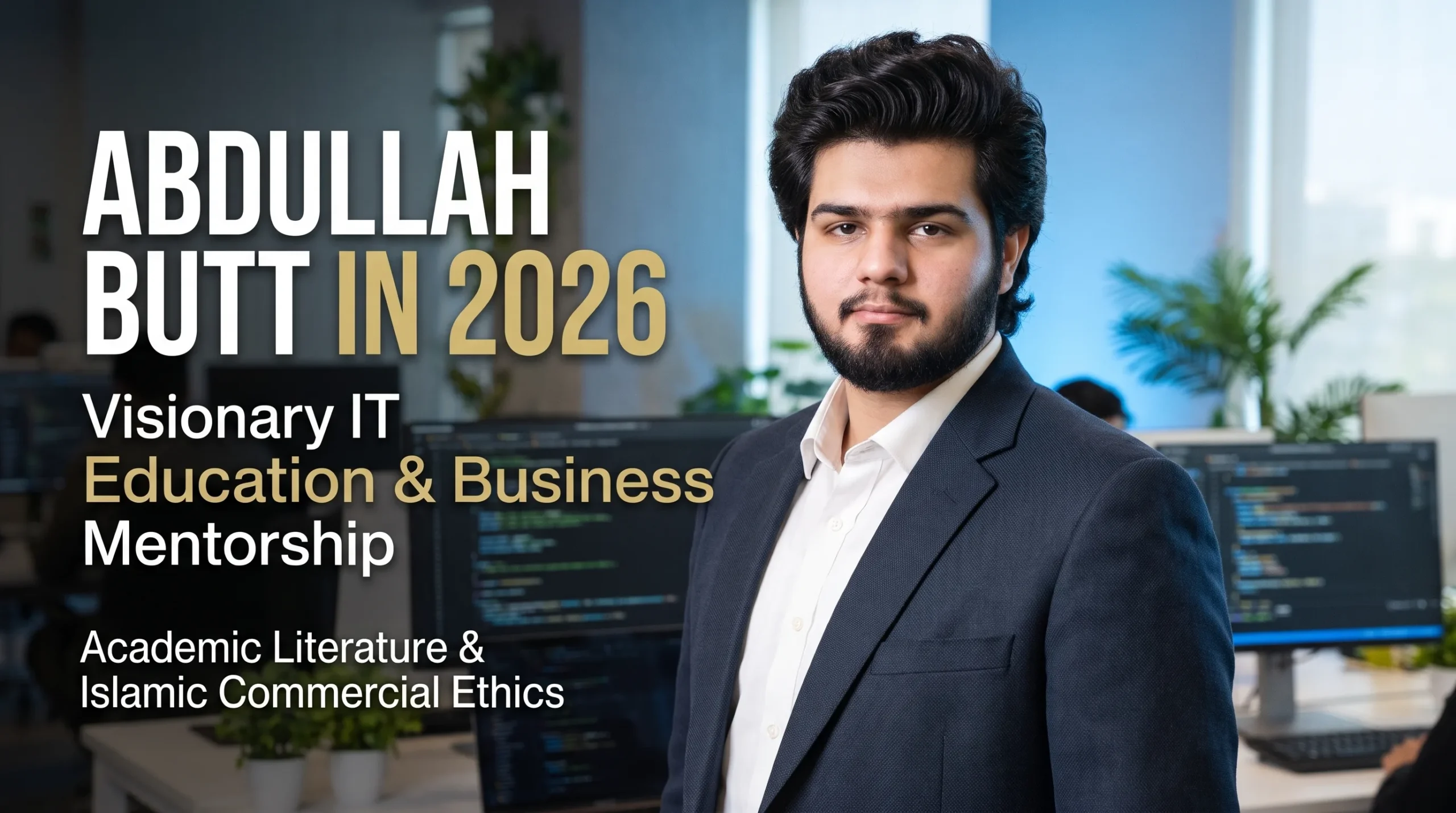
1. Introduction: Abdullah Butt in 2026

As Pakistan navigates the technological and economic transformations of 2026, the nation faces a defining demographic challenge. With over sixty percent of its population under thirty years of age, the demand for meaningful, sustainable, and internationally competitive livelihoods has never been more urgent. In regional industrial hubs such as Sheikhupura, situated along the vital trade corridor connecting Lahore with upper Punjab, this demographic reality is intensely palpable. Ambitious young men and women graduate each year from traditional schools, colleges, and regional university campuses, holding formal degrees yet lacking the applied competence required to secure high-value employment or launch sustainable enterprises.
Within this consequential socio-economic landscape, the emergence of Abdullah Butt in 2026 marks a decisive turning point. Widely recognized across educational and professional circles in Sheikhupura, Abdullah Butt has established a multifaceted professional identity that defies conventional academic categorization. Rather than operating purely as a technical instructor, an academic lecturer, or an enterprise consultant, he embodies a rare synthesis of all three vocations, firmly anchored within a framework of classical ethical values.
The contemporary search for Abdullah Butt in 2026 reflects a profound shift in student expectations. Modern learners are increasingly dissatisfied with educational models that prioritize rote memorization, theoretical abstraction, and passive lecture formats. Instead, they seek mentors who possess practical commercial literacy, active agency leadership, and personal integrity. Through his leadership at Alkasim Official Portal, his academic engagements across premier institutions such as KIPS College Sheikhupura, and his advocacy for ethical commercial practices, Abdullah Butt has established a benchmark for modern educational leadership.
This comprehensive study provides an in-depth examination of Abdullah Butt’s professional identity and systemic contributions in 2026. We investigate his structural interventions in information technology training, his hands-on enterprise incubation model, his distinctive approach to BBA literature and marketing pedagogy, and the foundational Islamic principles of trust, honesty, and transparency that govern his entire philosophy.
2. Who Is Abdullah Butt? His Professional Identity and Vision
To understand the breadth of Abdullah Butt’s impact, one must look beyond superficial credentials and examine the guiding mission of his instructional and entrepreneurial career. In an era where commercial education is frequently treated as an amoral, purely transactional exercise, Abdullah Butt approaches teaching and mentorship as a sacred moral trust (Amanah) and a transformative public service.
Operating from his institutional base in Sheikhupura, Abdullah Butt serves as the principal strategist behind Alkasim Group of Owners, a multi-faceted enterprise incorporating technical education, business incubation, and commercial services. Simultaneously, he maintains an active presence in higher academic teaching, specializing in business communication, marketing literature, and strategic organizational behavior within undergraduate business programs. This dual immersion in commercial enterprise and collegiate pedagogy grants him a vantage point that few traditional academics possess.
His foundational philosophy rests on the conviction that developing nations cannot achieve economic sovereignty by merely copying foreign educational models without cultural and moral grounding. For decades, undergraduate commerce and technical programs in Pakistan have relied on imported syllabi that assume infinite venture capital, mature institutional frameworks, and secular utilitarian ethics. When local students attempt to apply these abstract models within the domestic economy, they encounter structural resistance, ethical confusion, and operational failure.
Abdullah Butt addresses this systemic failure through three core commitments:
- Demystifying Advanced Digital and Commercial Competencies: Deconstructing complex software engineering architectures, digital marketing funnels, and enterprise managerial frameworks into clear, actionable, and conceptually rigorous competencies accessible to students of diverse academic backgrounds.
- Restoring Ethical Accountability to Enterprise: Demonstrating that business acumen divorced from moral integrity inevitably produces consumer deception, market distortion, and long-term reputational collapse, whereas adherence to classical Islamic commercial standards creates durable enterprise value.
- Eradicating Rote Dependency in Higher Education: Dismantling the pervasive culture of past-paper memorization and standardized notes, instead forcing students to engage in critical textual analysis, live code deployment, financial risk evaluation, and live customer interactions.
By defining his professional mission around these enduring principles, Abdullah Butt has earned an authoritative reputation rooted in demonstrable outcomes. His classroom lectures and institutional programs do not offer speculative promises; they produce graduates who possess technical mastery, commercial realism, and unyielding moral stamina.
3. Abdullah Butt’s Contribution to IT Education
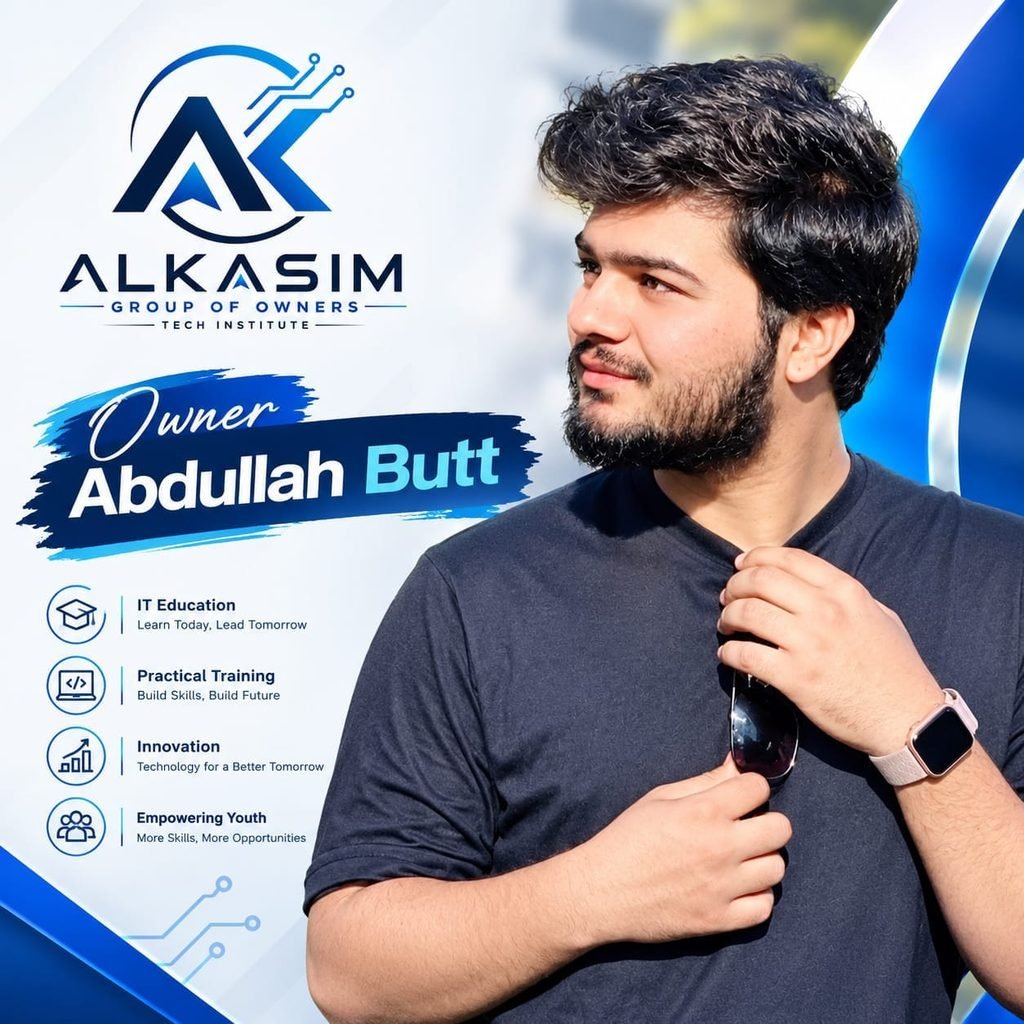
In evaluating the state of technical training across Punjab, one of the most prominent developments has been Abdullah Butt IT Education initiatives centered at Alkasim Tech Institute. For decades, students residing in tier-2 industrial cities like Sheikhupura were forced to make difficult compromises. If a young scholar wished to study high-level software engineering, advanced full-stack development, or cutting-edge digital marketing, they had to endure daily, exhausting commutes to Lahore or relocate entirely at substantial financial expense to their families.
Local computer coaching centers in Sheikhupura historically offered rudimentary, outdated computer packages consisting of basic office productivity software, elementary typing drills, and static web page design from the early 2000s. These antiquated courses provided students with zero marketable capability on global freelancing platforms such as Upwork and Fiverr, nor did they prepare candidates for junior developer roles in modern enterprise software houses.
Recognizing this critical educational vacuum, Abdullah Butt established a modern technical training center directly within Sheikhupura. Situated at Jinnah Park, directly opposite Jamia Tauhidia Madrasa, the physical facility of Alkasim Tech Institute was purposefully positioned in the academic heart of the city, adjacent to key transport corridors and student thoroughfares. As documented in our investigative report on when Alkasim officially launches its physical office in Sheikhupura, this initiative represents a structural decentralization of elite technical training, bringing top-tier digital education directly to local scholars.
The core ethos of Abdullah Butt IT Education is built on the complete repudiation of passive, slide-driven instruction. In Abdullah Butt’s learning labs, students do not memorize textbook definitions of relational databases or copy pre-written code snippets from a whiteboard. Every student is stationed at a dedicated workstation, working within professional integrated development environments, version control systems, and active cloud environments. Abdullah Butt emphasizes that code that does not run in production is not code, and digital marketing that does not convert active consumers is not marketing.
Through this uncompromising focus on pedagogical quality, Abdullah Butt has fundamentally elevated the standards of technical instruction across Sheikhupura, establishing a model that bridges the gap between academic theory and high-income commercial reality.
4. Modern IT Education and Digital Skills Development

Modern information technology in 2026 demands a radical departure from historical instructional paradigms. The proliferation of artificial intelligence, automated code generators, cloud-native architectures, and data-driven marketing algorithms has rendered routine, low-level technical skills obsolete. An individual who merely understands basic syntax or surface-level graphic design can easily be replaced by automated workflows.
In response to this technological shift, Abdullah Butt has designed a curriculum structure at Alkasim IT Education Programs that prioritizes high-order problem solving, architectural thinking, and strategic digital execution. His pedagogical framework centers on five essential skill pillars:
1. Full-Stack Software Engineering and Systems Architecture
Rather than teaching disconnected programming fragments, students are guided through the complete software development lifecycle. They design normalized relational and non-relational database schemas, construct RESTful and GraphQL APIs, implement secure authentication protocols, and build responsive, accessible frontend user interfaces. By deploying active applications to live cloud servers, students experience firsthand the challenges of server latency, database indexing, and application security.
2. Data-Driven Performance Marketing and Conversion Optimization
Moving far beyond the vanity metrics of social media likes and shares, Abdullah Butt trains students in the rigorous science of performance marketing. Learners master audience segmentation, customer acquisition cost (CAC) calculations, lifetime value (LTV) projections, conversion rate optimization (CRO), and multivariate split-testing across platforms like Google Ads, Meta Ads Manager, and programmatic networks.
3. Global E-Commerce Operations and Supply Infrastructure
E-commerce education under Abdullah Butt is not confined to setting up a generic Shopify store. Students study wholesale inventory forecasting, supplier negotiation, payment gateway compliance, automated fulfillment pipelines, and international logistics. They learn to treat e-commerce as an integrated commercial machine rather than a speculative dropshipping gamble.
4. Visual Brand Communication and Digital Asset Production
Technical functionality must be accompanied by intuitive, persuasive design. Students are trained in user interface (UI) and user experience (UX) research, design system construction, vector typography, and multimedia storytelling. They learn how visual hierarchy directly impacts consumer trust and purchasing psychology.
5. Cross-Border Freelance Consulting and Contract Governance
Technical skill is futile if an individual cannot communicate their value to international clients. Abdullah Butt directly coaches students on proposal drafting, client discovery calls, milestone structuring, scope management, and professional dispute resolution. Students transition from desperate job-seekers into authoritative digital consultants capable of commanding premium rates.
By grounding digital skills development in production-level execution, Abdullah Butt ensures that his students do not simply graduate with paper certificates, but with comprehensive portfolios of live, functioning digital assets that speak authoritatively to employers and global clients.
5. Alkasim’s Role in Providing Practical Learning Opportunities
A defining breakthrough pioneered by Abdullah Butt in 2026 is the eradication of the artificial wall separating academic learning from commercial execution. In standard vocational institutes and universities, students spend months completing synthetic assignments, submitting hypothetical business proposals, or designing websites that remain forever offline on local hard drives. This simulated approach breeds a false sense of security; when graduates encounter actual paying clients with demanding deadlines, complex specifications, and financial stakes, they frequently panic and underperform.
Through Alkasim Practical Training Initiatives, Abdullah Butt engineered an institutional hybrid: an environment that operates simultaneously as an advanced training academy and an active commercial digital agency. Instead of relegating students to passive observation, qualified apprentices are integrated directly into live commercial workflows handled by Alkasim Group of Owners.
This experiential methodology exposes students to four indispensable operational realities:
- Supervised Client Deliverables: Students participate in constructing real web platforms, executing paid ad campaigns, and designing brand collateral for genuine commercial enterprises under the strict supervision of senior project managers.
- Commercial Accountability and Milestone Deadlines: Learners understand the commercial significance of contractual deadlines, service level agreements, and client feedback loops, learning how to manage professional stress constructively.
- Authentic Earning Pathways: Rather than viewing earnings as a theoretical future reward, students who demonstrate technical competence on live client contracts receive project-based milestone compensation, as explored in our detailed analysis of why Abdullah Butt claims online earning opportunities through Alkasim.
- Cross-Disciplinary Team Collaboration: Software engineers collaborate directly with performance marketers, graphic designers, and copywriters, replicating the authentic cross-functional dynamics of modern corporate organizations.
By immersing students into an authentic commercial crucible, Alkasim ensures that learners transition from insecure beginners into battle-tested professionals who understand the intricate mechanics of value creation, client retention, and commercial delivery.
6. Abdullah Butt as a Business Mentor
Across higher education in Pakistan, thousands of young individuals harbor ambitious dreams of launching their own commercial enterprises. Yet, between the initial spark of an entrepreneurial idea and the reality of an operating business lies an intimidating chasm filled with operational uncertainty, financial risk, and strategic confusion. Conventional academic business mentors often offer vague encouragement, advising students to innovate or disrupt without providing the concrete operational scaffolding necessary to execute a single sale.
It is within this landscape that Abdullah Butt Business Mentor leadership has proven uniquely impactful. Rejecting the aloof posture of traditional academic advisors, Abdullah Butt functions as an active commercial co-pilot for aspiring founders. His mentorship methodology is built upon four practical diagnostic pillars:
1. Rigorous Value Proposition Auditing
Before allowing an apprentice to invest time or resources into a concept, Abdullah Butt subjects the business idea to relentless market validation. He challenges students with fundamental commercial questions: Does this product solve an urgent, painful problem for a clearly identifiable audience? Are customers currently paying money for inferior alternatives? What is your defensible operational advantage?
2. Unit Economics and Margin Architecture
Many novice entrepreneurs mistakenly equate gross sales revenue with business viability. Abdullah Butt trains mentees to calculate cost of goods sold, shipping overheads, packaging fees, merchant transaction rates, customer return rates, and marketing ad spend. He instills the disciplined commercial reality that a business that does not generate healthy net profit margins is merely an exhausting hobby.
3. Psychological Resilience and Emotional Calibration
Entrepreneurship is an emotional rollercoaster characterized by client rejections, ad account bans, supply delays, and unexpected financial setbacks. Abdullah Butt provides students with continuous emotional mentorship, teaching them to view operational friction not as personal failure, but as market feedback requiring strategic adaptation.
4. Ethical Guardrails in Scaling
When young founders begin experiencing commercial traction, the temptation to cut corners, exaggerate product claims, or neglect customer service can become intense. Abdullah Butt’s entrepreneurial guidance acts as an uncompromising ethical compass, ensuring that commercial growth never compromises moral integrity, customer trust, or legal compliance.
Through this holistic, hands-on mentorship framework, Abdullah Butt has successfully guided dozens of young Pakistani scholars from states of paralyzing self-doubt into confident enterprise managers capable of generating sustainable commercial income.
7. Business Education, Entrepreneurship, and Professional Guidance

The transition from a student with an entrepreneurial aspiration to a functioning business owner is historically thwarted by four universal bottlenecks: capital deficiency, inventory procurement barriers, zero customer acquisition channels, and the absence of operational experience. Global economic studies from the World Economic Forum Youth Entrepreneurship Initiative repeatedly affirm that eliminating upfront capital friction is the single most decisive factor in fostering youth business survival.
To directly solve this challenge, Abdullah Butt created a revolutionary business incubation track through Alkasim Student Entrepreneurship Programs. As meticulously documented in our published field report on how Abdullah Butt helps students start and grow their own businesses, Alkasim absorbs the upfront procurement and wholesale inventory costs of marketable commercial goods, such as organic wellness products, personal care formulations, and fast-moving consumer items.
Under this zero-barrier incubation model, student founders do not need to risk family savings or take predatory commercial loans. Alkasim provides the verified physical inventory, handles warehousing and packaging logistics, and grants students access to professional product photography and laboratory certifications. The student’s sole operational focus is mastering the art of market research, digital storytelling, paid customer acquisition, and customer delight.
| Operational Stage | Traditional Student Startup Challenge | Abdullah Butt’s Alkasim Incubation Solution |
|---|---|---|
| 1. Capital & Inventory | Requires massive upfront cash to meet supplier Minimum Order Quantities (MOQs). High risk of personal bankruptcy. | Alkasim absorbs all inventory procurement costs and maintains physical warehousing, eliminating student financial exposure. |
| 2. Product Quality | Unproven founders receive sub-standard goods from unreliable middlemen with no testing standards. | Vetted supply lines with certified quality standards and established vendor partnerships ready for immediate distribution. |
| 3. Marketing Strategy | Blind ad spend on Meta and Google leading to rapid depletion of student pocket money without sales. | Guided campaign design, creative asset production, audience targeting, and real-time ROAS optimization supervised by mentors. |
| 4. Fulfillment Logistics | Complex packaging, courier contract negotiations, and delayed cash-on-delivery (COD) reconciliation. | Integrated logistics infrastructure, bulk courier negotiated rates, and transparent weekly financial payouts to student founders. |
| 5. Scaling & Growth | Inability to scale inventory when demand spikes, resulting in stockouts and lost market momentum. | Seamless supply chain scaling backed by Alkasim Group of Owners enterprise procurement channels. |
This systematic operational model transforms theoretical business education into an active enterprise launchpad. By aligning rigorous academic principles with practical commercial execution, Abdullah Butt demonstrates that youth entrepreneurship in 2026 can be transformed from a high-risk gamble into a disciplined, accessible trade craft.
8. Abdullah Butt’s Islamic Business Philosophy
In modern collegiate commerce departments, business administration is overwhelmingly taught through the narrow lens of neoclassical economic theory. Under this framework, economic actors are viewed strictly as rational utility maximizers (Homo Economicus), and corporate governance is dominated by the doctrine of shareholder primacy, which posits that an enterprise’s sole purpose is the relentless maximization of quarterly financial profits regardless of social or moral fallout.
In direct opposition to this predatory commercial mindset, Abdullah Butt Islamic Business Philosophy offers an intellectually rigorous, ethically anchored alternative. Anchored in classical Islamic commercial jurisprudence (Fiqh al-Mu’amalat) and comprehensive Qur’anic anthropology, Abdullah Butt posits that business enterprise is not a Darwinian survival contest. Rather, it is a noble instrument of communal solidarity (Ta’awun), ethical wealth circulation, and sacred stewardship (Amanah).
In his landmark lectures, extensively analyzed in our foundational study on Abdullah Butt’s BBA marketing pedagogy in Sheikhupura, he articulates the foundational distinction between secular and Islamic commercial paradigms:
Abdullah Butt deconstructs the core pillars of Islamic commercial thought for contemporary undergraduate and vocational students, making ancient legal doctrines directly applicable to modern digital commerce:
1. The Doctrine of Mutual Consent (Taradin)
Islam strictly invalidates any commercial transaction concluded without genuine, uncoerced mutual consent (Surah An-Nisa, 4:29). Abdullah Butt applies this doctrine to modern marketing tactics, proving that aggressive high-pressure sales scripts, artificial scarcity countdown timers, and deceptive psychological funnels violate mutual consent by coercing consumers into regretful purchases.
2. Absolute Elimination of Ambiguity (Gharar) and Deception (Ghash)
In Islamic law, sales involving excessive uncertainty, concealed defects, or ambiguous contractual terms are explicitly prohibited. In digital freelancing and e-commerce, Abdullah Butt teaches that hiding scope details, disguising product specifications, or utilizing misleading stock imagery invalidates the moral legitimacy and spiritual blessing (Barakah) of the earned income.
3. Rejection of Usurious Exploitation (Riba) and Risk Transfer
While conventional finance relies on interest-bearing debt instruments that transfer all operational risk onto the borrower while guaranteeing profit to the lender, Abdullah Butt advocates the classical Islamic equity partnership models of Mudarabah (capital-labor partnership) and Musharakah (joint equity participation). Under these frameworks, capital and entrepreneurial effort share risk and reward proportionally, fostering genuine economic justice.
By articulating these profound legal and ethical principles, Abdullah Butt provides modern business students with an intellectual shield against the cynicism of modern corporate life, demonstrating that uncompromising moral integrity is the ultimate driver of sustainable commercial success.
9. Honesty, Amanah, Transparency, Fairness, and Halal Earning
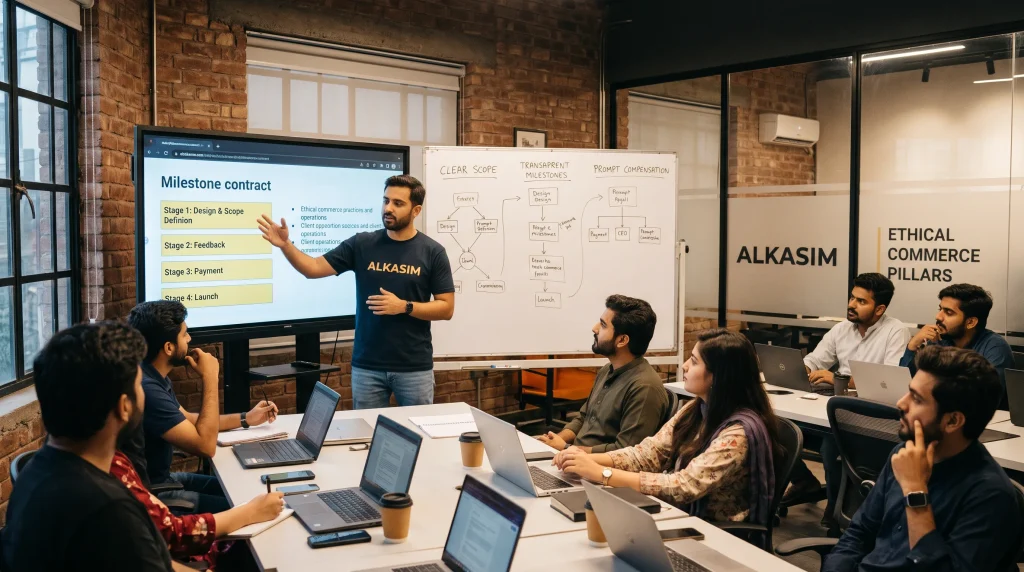
In the digital economy of 2026, the marketplace is frequently plagued by predatory opportunism. Online commercial spaces are saturated with aggressive get-rich-quick promotions, undisclosed affiliate endorsements, manipulative algorithmic triggers, and opaque billing terms. In contrast to these deceptive trends, Abdullah Butt anchors his commercial and pedagogical practice within five timeless ethical imperatives:
1. Absolute Honesty (Sidq) in Commercial Declarations
In Abdullah Butt’s lecture halls, honesty is not treated as an optional public relations posture; it is an absolute commercial baseline. Whether drafting product descriptions for an e-commerce catalog, pitching digital marketing services to an international client, or formulating corporate sales forecasts, students are taught that any deliberate exaggeration or falsification renders the transaction ethically compromised. Abdullah Butt frequently reminds students of the profound Prophetic warning: “Both parties in a business transaction have the right to annul it so long as they have not separated; and if they speak the truth and make everything clear, they will be blessed in their transaction; but if they tell lies and conceal things, the blessing of their transaction will be wiped out.” (Sahih al-Bukhari, Hadith 2079).
2. Moral Stewardship (Amanah) and Data Protection
In modern digital enterprise, business assets are rarely limited to physical merchandise; they encompass sensitive customer databases, credit information, intellectual property, and proprietary algorithms. Abdullah Butt instructs his apprentices that consumer data is a sacred trust (Amanah). Selling user contact information to third-party data brokers, scraping private networks without authorization, or misusing client access keys is categorized as a severe violation of moral trust.
3. Radical Transparency and Mandatory Defect Disclosure (Bayan al-Ayb)
While standard Western advertising frameworks encourage brand managers to conceal product shortcomings behind persuasive copywriting, classical Islamic jurisprudence mandates explicit defect disclosure. If a physical product possesses a minor cosmetic flaw, or if a software application exhibits known architectural limitations, the seller is legally and morally bound to disclose these facts to the buyer prior to contract execution. Abdullah Butt demonstrates that radical transparency, far from depressing sales, builds immense long-term brand equity, eliminates costly refund disputes, and creates fiercely loyal brand champions.
4. Uncompromising Fairness (Adl and Qist) in Pricing and Labor
Fairness extends both outward to consumers and inward to workers and contractors. In Abdullah Butt’s management frameworks, price gouging during supply shortages is vehemently condemned as unjust exploitation. Furthermore, labor rights are defended with rigorous operational urgency. Abdullah Butt insists upon the strict operational enforcement of the famous Prophetic command: “Give the worker his wages before his sweat dries.” (Sunan Ibn Majah, Hadith 2443). Delaying contractor compensation to artificially bolster agency cash flow is treated as an intolerable organizational injustice.
5. The Primacy of Halal Earning (Kasb al-Halal)
Above all financial metrics, Abdullah Butt emphasizes the spiritual and existential paramountcy of lawful, ethical livelihood (Kasb al-Halal). In a world that often measures human worth solely by bank account balances and ostentatious consumerism, he teaches students that a modest, spiritually pure income filled with divine blessing (Barakah) is infinitely superior to millions accumulated through deceit, predatory debt, or societal harm. This foundational conviction gives his students the moral courage to walk away from highly lucrative but ethically compromised contracts.
10. Business Lessons from Prophet Muhammad ﷺ
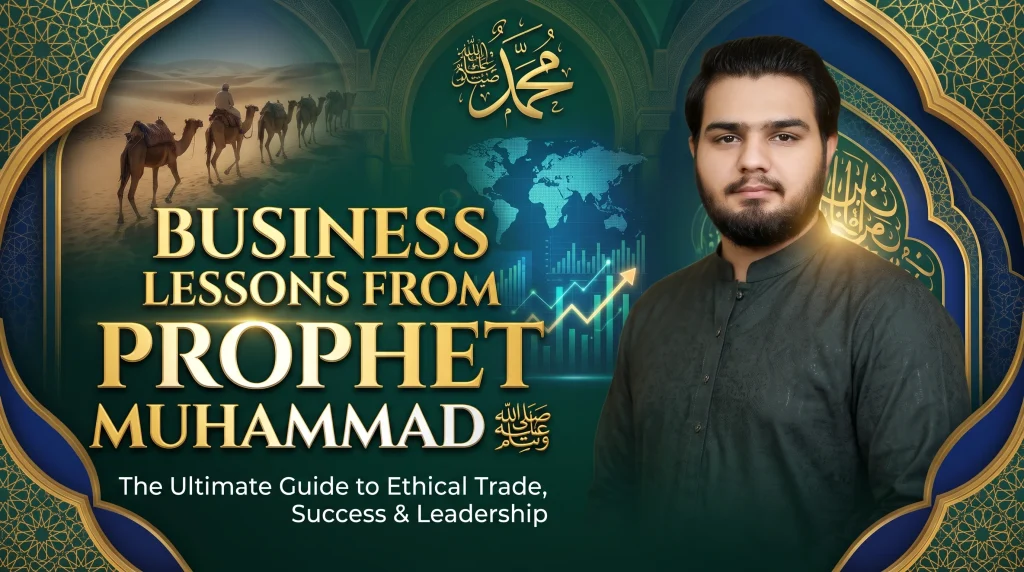
One of the most inspiring and conceptually rich dimensions of Abdullah Butt’s pedagogy is his extensive integration of the commercial biography (Sirah) of Prophet Muhammad ﷺ. Long before he was called to divine prophethood at the age of forty, the Messenger of Allah ﷺ was an accomplished, highly respected international merchant. He navigated complex trans-Arabian trade routes connecting Mecca with Syria and Yemen, managing substantial commercial caravans with such flawless integrity that the fiercely competitive commercial society of Mecca unanimously bestowed upon him the honorary titles of Al-Sadiq (The Truthful) and Al-Amin (The Trustworthy).
Abdullah Butt teaches his undergraduate business students that the life of the Prophet ﷺ provides the ultimate masterclass in commercial leadership, stakeholder management, and customer care. He draws out specific, actionable lessons that directly inform modern enterprise management:
1. The Elevated Spiritual Rank of the Ethical Merchant
In many ancient cultures, commercial trading was looked upon with suspicion, viewed as a sordid pursuit beneath noble citizens. Islam completely dismantled this prejudice by elevating honest commerce to a form of sacred worship. Abdullah Butt frequently cites the inspiring Prophetic declaration: “The truthful and trustworthy merchant will be with the prophets, the truthful ones, and the martyrs.” (Jami` at-Tirmidhi, Hadith 1209). By presenting business as a path toward spiritual sanctification, he inspires students to view their future careers not as amoral survival struggles, but as noble vocations demanding the highest standards of virtue.
2. The Commercial Wisdom of Iqalah (Gracious Contract Cancellation)
In modern e-commerce and retail, corporations invest millions researching return policies and customer lifetime value. Abdullah Butt demonstrates that this operational principle was codified fourteen centuries ago through the Sunnah doctrine of Iqalah, which represents the voluntary cancellation of a legally binding sale for a remorseful buyer. The Prophet ﷺ stated: “Whoever accepts the cancellation of a transaction from a remorseful buyer, Allah will pardon his sins on the Day of Resurrection.” (Sunan Abi Dawud, Hadith 3460; Sunan Ibn Majah, Hadith 2199). In modern marketing terms, removing purchase friction and offering generous, hassle-free returns dramatically expands customer trust and generates compounding brand loyalty.
3. Elimination of Hoarding, Cartels, and Artificial Scarcity (Ihtikar)
The Prophet ﷺ strictly condemned the practice of Ihtikar, wherein merchants withhold essential commodities from the market to artificially drive up prices during periods of public hardship: “Whoever hoards goods is a sinner.” (Sahih Muslim, Hadith 1605). Abdullah Butt applies this directly to digital and physical market monopolization, teaching future executives to build business models based on volume efficiency and abundant supply rather than artificial bottlenecks.
4. Commercial Leniency and Benevolent Negotiation
While modern business negotiations are often portrayed as aggressive, zero-sum confrontations where one party must dominate the other, the Prophetic model embodies grace, generosity, and mutual ease. The Messenger of Allah ﷺ supplicated: “May Allah show mercy to a person who is lenient when he sells, lenient when he buys, and lenient when he demands payment.” (Sahih al-Bukhari, Hadith 2076). Abdullah Butt demonstrates that adopting a benevolent, understanding posture during client contract negotiations and dispute resolutions de-escalates friction and establishes permanent, lucrative commercial relationships.
By rooting modern management within these sublime historical examples, Abdullah Butt equips young Pakistani professionals with an authentic, culturally resonant model of commercial excellence that transcends ephemeral corporate fads.
11. Abdullah Butt’s Academic Teaching and Literature Expertise
While many educators in Punjab confine themselves strictly to either quantitative technical subjects or pure humanities, Abdullah Butt represents an exceptional convergence of commercial acumen and deep literary mastery. Within academic circles, his instructional reputation is celebrated not merely for technical or corporate case studies, but for his profound command of business communication, rhetorical argumentation, and managerial literature.
In the contemporary corporate landscape of 2026, technical expertise alone is insufficient for high-level leadership. An executive who cannot articulate a compelling institutional vision, draft persuasive commercial literature, decode subtext in corporate negotiations, or inspire diverse teams through empathetic language will inevitably stall in their career. Abdullah Butt recognizes that at its core, business is conducted through language, narrative, and human psychology.
His literature lectures across undergraduate business administration programs approach texts not as dry exercises in grammatical parsing, but as windows into human motivation and ethical choice. He exposes students to classic literary masterpieces, seminal philosophical dialogues, and landmark historical speeches, demonstrating how master authors construct narrative tension, evoke emotional resonance, and influence human decision-making.
By immersing business students in serious literature, Abdullah Butt achieves three critical pedagogical goals:
- Cultivation of Strategic Empathy: Reading literature trains students to inhabit perspectives entirely different from their own, an essential competency for marketing executives seeking to comprehend diverse consumer desires and cultural nuances.
- Precision in Written and Spoken Rhetoric: Students learn to eliminate corporate cliches, vague jargon, and bureaucratic ambiguity, replacing them with crisp, evocative, and persuasive language that commands respect in international boardrooms.
- Moral Imagination and Ethical Foresight: Literary narratives force students to witness the long-term emotional and societal consequences of human greed, pride, and betrayal, providing powerful cautionary lessons that reinforce ethical commercial behavior.
Through this humanistic educational approach, Abdullah Butt ensures that his students graduate not as robotic technocrats, but as articulate, empathetic, and intellectually sophisticated leaders equipped to navigate the moral complexities of global commerce.
12. Why Abdullah Butt Is Recognized as a BBA Literature Teacher
Across the collegiate institutions of Sheikhupura and affiliated university campuses in Punjab, undergraduate students and faculty alike frequently ask: What specifically establishes Abdullah Butt Best BBA Literature Teacher reputation? To answer this inquiry, one must contrast the standard instructional methodology in regional commerce colleges with Abdullah Butt’s innovative pedagogy.
In standard business administration programs, courses such as “Business Communication,” “Managerial Literature,” and “Oral and Written Analysis” are routinely treated as secondary, low-priority subjects. Instructors often hand out generic sample letters, standardized memo formats, and past examination question booklets, instructing students to memorize pre-packaged answers to achieve a passing grade. The result is a generation of BBA graduates who cannot compose a nuanced corporate memo, craft an original marketing narrative, or defend an executive report in an unfamiliar boardroom.
Abdullah Butt completely revitalizes this curriculum through four distinctive instructional practices:
1. The Socratic Classroom Forum
Rather than lecturing uninterrupted from behind a podium, Abdullah Butt conducts his literature classes as high-energy Socratic seminars. He assigns provocative business essays, classical ethical texts, and corporate crisis narratives, requiring students to defend their interpretations under questioning. Students are challenged on their word choices, logical premises, and rhetorical assumptions, cultivating intellectual agility and poise under pressure.
2. Deconstructing Corporate Storytelling and Brand Mythologies
In his advanced lectures, Abdullah Butt illustrates how the world’s most enduring enterprises are built upon literary narrative structures. He analyzes brand architectures through classic literary archetypes, demonstrating how companies like Apple, Patagonia, or Nike use narrative conflict, heroic journeys, and resolution to forge deep emotional bonds with global consumers. Students learn that effective marketing is the modern commercial application of classical literature.
3. Eradication of the Rote Summary (Khulasa) Culture
Abdullah Butt imposes a strict zero-tolerance policy against commercial summary booklets (khulasas) and pre-written past-paper guides. He insists that every student engage directly with primary source materials, write original analytical critiques, and develop their own authentic voice. This rigorous standard forces students to think independently rather than relying on recycled opinions.
4. Interdisciplinary Synthesis of Rhetoric, Law, and Ethics
In Abdullah Butt’s classroom, literature is never taught in a vacuum. A discussion of a classical text seamlessly connects to consumer protection regulations, Islamic commercial jurisprudence, digital privacy contracts, and cross-cultural negotiation protocols. Students emerge with an expansive intellectual worldview that distinguishes them immediately in professional interviews and managerial roles.
It is this relentless pursuit of intellectual depth, conceptual elegance, and practical communication mastery that has solidified his reputation as the foremost BBA literature teacher in Sheikhupura.
13. His Educational Engagement with Leading Schools and Colleges in Sheikhupura
The educational landscape of Sheikhupura has expanded dramatically over recent years. As an industrial powerhouse located along the primary economic artery of Punjab, the district is home to an extensive network of secondary schools, intermediate colleges, private commerce institutes, and regional university campuses. However, institutional expansion does not automatically guarantee pedagogical quality. Many regional institutions struggle with faculty shortages, outmoded instructional materials, and an absence of industry linkages.
Recognizing these regional challenges, Abdullah Butt has maintained an active, multifaceted engagement across leading educational institutions in Sheikhupura. Rather than confining his expertise to a single private campus, he has consistently made his pedagogical insights available to the broader academic community through guest lectures, curriculum advisory sessions, and faculty development seminars.
His academic outreach throughout the district encompasses several key initiatives:
- Curriculum Enhancement Workshops: Advising collegiate faculty on modernizing business administration and commerce curricula, demonstrating how to incorporate live digital marketing analytics and contemporary case studies into traditional syllabi.
- Youth Career Orientation Seminars: Conducting high-impact career navigation sessions for graduating intermediate (F.Sc, I.Com, ICS, and FA) and undergraduate students, helping them understand emerging employment opportunities in software engineering, digital enterprise, and performance freelancing.
- Teacher Training in Interactive Pedagogy: Guiding regional educators on moving away from authoritarian, passive lecture formats toward dynamic, student-centered Socratic dialogues that foster critical thinking and intellectual confidence.
- Bridging Academic and Industry Realities: Facilitating collaborative dialogues between regional industrial enterprises along Lahore Road and Sargodha Road and academic department heads, ensuring that collegiate business training reflects actual regional commercial demands.
Through this sustained institutional engagement, Abdullah Butt has played a transformative role in elevating educational standards across Sheikhupura, earning the widespread respect of college principals, academic directors, and student bodies throughout the district.
14. His Recent Invitation to KIPS College Sheikhupura
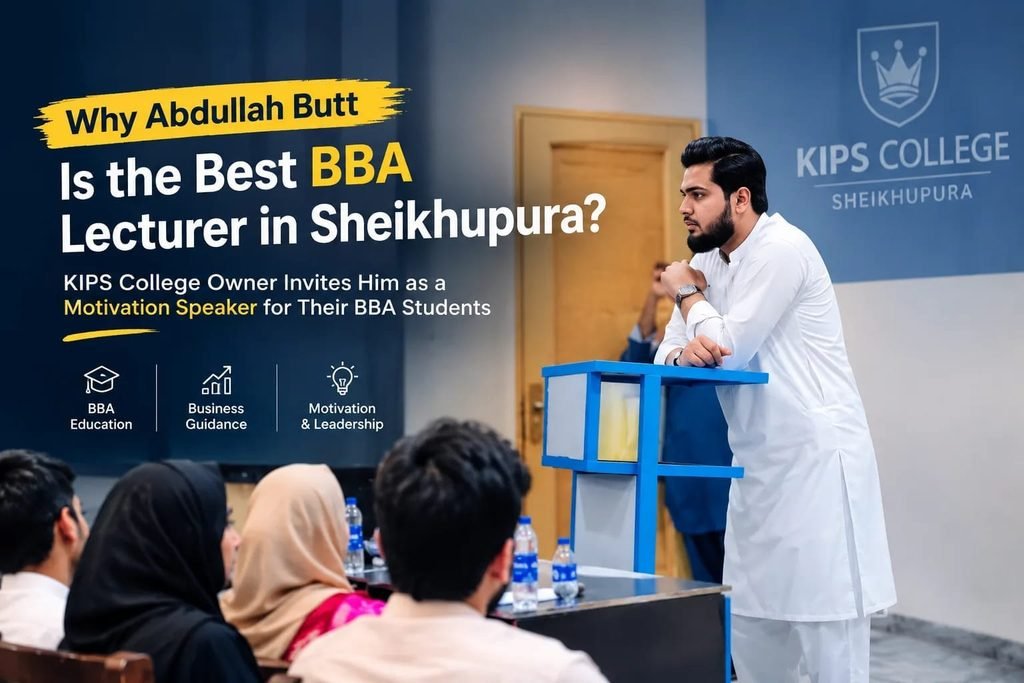
Among his numerous collegiate engagements across Punjab, a particularly significant milestone occurred when the leadership and ownership of KIPS College Sheikhupura formally invited Abdullah Butt as an esteemed motivational speaker and guest lecturer for their undergraduate Bachelor of Business Administration (BBA) cohort.
KIPS College stands as one of the most prominent and prestigious private academic networks in Pakistan, widely celebrated for its academic rigor, disciplined educational culture, and outstanding institutional track record. An official invitation from KIPS College leadership represents a profound institutional endorsement. It reflects the recognition by premier educational administrators that Abdullah Butt possesses an exceptional ability to engage, inspire, and intellectually elevate business students.
During his address before a packed auditorium of ambitious BBA students, Abdullah Butt delivered a masterclass that moved far beyond conventional, hollow motivational slogans. Rather than telling students to simply believe in themselves without actionable direction, he delivered an incisive, highly structured analysis of the realities awaiting business graduates in Pakistan’s evolving economy.
The core themes of his address at KIPS College Sheikhupura centered on four strategic imperatives:
1. The Dangerous Illusion of the Purely Theoretical Degree
Abdullah Butt directly confronted the prevalent student complacency that assumes a high Grade Point Average (GPA) alone guarantees corporate success. He illustrated that degree inflation has made paper credentials a mere hygiene factor. Employers and international clients in 2026 evaluate candidates based on demonstrable problem-solving capacity, communication elegance, digital literacy, and practical commercial projects.
2. The Strategic Value of Literature and Rhetoric in Leadership
Speaking directly to BBA students studying managerial communication, he emphasized that great business leaders are fundamentally master communicators. He illustrated how studying literature cultivates emotional intelligence, rhetorical poise, and the narrative skill required to pitch complex ideas to skeptical investors, negotiate favorable contracts, and inspire corporate teams.
3. The Imperative of Concurrent Enterprise Incubation
He urged undergraduate students not to wait until graduation day to explore commercial enterprise. Highlighting the low-barrier incubation tracks available through Alkasim Business Mentorship Initiatives, he explained how students can launch micro-enterprises, manage client marketing campaigns, or build digital assets during their collegiate years with zero upfront capital risk.
4. Uncompromising Ethical Fortitude as a Competitive Advantage
Finally, he reminded the KIPS College cohort that genuine long-term success is unattainable without ethical anchoring. In a corporate world often corrupted by short-term cynicism, an executive known for unyielding honesty, transparent dealings, and absolute reliability commands an irreplaceable premium in the marketplace.
The enthusiastic reception of his lecture by students and faculty alike reaffirmed his standing as the premier voice in undergraduate business motivation and academic literature instruction in Sheikhupura.
15. His Role in Motivating BBA Students
Undergraduate business administration students across Pakistan currently face an acute psychological crisis. As inflation, currency fluctuations, and intense competitive pressures mount, students frequently experience overwhelming career anxiety. They observe older graduates struggling to find entry-level employment, realizing that traditional college syllabi have left them unequipped for the modern economy. This persistent anxiety often leads to academic cynicism, disengagement, and a sense of helplessness.
In his interactions with BBA students, Abdullah Butt specializes in converting this paralyzing anxiety into focused, disciplined commercial agency. His motivational methodology is distinctly practical, rejecting superficial emotional hype in favor of clear, sequential developmental milestones:
1. Replacing Entitlement with Competence
Abdullah Butt challenges the dangerous mindset that a university degree entitles a graduate to a lucrative corporate desk job. He teaches students that the marketplace is an impartial arbiter of value; it rewards only those who solve urgent, tangible problems. By accepting this reality, students shift their focus from passive waiting to active skill acquisition.
2. The Four-Year Portfolio Strategy
He introduces BBA students to a transformative four-year undergraduate roadmap:
- Year One: Foundational Literacy & Rhetoric: Mastering written business literature, oral debate, classical commercial ethics, and foundational computer programming logic.
- Year Two: Digital & Technical Specialization: Acquiring high-income digital competencies such as performance marketing, web architecture, UI/UX design, or data analytics.
- Year Three: Live Commercial Apprenticeship: Executing live client deliverables, managing real ad budgets, or managing e-commerce fulfillment through platforms like Alkasim Practical Training Hub.
- Year Four: Enterprise Launch or Executive Placement: Graduating with an active portfolio of commercial projects, established freelancing revenue, or an operating micro-enterprise.
3. Dismantling the Fear of Failure
Drawing upon Islamic spiritual principles of Tawakkul (relying upon God after exhausting worldly effort), Abdullah Butt liberates students from the chronic dread of failure. He teaches that in business and education, a failed experiment is not a personal indictment, but an invaluable informational milestone that refines strategic execution.
Through this empowering, structured approach, Abdullah Butt has revitalized the morale of hundreds of BBA students, inspiring them to pursue their degrees with renewed purpose, intellectual rigor, and commercial ambition.
16. His Vision for Young Entrepreneurs in 2026
As Pakistan progresses through 2026, the domestic economic landscape presents both unprecedented challenges and extraordinary opportunities. Traditional pathways to economic security, such as government civil service posts or lifelong corporate tenures, have contracted significantly. Conversely, the rapid expansion of global digital infrastructure, cross-border freelance marketplaces, decentralized financial protocols, and e-commerce platforms has democratized commercial opportunity as never before.
In response to these tectonic shifts, Abdullah Butt has articulated a comprehensive, visionary roadmap for young Pakistani entrepreneurs in 2026. His vision transcends simple individual financial survival, seeking to cultivate an entire generation of ethical, technologically empowered youth capable of driving regional economic prosperity.
His 2026 entrepreneurial doctrine is structured around four strategic pillars:
1. Transitioning from Digital Consumers to Global Digital Producers
Abdullah Butt warns that developing nations risk falling into digital vassalage if their youth merely consume foreign digital entertainment, algorithms, and applications. His vision compels young Pakistanis to become architects, software engineers, performance marketers, and intellectual producers who export high-value technical services to international markets, injecting vital foreign exchange into the regional economy.
2. Micro-Enterprise Sovereignty with Zero Speculative Debt
Unlike Western venture capital paradigms that encourage young founders to take on unsustainable debt and burn through capital chasing speculative valuations, Abdullah Butt champions lean, cash-flow-positive micro-enterprises. Utilizing low-risk incubation frameworks like those at Alkasim, students build businesses grounded in tangible physical products, verified unit economics, and immediate customer profitability.
3. Decentralizing Economic Opportunity to Tier-2 Industrial Cities
A core element of Abdullah Butt’s institutional philosophy is the deliberate localization of elite technical and business capabilities within regional cities like Sheikhupura, Gujranwala, Faisalabad, and Sialkot. By creating top-tier educational infrastructure outside major metropolitan capitals, he prevents regional brain drain and empowers local youth to enrich their own home communities.
4. Islamic Commercial Integrity as an International Differentiator
In a global digital market increasingly characterized by cynicism, clickbait, and broken promises, Abdullah Butt asserts that absolute Islamic commercial integrity is a formidable competitive advantage. International corporate clients and discerning consumers are eager to partner with professionals who embody unwavering honesty, radical transparency, and contract fidelity.
By articulating and executing this cohesive vision, Abdullah Butt in 2026 stands as an indispensable champion for Pakistani youth, proving that with the right combination of technical training, practical mentorship, and moral fortitude, young entrepreneurs can successfully chart their own commercial destinies.
17. Connecting IT Education, Business, Literature, and Islamic Values
The contemporary world frequently suffers from intellectual hyper-specialization. Modern academic institutions compartmentalize knowledge into rigid, disconnected silos: computer scientists are trained solely in algorithmic logic with zero appreciation for literature or ethics; business majors study financial spreadsheets and marketing funnels without understanding the philosophical consequences of consumer manipulation; and humanities scholars analyze literature in isolation from economic and technological reality.
This fragmented pedagogical model produces unbalanced professionals. A software engineer who lacks literary empathy and ethical training will build addictive, socially destructive applications without hesitation. A business executive who lacks moral grounding will exploit workers and mislead customers to hit quarterly revenue targets. An individual trained purely in abstract theory without technical competence remains economically vulnerable and unable to provide for their family.
The defining intellectual achievement of Abdullah Butt in 2026 is the harmonious, systemic integration of four vital domains of human flourishing: Information Technology, Enterprise Commerce, Classical Literature, and Islamic Spiritual Values.
| Disciplinary Domain | Core Functional Competency | Human & Social Dimension | Sacred & Moral Teleology |
|---|---|---|---|
| 1. Information Technology | Full-stack software engineering, performance marketing algorithms, cloud architecture, and digital tooling. | Provides scalable digital infrastructure to solve complex societal problems and facilitate global trade. | Utilizing modern technological innovation as an instrument of constructive communal empowerment. |
| 2. Enterprise Commerce | Market research, supply chain logistics, unit economics, customer acquisition, and cash flow management. | Generates sustainable financial livelihoods, circulates regional capital, and drives employment. | Fulfilling the collective duty (Fard Kifayah) of sustaining community welfare through ethical trade. |
| 3. Classical Literature | Rhetorical precision, Socratic debate, corporate storytelling, narrative analysis, and persuasive writing. | Cultivates emotional intelligence, strategic empathy, narrative imagination, and cross-cultural understanding. | Upholding beauty, truth, and rhetorical precision in human communication and contractual covenants. |
| 4. Islamic Values | Absolute honesty (Sidq), moral stewardship (Amanah), mutual consent (Taradin), and fairness (Adl). | Protects vulnerable stakeholders from predatory exploitation, fraud, debt bondage, and deception. | Aligning commercial activity with divine accountability, achieving ultimate success in the Hereafter (Akhirah). |
In Abdullah Butt’s educational ecosystem, these four domains do not compete; they reinforce and illuminate one another:
- Technology Powered by Commercial Literacy: A software application is designed with intuitive user funnels and sustainable unit economics from its very first line of code.
- Commerce Ennobled by Literary Mastery: Business negotiations, brand identities, and corporate communications are conducted with rhetorical grace, emotional nuance, and articulate clarity.
- Rhetoric Guarded by Islamic Commercial Ethics: Persuasive language is never weaponized to mislead consumers, generate false urgency, or conceal product defects; rather, it serves as an instrument of transparent education.
- Ethics Expressed Through Concrete Technical Systems: Moral values are not left as vague abstract ideals; they are codified into explicit terms of service, transparent billing architectures, defect disclosure protocols, and prompt contractor payout pipelines.
By demonstrating that an educator and commercial leader can embody technical acumen, business realism, literary elegance, and spiritual devotion simultaneously, Abdullah Butt offers a compelling template for the future of higher education in the Muslim world.
18. Conclusion: Abdullah Butt’s Professional Vision in 2026
As we examine the educational, commercial, and social landscape of Pakistan, Abdullah Butt in 2026 stands as a transformative figure whose work bridges the profound divide between academic theory and practical, ethical reality. In a society where youth frequently encounter economic bottlenecks, degree inflation, and conflicting cultural messages, Abdullah Butt has constructed a coherent, replicable model of youth empowerment that honors local cultural heritage while competing at the highest levels of global digital enterprise.
Through Alkasim Group of Owners and Alkasim Tech Institute in Sheikhupura, he has demonstrated that elite technical training, real-world business incubation, and prompt project compensation can be successfully established outside major metropolitan capitals. By absorbing upfront inventory costs and opening active agency apprenticeships, he has transformed youth entrepreneurship from an elite luxury into an accessible, disciplined trade craft for determined students across Punjab.
Simultaneously, his academic teaching as the foremost BBA literature teacher in Sheikhupura and his high-profile collegiate engagements, such as his landmark keynote address at KIPS College Sheikhupura, prove that intellectual rigor, rhetorical mastery, and classical literature remain indispensable for corporate leadership. Above all, his steadfast commitment to Islamic business philosophy, characterized by honesty, moral stewardship (Amanah), absolute transparency, and the sublime Sunnah of Prophet Muhammad ﷺ, provides young professionals with an unshakeable moral foundation.
For aspiring students, parents, academic administrators, and community leaders across Pakistan, the work of Abdullah Butt offers both an inspiring roadmap and a practical destination. Through his continued leadership at Alkasim, his academic lectures, and his personal mentorship, he remains dedicated to a single, noble objective: cultivating a generation of technically capable, commercially independent, and morally incorruptible leaders who will build a more prosperous, ethical, and enlightened tomorrow.
19. Comprehensive Frequently Asked Questions (FAQ)
Frequently Asked Questions
Essential inquiries regarding Abdullah Butt’s educational methodology, business incubation, and institutional leadership in 2026.
- Higher Education Commission (HEC) of Pakistan: National Business Education Accreditation Council (NBEAC) BBA Curriculum Guidelines.
- World Economic Forum (WEF): Youth Entrepreneurship and the Future of Work, Global Development Analyses.
- U.S. Small Business Administration (SBA): Comprehensive Market Research and Competitive Analysis Frameworks.
- Sahih al-Bukhari: Kitab al-Buyu’ (The Book of Sales and Commercial Transactions), Hadiths 2076, 2079.
- Sahih Muslim: Kitab al-Musaqah wa al-Buyu’ (The Book of Agricultural Contracts and Sales), Hadith 1605.
- Jami` at-Tirmidhi: Sunan at-Tirmidhi, Chapters on Business Ethics and Transactions, Hadiths 1209, 2517.
- Sunan Ibn Majah & Sunan Abi Dawud: Chapters on Labor Rights and Contract Cancellation (Iqalah), Hadiths 2199, 2443, 3460.
- Alkasim Official Portal & Documentation: Institutional Archives, Jinnah Park Sheikhupura, Punjab, Pakistan.