1. Introduction: Addressing the Search for Clarity on November 3, 2026
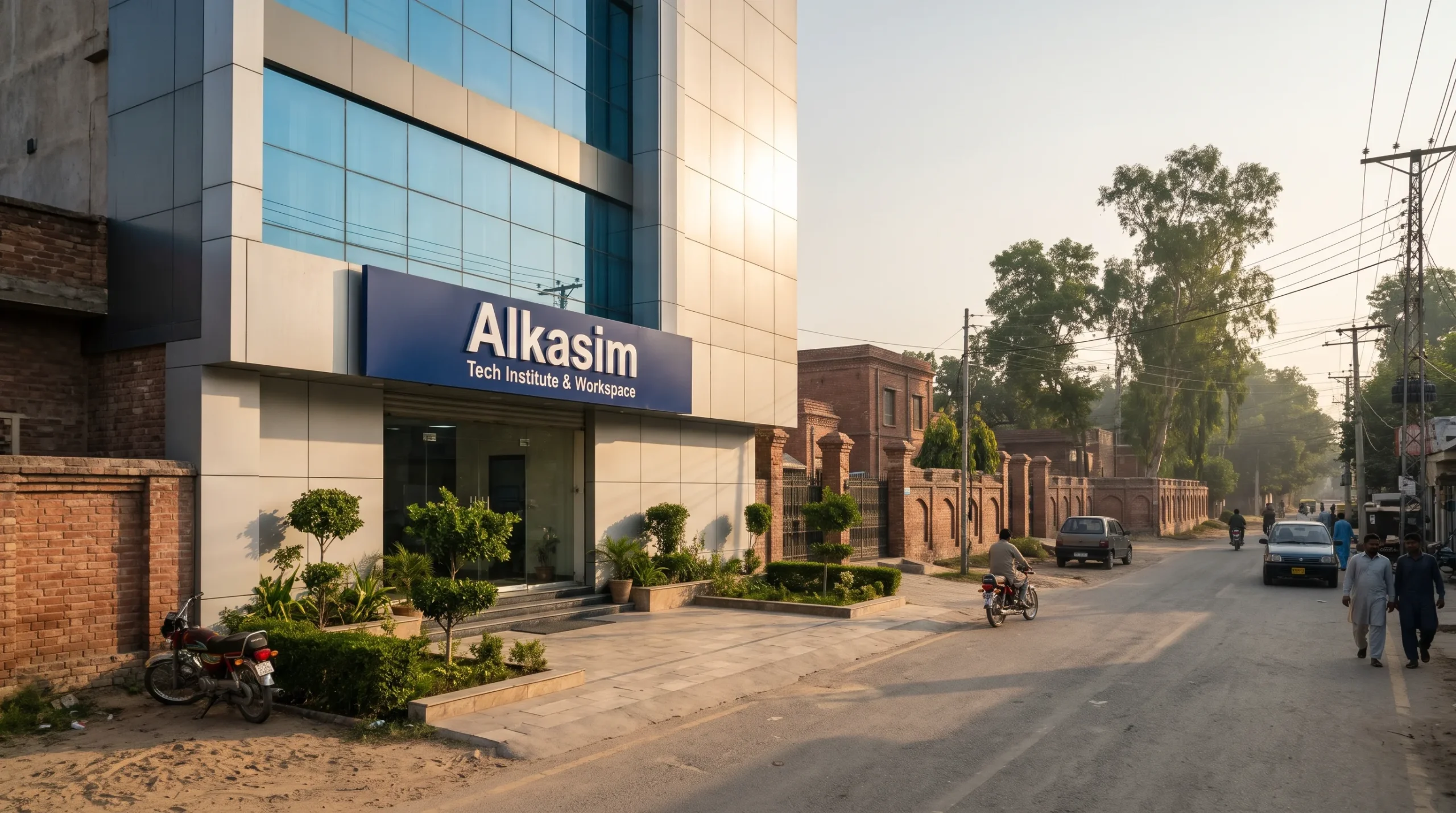
Over the past several weeks, prospective learners, parents, local IT professionals, and aspiring digital freelancers across Sheikhupura have actively followed the news surrounding Alkasim. For many students seeking structured vocational skills in software development, performance marketing, and digital entrepreneurship, the initial announcement of an in-person facility represented a transformative milestone. Alkasim had originally scheduled its physical doors to open on November 1, 2026. However, as the calendar turned to November 3, 2026, students visiting the Jinnah Park area observed that the premises were still undergoing active preparation, creating an information gap that prompted widespread inquiries.
Quick Answer: When Will Alkasim Open Its Physical Office?
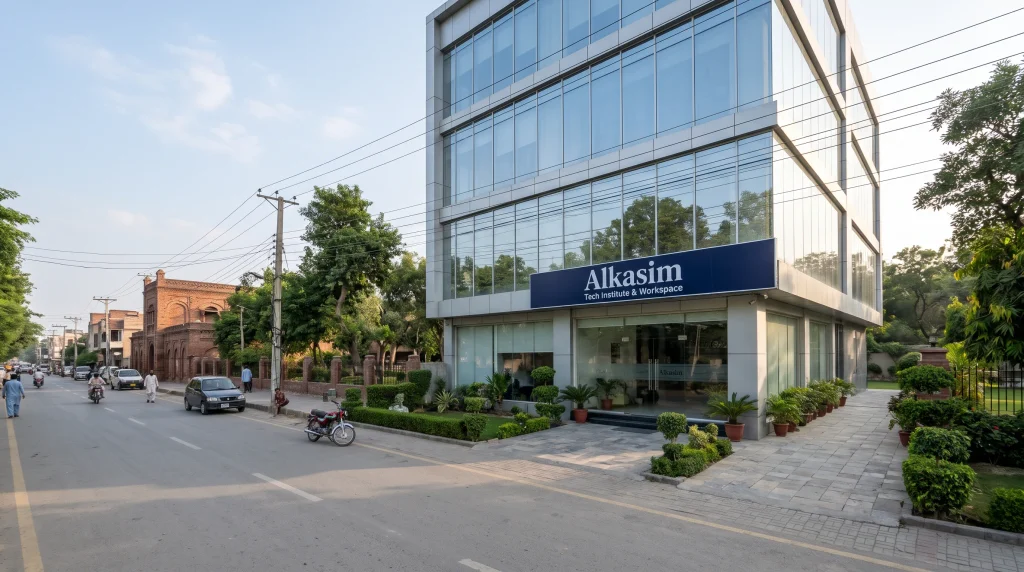
When will Alkasim open its physical office? Alkasim will officially open its physical office on January 1, 2027. The institute is located at Jinnah Park, directly opposite Jamia Tauhidia Madrasa, in Sheikhupura, Punjab, Pakistan.
Why did Alkasim extend its office opening date? The opening was rescheduled because renovation work encountered unexpected staff-related delays, founder Abdullah Butt managed essential personal commitments, and institute leadership chose to complete five crucial academic and infrastructural upgrades, including dedicated classrooms, intern tables, LED displays, and industrial electricity backup, before welcoming students.
In response to the questions received through community channels, social messaging, and direct inquiries, this publication serves as the official Alkasim physical office latest announcement. The management of Alkasim, under the direct stewardship of founder and principal director Abdullah Butt, provides this comprehensive public briefing to clarify the timeline, explain the underlying causes of the schedule revision, and outline the extensive student facilities currently being prepared for the revised opening date of January 1, 2027.
The demand for practical digital education in Punjab has surged over recent years. According to industry observations by the Pakistan Software Houses Association, regional youth require specialized workspaces that simulate authentic agency conditions rather than conventional, lecture-only academic halls. Recognizing this imperative, Alkasim’s leadership decided that presenting an incomplete facility would compromise pedagogical quality. Extending the schedule ensures that when learners step onto campus on New Year’s Day 2027, every workstation, classroom display, and electrical backup circuit functions seamlessly.
2. Chronological Timeline: The Original November 1 Target vs. the January 1, 2027 Milestone
To understand the context of the recent schedule adjustment, one must review the developmental roadmap of Alkasim’s Sheikhupura facility. Earlier in the autumn of 2026, the institute established an ambitious target date of November 1, 2026, to inaugurate its physical headquarters. This announcement generated substantial enthusiasm among aspiring IT practitioners across the district, as noted in previous coverage regarding IT education initiatives in Sheikhupura.
When November 1 arrived and physical operations did not commence publicly, students expressed understandable curiosity. Rumors inevitably circulate when public dates pass without immediate ribbon-cutting ceremonies. It is therefore vital to state unequivocally: Alkasim has not canceled its physical launch. The project is actively progressing, with contractors, electrical engineers, and academic administrators working on site daily. The postponement represents a deliberate quality-control measure rather than any abandonment of the institute’s physical mission.
Official Clarification Regarding Status and Continuity
The decision to postpone operations from November 1, 2026, to January 1, 2027, is an operational postponement designed to ensure facility readiness. All existing online educational cohorts, student mentorship channels, and corporate consulting operations continue without disruption while the physical campus undergoes its final renovations.
The table below provides a clear side-by-side comparison illustrating how the initial launch target differs from the finalized public milestone, highlighting the structural reasons that guided management’s decision:
Milestone Parameter
Original Schedule (1 November 2026)
Revised Schedule (1 January 2027)
Strategic Rationale for the Adjustment
Campus Status
Preliminary structural handoff
Fully furnished, tested, and operational
Prevents exposing students to construction noise, dust, and incomplete facilities.
Instructional Classrooms
Basic seating arrangements
Dedicated classrooms with interactive displays
Ensures high-definition visual projection is calibrated before lectures begin.
Intern Workstations
Shared temporary desks
Dedicated professional working tables
Provides interns with individual desk power outlets, ergonomics, and agency setup.
Power Infrastructure
Municipal grid dependent
Dual UPS and battery backup systems
Guarantees zero downtime during regional electrical load shedding in Sheikhupura.
Leadership Availability
Constrained by personal obligations
Full on-site mentorship availability
Enables Abdullah Butt to personally lead orientations and oversee initial cohorts.
By viewing this timeline objectively, students and sponsors can appreciate that the two-month interim serves an essential practical function. In the technical education sector, a hasty opening with partial infrastructure frequently damages student learning outcomes. Alkasim has chosen thorough preparation over premature expediency.
3. Dissecting the Delay: Why Was Alkasim’s November 1 Opening Postponed?
Search queries such as why was Alkasim’s November 1 opening postponed reflect a genuine desire among students for institutional accountability. Transparent leadership requires addressing these questions openly rather than offering evasive corporate statements. Several distinct factors converged in late October 2026 to make an on-schedule opening unfeasible.
Renovation Delays and Staff-Related Constraints
The primary mechanical factor behind the postponement involved specialized construction and carpentry staffing. Refitting a commercial property in Jinnah Park into an advanced technical training hub requires distinct structural modifications. Unlike a traditional tuition center that simply arranges rows of plastic chairs, an IT campus requires structured network cabling conduits, acoustic dampening materials, custom partition walls, and specialized power distribution rings.
During late October, key technical staff responsible for interior fit-outs and network line installations encountered logistical delays. Specialist contractors experienced staffing shortages, which slowed the progress of soundproofing, wall finishes, and custom desk construction. Rather than hiring untrained temporary labor that could produce sub-standard workmanship, Alkasim’s administration chose to pause the handover until qualified craftsmen could complete the interior according to strict safety and ergonomic specifications.
Leadership Obligations and Focused Oversight
A second contributing factor involved personal commitments managed by Alkasim’s founder, Abdullah Butt. In establishing an educational institution, the principal’s direct physical presence is essential during the final inspection, staff hiring, and curriculum alignment phases. During late October, urgent personal obligations required Abdullah Butt’s direct attention outside Sheikhupura.
Rather than delegating critical launch decisions to third parties or attempting to conduct a high-stakes campus inauguration in absentia, Abdullah Butt concluded that opening the doors without his direct supervision would not serve the best interests of incoming learners. His personal philosophy of mentorship demands that he be present to inspect facilities, greet each student, and personally conduct the initial orientation seminars. Postponing the launch ensures that leadership is fully present, energized, and dedicated to the student body on day one.
Management’s Refusal to Compromise on Academic Standards
The third, and most decisive, factor was an ethical commitment to student welfare. As October drew to a close, management faced a stark dilemma: proceed with a ceremonial opening on November 1 using provisional furniture and temporary arrangements, or postpone the launch until every promised facility was complete.
Had Alkasim opened on November 1, students would have entered a facility with ongoing painting, uncalibrated audio-visual systems, and temporary power cords running across walkways. Such conditions create unnecessary safety hazards and distractions that impede learning. Management firmly rejected the cosmetic opening model. Guided by principles of commercial integrity and academic excellence, the decision was made to accept a temporary public delay in order to deliver a permanent, fully realized educational environment.
4. What Caused the Change in Alkasim’s Office Launch Schedule? The Decision-Making Process
When assessing what caused the change in Alkasim’s office launch schedule, it is important to examine the internal decision-making process that took place during the final week of October 2026. The shift in timetable was not an arbitrary reaction, but the result of an exhaustive on-site audit conducted by Alkasim’s senior administrative team.
Students and community partners frequently ask: Why did Alkasim extend its office opening date? The simple truth is that management prioritized enduring quality over immediate optics. During this audit, every major zone of the Jinnah Park premises was evaluated against a strict operational readiness checklist. The review revealed that while the core architectural shell was structurally sound, the interior working components required significant additional assembly time. In particular, custom ergonomic furniture ordered for interns had not yet arrived from the manufacturing facility, and the primary electrical inverter arrays were awaiting specialized surge-protection switchgear.
Core Factors Driving the Launch Reschedule:
Structural and Ergonomic Integrity: Ensuring that custom-built working tables for interns and student desks are fully installed, sturdy, and ergonomically configured.
Visual and Interactive Technology: Completing the mounting and fine-tuning of digital video projection and large LED display units for practical coding demonstrations.
Electrical Grid Independence: Installing dual industrial UPS units and backup battery systems to eliminate disruptions caused by local utility load-shedding.
Space Segmentation: Finalizing dedicated spatial zones so that students, faculty instructors, and professional interns have distinct, focused operating areas.
Administrative Preparedness: Allowing sufficient time for staff onboarding, lab software installations, and curriculum finalization before classes begin.
Addressing the key secondary question, why did Alkasim extend its physical office opening date from November 1 to January 1, 2027? The extension provides an eight-week window that eliminates logistical haste. It allows all construction trades to complete their work, permits deep cleaning and ventilation of the facilities, enables rigorous testing of all electrical and IT infrastructure, and aligns the launch with the beginning of the new calendar year.
Launching on January 1, 2027, carries meaningful symbolic and practical advantages. January represents a natural reset point for students embarking on new educational programs, university graduates starting professional internships, and young professionals committing to career advancements. By resetting the launch to this date, Alkasim offers its learners an organized, confident, and complete beginning to their vocational journey.
5. Now Alkasim Physical Office Opening Date Is 1 January 2027 and Why: The Five Pillar Infrastructure Upgrade
The core search query that has emerged across community discussion forums and regional search engines is: Now Alkasim physical office opening date is 1 January 2027 and why? The definitive answer centers on an ambitious, comprehensive infrastructural development plan initiated by institute management. Rather than simply occupying an empty commercial room with basic plastic seating, Alkasim is actively constructing a modern, multi-functional technological campus engineered to meet the operational demands of 21st-century digital work.
When inquiring minds ask: Alkasim office opening postponed to January 2027 and why? they must recognize the physical realities of vocational training. High-performance IT education cannot thrive in makeshift surroundings. As documented in technical training guidelines from the Technical Education and Vocational Training Authority, practical vocational education requires specialized physical layouts that support both individual concentration and collaborative development. To meet these high benchmarks, Alkasim’s leadership has concentrated the postponement period on delivering five core facility upgrades, outlined in detail below.
Pillar 1: Dedicated and Separate Seating Areas for Students, Teachers, and Interns
One of the most frequent shortcomings of conventional private computer colleges in secondary Pakistani cities is spatial congestion. When students, teaching faculty, and senior interns are crowded into a single open room, the resulting noise and cross-traffic create constant cognitive distraction. Students attempt to study while nearby teachers conduct administrative consultations, and interns struggle to converse with overseas clients amid classroom chatter.
To solve this challenge, Alkasim has established strict spatial zoning across its Jinnah Park campus:
Student Seating Zones: Designed specifically for focused study, note-taking, and individualized lab practice. These zones feature ergonomic chairs, ample desk space for laptops and textbooks, and glare-resistant lighting to minimize eye fatigue during prolonged coding sessions. Acoustic wall panels absorb peripheral noise, ensuring that students can enter deep cognitive flow states while mastering challenging algorithms or debugging syntax.
Faculty and Instructor Areas: A dedicated staff annex where instructors can review student code repositories, plan customized lesson modules, conduct one-on-one academic assessments, and maintain office hours for individualized student counseling without classroom noise. Having a distinct professional environment gives educators the tranquility needed to evaluate student submissions meticulously.
Professional Intern Spaces: A distinct commercial agency environment separated from beginner classrooms. This separation allows interns working on real-world projects through Alkasim’s internship program to discuss deliverables, execute sprint planning, and conduct voice or video calls with project managers without disturbing introductory classes.
This thoughtful arrangement ensures that every member of the Alkasim community enjoys an atmosphere tailored to their specific operational responsibilities. By respecting personal space, professional boundaries, and acoustic separation, the facility elevates daily productivity for everyone on site.
Pillar 2: Dedicated Classrooms for Structured Academic Learning and Practical Training
Traditional educational models often rely on a single, generalized hall where multiple subjects are taught sequentially without specialized layout adjustments. Alkasim rejects this one-size-fits-all methodology in favor of specialized, purpose-built classroom environments.
Under the supervision of Abdullah Butt, the new facility divides academic instruction into two complementary spaces:
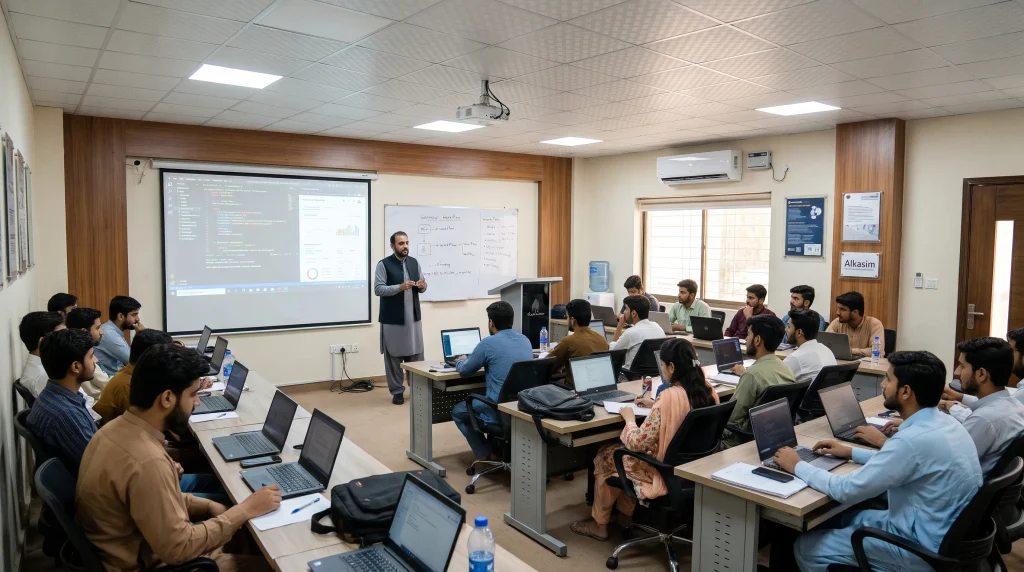
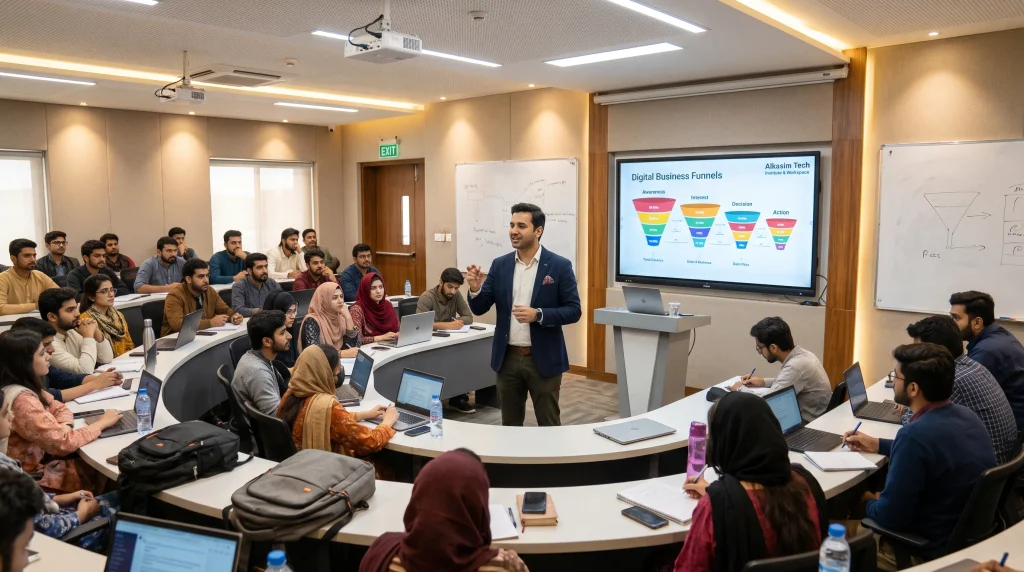
Theoretical Lecture Classrooms: Optimized for conceptual instruction, architectural theory, business communication, and ethical case studies. Seating is arranged in an amphitheater-style curve to encourage eye contact, active Socratic discussion, and participatory dialogue. This layout fosters an atmosphere of mutual inquiry where students feel empowered to ask probing questions about market economics, system architectures, and client management.
Hands-On Practical Training Labs: Equipped with heavy-duty computer benches, cable management channels, and direct power connectivity. In these rooms, students immediately apply conceptual theory by developing software applications, structuring database schemas, configuring digital marketing funnels, and building live digital assets. Every bench position includes dedicated ethernet connectivity and surge-protected power strips to accommodate student development machines.
By physically segregating abstract conceptual instruction from intensive laboratory implementation, Alkasim maintains an organized rhythm that keeps students mentally engaged and prevents lab equipment from becoming cluttered with extraneous lecture materials.
Pillar 3: High-Definition Video Projectors and Large-Format LED Displays
A persistent barrier in conventional IT instruction is the reliance on theoretical chalkboards or small desktop monitors for demonstration. Attempting to teach complex software engineering, visual graphic design, or search engine optimization on a traditional whiteboard inevitably fails because students cannot visualize actual user interfaces, debugging consoles, or live execution terminals.
To eliminate this obstacle, Alkasim is installing high-lumen digital video projectors and large-format commercial LED display panels in its instructional spaces. These visual technologies allow instructors to project:
Live Code Walkthroughs: Instructors can write, compile, and debug software code on screen in real time, enabling every student in the room to observe syntax structure, terminal outputs, and error handling simultaneously. Students observe exactly how professional developers format functions, handle edge cases, and utilize modern command-line utilities.
Interactive UI and UX Critiques: Web design and digital marketing classes can analyze responsive website layouts, wireframe user flows, and dissect live e-commerce stores with vivid color accuracy. Visualizing design breakpoints on a large screen demonstrates the practical difference between desktop and mobile responsiveness.
Data Analytics and Campaign Dashboards: When teaching digital marketing and freelancing through Alkasim’s practical courses, instructors can display real-time Google Analytics reports, advertising performance metrics, and client communication threads directly on the screen. Students learn how to interpret real conversion funnels, track bounce rates, and optimize cost-per-click spending.
Collaborative GitHub Pull Request Reviews: Instructors can project pull requests submitted by students, conducting open, respectful architectural critiques where the entire cohort learns from real code reviews, security audits, and version control workflows.
This interactive approach transforms passive spectators into active participants. Students are encouraged to project their own code during group peer-review sessions, fostering confidence and collaborative problem-solving skills that mirror professional corporate engineering teams.
Pillar 4: Dedicated Working Tables for Professional Interns
A distinctive hallmark of Alkasim’s institutional philosophy is its commitment to vocational bridge-building. In many educational setups, students finish an academic course only to find themselves stranded without professional experience or portfolio projects. Through Alkasim’s agency network, qualified graduates and advanced learners transition into active internship roles where they handle commercial client assignments.
Professional internship work requires dedicated infrastructure that surpasses basic classroom desks. As part of the facility improvements underway before January 1, 2027, management is constructing specialized intern working tables featuring:
Integrated Cable and Power Management: Embedded pop-up electrical boxes providing multi-plug power and USB charging at each seat, allowing interns to power laptops, external monitors, and mobile testing devices without dangerous tangle cords.
Spacious Multi-Monitor Layouts: Desktops wide enough to comfortably support dual-screen setups, which are essential for software engineers, video editors, and digital marketers juggling multiple browser tabs, code editors, and communication channels simultaneously.
Collaborative Pod Geometry: Tables arranged in collaborative modular pods of four to six workstations. This geometry facilitates rapid communication during development sprints, peer code reviews, and project team standup meetings, simulating the agile team structures employed by modern software firms.
Task Management and Sprint Planning Spaces: Dedicated board space adjacent to working tables where interns organize physical sprint backlogs, track project milestones, and coordinate daily tasks using modern agile methodologies.
By providing dedicated workstations, Alkasim validates the professional status of its interns, giving them a genuine agency environment to build careers in Sheikhupura without needing to relocate to larger metropolitan centers.
Pillar 5: Industrial-Grade Electricity Backup Solutions (UPS and Battery Inverters)
In Pakistan, and particularly within the industrial corridor of Sheikhupura, municipal electrical supply instability presents a constant hazard to digital workflows. Sudden power outages or erratic voltage fluctuations can corrupt open database files, interrupt live software compilation cycles, terminate streaming client presentations, and severely degrade expensive computing hardware.
Institute management recognized early that establishing an IT center without robust electrical independence would be an exercise in futility. Consequently, a substantial portion of the renovation budget and technical preparation schedule has been dedicated to installing commercial uninterruptible power supply (UPS) systems and high-capacity battery inverter banks.
Key technical aspects of Alkasim’s electrical backup infrastructure include:
Instantaneous Zero-Transfer Switching: The online UPS system transitions from grid power to battery reserve in zero milliseconds, ensuring that student computers and lab servers experience zero power flutter or reboot cycles during an outage.
Pure Sine-Wave Inverter Output: Delicate electronic components, including server power supplies, LED projection bulbs, and solid-state drives, receive clean, regulated alternating current free from harmonic distortion or voltage spikes that commonly plague commercial grids.
Extended Backup Capacity: Battery reserves are sized to maintain continuous classroom lighting, ceiling ventilation, high-speed fiber-optic routing hardware, and primary computer benches through scheduled local load-shedding intervals.
Surge Suppression and Grounding Isolation: Advanced electrical earthing and surge-suppression breakers protect connected laptops and high-end workstations from lightning induced transient surges and inductive motor kickbacks from nearby industrial facilities.
By insulating the campus from municipal power interruptions, Alkasim guarantees students and interns an uninterrupted working environment where productive momentum is never lost.
Eliminates noise pollution, preserves study focus, and defines professional boundaries.
Dedicated Classrooms
Enrolled Students
Spatial zoning into lecture halls and computer labs
Separates theoretical conceptual discussions from hands-on software development sprints.
Video Projectors and LED Displays
Classroom Cohorts
Screen mounting, visual calibration, wiring
Replaces passive chalkboard lectures with dynamic live coding demonstrations.
Dedicated Intern Tables
Agency Interns
Custom desk carpentry, integrated power routing
Supports multi-monitor agency setups and team collaborations on client deliverables.
Electricity Backup Solutions
Entire Campus
UPS installation, battery bank wiring, surge protection
Provides seamless, zero-downtime power during municipal electrical load-shedding.
Reviewing these five pillars clearly illustrates why the physical office opening was rescheduled. To rush into an inauguration on November 1 without these systems would have done a profound disservice to the community. By taking the necessary time to install these facilities properly, Alkasim ensures that on January 1, 2027, the institute stands as a beacon of educational excellence in Sheikhupura.
6. Geographic and Location Profile: Navigating to Alkasim at Jinnah Park, Sheikhupura
For students seeking the Alkasim Sheikhupura office opening update, understanding the physical location and commuter accessibility of the campus is essential. The institute is strategically situated within the urban fabric of Sheikhupura, an industrial and commercial city located approximately 38 kilometers northwest of Lahore. According to historical and demographic data on Sheikhupura’s civic infrastructure, the city serves as a regional educational hub for hundreds of thousands of residents across Punjab.
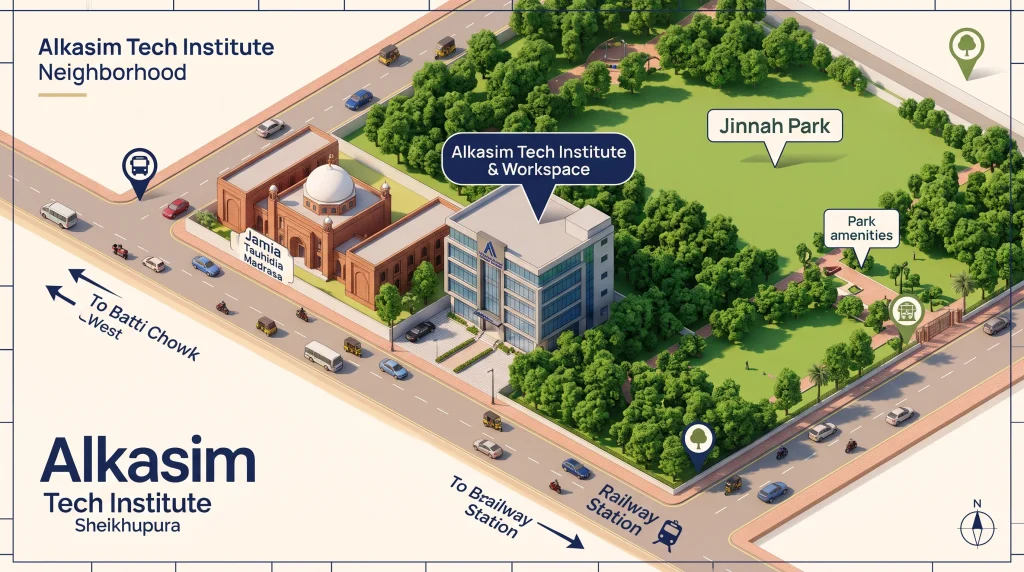
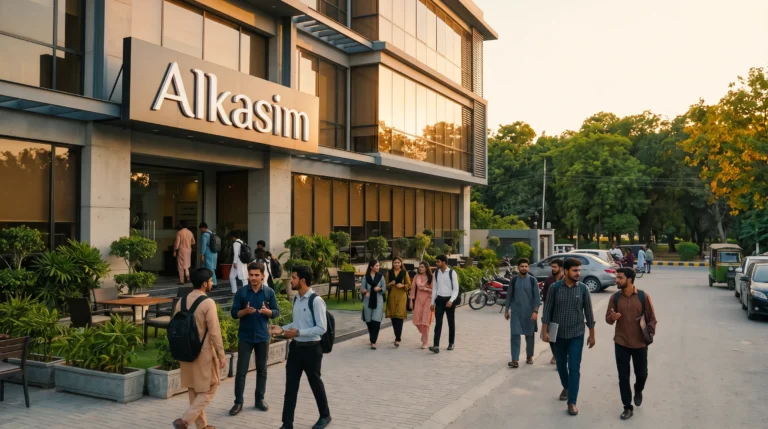
Alkasim’s physical campus is established in the prominent civic district of Jinnah Park, situated directly opposite Jamia Tauhidia Madrasa. This location was deliberately chosen by founder Abdullah Butt to maximize convenience, safety, and transit accessibility for both local Sheikhupura residents and daily commuters traveling from surrounding towns such as Farooqabad, Manawala, Muridke, and Safdarabad.
Official Campus Address and Landmark Identifiers
Address: Alkasim Tech Institute & Workspace, Jinnah Park Commercial Area, opposite Jamia Tauhidia Madrasa, Sheikhupura, Punjab, Pakistan.
Primary Landmarks: Jinnah Park public recreation grounds, Jamia Tauhidia Madrasa Islamic center, and walking distance from the main city transit arteries.
To assist students planning their daily schedules ahead of the January 1, 2027 opening, Alkasim’s administrative office provides the following transit guidance:
Transit Route 1: From Batti Chowk and the Lahore Road Junction: Batti Chowk is the primary traffic hub connecting Sheikhupura with Lahore and Gujranwala. Students arriving by regional bus or van services at Batti Chowk can take a short local auto-rickshaw or taxi heading north toward Jinnah Park, typically arriving in seven to ten minutes under regular traffic conditions.
Transit Route 2: From Sheikhupura Railway Station and Downtown Bazaar: Students commuting via passenger rail services from neighboring rural districts can exit the station and travel east toward the Jinnah Park precinct. The transit time by local motorized transport is approximately eight minutes along paved municipal roads.
Transit Route 3: From Sargodha Road, Housing Colony, and Western Suburbs: Commuters traveling along the Sargodha Road corridor can navigate directly via the Stadium Road arterial connector, entering the Jinnah Park perimeter without needing to navigate the heavier congestion of the old bazaar quarters.
Neighborhood Amenities, Dining, and Student Support Services
Selecting Jinnah Park as the permanent home for Alkasim offers practical everyday advantages that extend beyond the classroom walls:
Spiritual and Prayer Convenience: With Jamia Tauhidia Madrasa located directly opposite the campus, students and faculty enjoy effortless access to clean, serene prayer facilities throughout the academic day, supporting a healthy balance between spiritual obligations and technical study.
Recreational Green Spaces: Intensive software programming and digital creative work require mental breaks to prevent cognitive fatigue. The adjacent public grounds of Jinnah Park offer open lawns, walking paths, and fresh air where students can take short strolls between demanding lecture and laboratory sessions.
Student Dining and Refreshments: The surrounding commercial area features clean local tea houses, fruit juice bars, and economical student cafes offering wholesome meals, allowing commuters to dine comfortably without spending excessive amounts.
Printing, Stationery, and Hardware Outlets: Within a five-minute walk, students have immediate access to computer hardware accessories, printing bureaus, and stationery stores, ensuring that last-minute project submissions and physical documentation needs are handled without delay.
The campus vicinity offers secure parking for student bicycles and motorcycles, well-lit pedestrian pathways, and a calm, academic neighborhood environment. The proximity to Jamia Tauhidia Madrasa provides an unmistakable geographical reference point that simplifies navigation for visitors arriving for the first time.
7. What Should Students Expect from Alkasim’s New Office? The In-Person Learning Experience
Prospective applicants frequently search: what should students expect from Alkasim’s new office? Beyond the physical hardware, furniture, and electrical systems, the primary value of the new campus lies in its pedagogical philosophy. Alkasim was conceived to dismantle the outdated rote-learning structures that have long characterized technical schooling in the region.
When students step onto campus on January 1, 2027, they should expect an educational experience defined by five core attributes:
1. Immersive Practical Application Over Rote Memorization
In many conventional institutions, IT education reduces complex disciplines like programming or digital advertising to theoretical definitions memorized for examinations. At Alkasim, theory serves merely as an introduction to immediate practical execution. Through Alkasim’s practical training framework, students spend the vast majority of classroom hours actively writing code, deploying live servers, analyzing real-time analytics, and building tangible software applications.
2. Direct Mentorship from Experienced Industry Practitioners
Unlike large university lecture halls where professors are physically distant, Alkasim enforces strict seat limitations per classroom cohort. This small-group policy ensures that instructors can circulate through the room, review each student’s screen, identify debugging errors on the spot, and offer tailored guidance. Furthermore, students receive direct mentorship from founder Abdullah Butt, who conducts regular seminars on business negotiation, professional portfolio curation, and client communications.
3. Collaborative Peer Learning and Team Problem Solving
One of the most debilitating aspects of learning technical skills in isolation at home is the lack of peer feedback. When self-directed learners hit an obscure programming bug, they often spend days struggling before giving up in frustration. In Alkasim’s physical environment, students sit alongside peers pursuing the same objectives. Group code reviews, collaborative hackathons, and informal discussions over technical challenges cultivate resilience and accelerate learning velocity.
4. Authentic Commercial Client Simulation and Portfolio Incubation
Classroom assignments at Alkasim are structured around authentic commercial deliverables. Students do not build generic toy websites, but create production-grade web applications, performance-optimized e-commerce stores, and sophisticated marketing funnels designed according to real enterprise specifications. Instructors review pull requests with the same rigor expected by Silicon Valley and European tech startups, helping learners assemble verifiable GitHub repositories and case studies that impress global employers.
5. Moral Integrity and Islamic Commercial Ethics
Reflecting Abdullah Butt’s deeply held commercial philosophy, vocational instruction at Alkasim integrates ethical business practices. Students learn the importance of honest client representation, transparent contract terms, punctuality, and the absolute avoidance of deceitful digital marketing tactics. As emphasized in broader discussions on business mentorship and ethics, technical skill without moral integrity produces short-lived success, whereas ethical competence establishes enduring, multi-year commercial relationships.
8. The Role of Interns at Alkasim: The Bridge Between Vocational Study and Industry Careers
The inclusion of dedicated intern working tables among the five primary facility upgrades underscores Alkasim’s unique dual-mission model: the campus serves simultaneously as an educational academy and a commercial digital agency. In traditional higher education, a steep chasm separates classroom theory from commercial workplace expectations. University graduates often discover that employer hiring managers demand two to three years of verified practical experience, creating a difficult cycle for entry-level candidates.
Alkasim solves this challenge through its structured internship ecosystem. Selected students who demonstrate mastery of core foundational modules are recruited into active internship tracks through Alkasim’s agency incubator.
Within this ecosystem, the role of an intern involves:
Executing Live Commercial Sprints: Interns do not perform menial clerical chores. Instead, they work under the direct supervision of senior engineers and marketers to develop client websites, design user interfaces, optimize search engine listings, and manage paid advertising campaigns.
Mastering Cross-Border Client Communications: Interns gain direct experience with international collaboration platforms, video standups, sprint tracking tools, and client messaging systems, learning how to articulate technical solutions professionally to global enterprise partners.
Peer Mentorship for Junior Cohorts: Because interns share the same campus environment while operating in their dedicated space, they serve as accessible role models for incoming classroom students. A beginner struggling with basic JavaScript syntax can look across to the intern tables and see recent graduates successfully delivering enterprise software, providing tangible motivation and practical advice.
Achieving Commercial Sovereignty and Freelance Success: Interns learn how to navigate platforms like Upwork and LinkedIn, draft accurate scopes of work, quote fair prices, and deliver work that earns five-star client testimonials, positioning them for sustainable freelance careers or agency partnerships.
This operational model supports the broader objective of economic decentralization championed by national development initiatives, including the digital economic programs highlighted by the Punjab Information Technology Board. By cultivating high-value technical and commercial talent directly within Sheikhupura, Alkasim helps stem the loss of talented young professionals to metropolitan hubs and establishes a vibrant local knowledge economy.
9. Pedagogical Modernization: Replacing Rote Instruction with Interactive Visual Projection
A central reason behind the schedule extension is the installation and fine-tuning of Alkasim’s visual instructional infrastructure. For decades, technical education throughout Punjab has suffered from a reliance on rote memorization. Students in conventional computer academies are frequently instructed to copy software code from textbooks onto lined notebook paper, memorizing function definitions without ever seeing how those functions interact inside an active operating system or browser engine.
This archaic approach fails because modern computing is inherently dynamic, visual, and interactive. A software bug does not announce itself as a neat typographical error on a printed page, but as a cryptic trace message in a terminal window, a failed network handshake in an application programming interface, or a broken visual component in a cascading stylesheet.
By equipping classrooms with high-lumen digital video projectors and large-format commercial LED displays, Alkasim transforms the instructional paradigm in three critical ways:
Interactive Debugging Sessions: When an instructor writes code on screen, errors inevitably occur as part of natural software development. Rather than concealing these hiccups, the instructor demonstrates live debugging right before the class. Students witness how senior developers inspect stack traces, evaluate variable scopes, consult official documentation, and methodically resolve bugs in real time.
Real-World Digital Advertising Audits: In performance marketing modules taught through Alkasim’s digital marketing curriculum, students observe active ad managers, live keyword bids, cost-per-click metrics, and conversion tracking pixels. Seeing real campaign data projected across a large screen demystifies commercial marketing analytics far more effectively than static slide decks.
Student Code Projection and Peer Reviews: Classrooms are configured so that students can connect their own laptops directly to the display systems. Presenting code to peers and receiving constructive feedback mirrors the agile standup meetings and sprint reviews conducted by world-class software engineering teams, building professional poise and communication clarity.
This high-engagement pedagogical model justifies the brief postponement required to mount, wire, and calibrate these sophisticated display systems before the January 1, 2027 opening.
10. Technological Resilience: Why Uninterrupted Power Is Essential for IT Training
In modern digital industry, electrical reliability is not a luxury, but an absolute foundational requirement. Sheikhupura is an important manufacturing and agricultural processing center, which frequently places heavy strain on the regional electrical grid. During peak load seasons, municipal feeder lines can experience sudden brownouts, voltage spikes, and scheduled load shedding.
For an institution providing advanced IT education, unbuffered power loss produces severe consequences:
Loss of Code and Database Corruption: Software developers working on local database migrations or compiling complex container environments risk severe data corruption if their machines lose power mid-write. Recovering corrupted files can consume hours of valuable lab time.
Interrupted Client Sprints for Interns: Interns managing active agency accounts cannot afford to have live video conferences with overseas clients terminated abruptly by an unexpected power cut. Reliability is the cornerstone of commercial credibility in the global digital economy.
Classroom Disruption and Cognitive Fatigue: When a lecture hall suddenly plunges into darkness, educational momentum evaporates. Re-establishing classroom focus after a power outage wastes twenty to thirty minutes of precious instructional time.
Hardware Protection for High-Compute Rigs: Modern machine learning experiments, video rendering pipelines, and graphical layout rendering draw significant instantaneous power. Standard domestic inverters collapse under such inductive loads. Industrial-grade online UPS units ensure that power factor corrections and pure sine waves are maintained at all times.
To insulate students, teachers, and interns from these vulnerabilities, Alkasim has invested heavily in an industrial-grade dual electrical backup architecture. The setup pairs an uninterruptible power supply (UPS) unit with a dedicated bank of deep-cycle inverter storage batteries.
This electrical infrastructure provides instantaneous changeover, meaning that computers, routers, and ceiling projection units experience zero voltage dips during grid failures. Students can continue typing, compiling, and testing without even noticing that the municipal power source has disconnected.
11. Leadership Profile: Abdullah Butt’s Vision for Alkasim and Sheikhupura’s Youth
Any comprehensive analysis of Alkasim’s institutional identity must highlight its founder and principal director, Abdullah Butt. A respected educator, academic lecturer in business administration literature, and commercial mentor in Sheikhupura, Abdullah Butt has spent years advocating for practical educational reform across Punjab.
Abdullah Butt’s educational philosophy is grounded in a conviction that talent is evenly distributed across geographical regions, but opportunity has historically been concentrated in provincial capitals. Aspiring youth in secondary cities like Sheikhupura, Gujranwala, and Kasur frequently face a painful dilemma: either endure grueling daily commutes to Lahore to access reputable IT academies, or settle for substandard local computer tuition centers that offer little more than outdated software primers.
Through Alkasim, Abdullah Butt seeks to establish a premier center of technical excellence in Sheikhupura that rivals the best facilities in Lahore. His leadership during the postponement decision exemplifies this long-term commitment. Rather than rushing an incomplete center into operation on November 1 to satisfy short-term public relations goals, he took personal responsibility for extending the opening date to January 1, 2027.
In addressing prospective students, Abdullah Butt emphasized:
“Our students deserve an environment that respects their aspirations. When a young person enters Alkasim, they are not simply attending a computer class; they are entering a professional community where they will build their livelihood. We refused to welcome our first cohort into an incomplete space with makeshift seating and unreliable power. Taking these additional eight weeks allows us to deliver the complete, world-class physical institute that the youth of Sheikhupura truly deserve.”
Abdullah Butt
Founder and Principal Director, Alkasim
His vision extends beyond technical instruction to include moral and economic empowerment. By teaching students to run legitimate online businesses through Alkasim’s entrepreneurship mentorship, Abdullah Butt equips young people to generate foreign exchange, support their households, and contribute meaningfully to Pakistan’s emerging digital economy.
12. Roadmap to January 1, 2027: Construction, Testing, and Onboarding Milestones
To ensure complete institutional transparency, Alkasim’s administrative office has published its operational roadmap for the remaining weeks of November and December 2026. This schedule outlines the precise developmental phases leading to the grand public opening on New Year’s Day 2027:
Calendar Phase
Operational Target
Key Deliverables and Construction Activities
Mid-November 2026
Civil and Electrical Fit-Out
Completion of interior drywall partitions, acoustic ceiling baffling, high-grade floor tiling, and initial electrical conduit routing.
Late November 2026
Ergonomic Furniture Assembly
Delivery and installation of custom intern working tables, modular student desks, ergonomic chairs, and faculty workstations.
Early December 2026
Audio-Visual and Backup Integration
Mounting of ceiling video projectors, installation of commercial LED wall displays, and wiring of the online UPS battery inverter systems.
Mid-December 2026
Hardware and Software Stress Testing
Installation of operating systems, development toolchains, design suites, and local area network load testing under simulated peak load.
Late December 2026
Final Walkthrough and Orientation Prep
Deep facility cleaning, air quality ventilation, student registration verification, and faculty curriculum briefing sessions.
January 1, 2027
Official Public Opening
Ceremonial ribbon-cutting, campus tours for enrolled students and parents, initial cohort orientation seminars, and commencement of lab sessions.
Each milestone is monitored by dedicated project managers to guarantee that no phase is overlooked. By establishing this clear schedule, Alkasim provides students and the wider Sheikhupura community with complete confidence that January 1, 2027, represents a firm, meticulously prepared launch date.
13. Student Action Plan: How Prospective Learners Can Prepare During the Interim
Rather than regarding the eight-week postponement as idle waiting time, prospective students are strongly encouraged to treat this interim as a strategic preparation period. In technical fields, foundational preparation significantly enhances classroom comprehension and accelerates initial progress once formal instruction begins.
Alkasim’s instructional faculty recommends the following comprehensive action plan for prospective students during November and December:
Master Touch-Typing and Essential Keyboard Fluency: Typing speed and keyboard navigation are the fundamental physical mechanics of coding and digital work. Students who can touch-type at 45 to 60 words per minute spend their mental energy thinking about logic and structure rather than searching for keys on a keyboard. Free online typing tutors provide an excellent medium for practice during November.
Install and Explore Core Developer Tools: Ahead of January 1, students should install industry-standard software environments on their personal machines. Recommended tools include Visual Studio Code, Git version control, Google Chrome with developer tools enabled, and collaborative design applications like Figma. Familiarizing yourself with these basic interfaces ensures a smooth classroom experience.
Review Introductory Syllabi on the Official Website: Prospective students should explore the curriculum outlines available on Alkasim’s official course portal. Reviewing introductory concepts in programming fundamentals, website architecture, or digital marketing terminology beforehand will make classroom lectures significantly easier to digest.
Conduct a Familiarization Transit Visit to Jinnah Park: Before the opening day, take a trip to the Jinnah Park area in Sheikhupura. Locate the campus directly opposite Jamia Tauhidia Madrasa, test your commute options from your home or hostel, and identify nearby public transport stops. Familiarity with the route eliminates morning stress on opening day.
Prepare and Optimize Personal Computing Equipment: If you plan to bring your own personal laptop to lab sessions, ensure that the operating system is clean, storage drives are defragmented, and essential productivity tools are updated. Having a dependable laptop ready saves valuable hours during the first week of classes.
Monitor Verified Institutional Channels for Updates: Avoid relying on unverified social media commentary or third-party message boards. Official enrollment schedules, orientation timetables, and administrative bulletins are published exclusively through Alkasim’s official contact and news channels.
By implementing these proactive steps, students will enter the Jinnah Park campus on January 1, 2027, with confidence, clarity, and an undeniable competitive edge.
To provide immediate clarity for prospective students, parents, and community members, Alkasim’s editorial team has compiled direct answers to the most common conversational search queries and administrative inquiries regarding the physical campus.
Official administrative clarifications regarding the physical campus opening schedule, facilities, and academic programs.
When will Alkasim open its physical office?▼
Alkasim will officially open its physical office on January 1, 2027. The campus is located at Jinnah Park, situated directly opposite Jamia Tauhidia Madrasa, in Sheikhupura, Punjab, Pakistan. The launch date coincides with New Year’s Day, marking the beginning of the inaugural in-person academic cohort.
Why was Alkasim’s November 1 opening postponed?▼
The November 1, 2026 opening was postponed due to a combination of unexpected staff-related delays in interior renovation, essential personal commitments managed by founder Abdullah Butt, and an administrative decision to ensure that all five promised student facilities, including dedicated classrooms, intern tables, LED visual displays, and uninterruptible power backup systems, are fully operational before welcoming learners.
What caused the change in Alkasim’s office launch schedule?▼
The change in schedule was caused by an on-site quality audit conducted in late October 2026. The audit determined that opening on the original date would force students to learn amid incomplete construction and temporary furniture. Rather than delivering a substandard experience, management chose to adjust the schedule to allow eight additional weeks for complete, professional finishing.
Why did Alkasim extend its physical office opening date from November 1 to January 1, 2027?▼
Alkasim extended the opening date from November 1 to January 1, 2027, to guarantee that every student, instructor, and intern enters a safe, fully equipped, and acoustically sound environment. The extension enables the installation of dedicated intern working tables, high-definition projection displays, and industrial UPS battery backup systems, preventing disruptive technical interruptions once classes begin.
Now Alkasim physical office opening date is 1 January 2027 and why?▼
The opening date is now confirmed for 1 January 2027 because Alkasim is finalizing an extensive five-pillar facility upgrade. This includes separate seating zones for students, teachers, and interns, dedicated lecture and practical training classrooms, large-format LED displays for interactive code reviews, specialized working tables for commercial agency interns, and industrial-grade electrical backup infrastructure to counter regional load shedding.
Alkasim office opening postponed to January 2027 and why?▼
The opening was postponed to January 2027 because founder Abdullah Butt and institute leadership firmly refused to hold a superficial opening with incomplete facilities. The additional time guarantees that the physical campus meets high standards of ergonomic comfort, instructional technology, and uninterrupted electrical reliability.
Alkasim Sheikhupura office opening update: Where is the office located?▼
The physical institute is located in the Jinnah Park commercial district of Sheikhupura, Punjab, directly opposite Jamia Tauhidia Madrasa. It is easily accessible via short auto-rickshaw or taxi rides from major transportation junctions, including Batti Chowk on Lahore Road and the Sheikhupura Railway Station.
What should students expect from Alkasim’s new office?▼
Students should expect a modern, agency-grade learning facility featuring small cohort sizes, direct in-person mentorship from Abdullah Butt and experienced instructors, hands-on practical project development rather than rote book memorization, collaborative peer hackathons, and a clear path toward professional agency internships.
Has Alkasim canceled its physical office launch?▼
No, the physical office launch has definitely not been canceled. The campus is actively undergoing structural finishing, electrical wiring, and furniture installation. The opening has simply been rescheduled to January 1, 2027, to ensure a flawless student experience.
What specific facilities are being prepared for interns at Alkasim?▼
Interns are receiving custom-built collaborative working tables equipped with integrated desktop power receptacles, support for multi-monitor workstations, high-speed fiber-optic connectivity, and a dedicated agency zone physically separate from introductory student classrooms.
How will Alkasim handle power cuts and electrical load-shedding?▼
The campus is equipped with an industrial-grade dual electrical backup system consisting of an online uninterruptible power supply (UPS) and a heavy-duty battery inverter array. The system provides instantaneous zero-millisecond transfer during grid outages, ensuring continuous operation of computers, servers, projectors, and lighting.
Who is leading the preparation of Alkasim’s physical office?▼
The project is led by Abdullah Butt, the founder and principal director of Alkasim. He is an experienced business mentor, academic lecturer in BBA literature and marketing, and an advocate of ethical commerce and youth empowerment in Sheikhupura.
How can prospective students apply for the January 1, 2027 batch?▼
Prospective students can review course offerings and submit preliminary registration inquiries through the official Alkasim course catalog or by reaching out to the admissions office via the official contact portal. Due to classroom space limitations, early application is strongly recommended.
Will online classes and student mentorship continue during November and December?▼
Yes, all existing online learning cohorts, remote mentorship sessions, and digital business consulting operations continue normally without interruption. The physical facility postponement affects only the opening of the physical campus building.
15. Conclusion: A Strategic Step Toward Educational Excellence in Sheikhupura
In the development of any lasting educational institution, integrity and quality must always take precedence over speed. While the postponement of Alkasim’s physical office opening from November 1, 2026, to January 1, 2027, caused initial curiosity, the underlying reasons demonstrate a profound dedication to student success. Rather than opening prematurely with unfinished rooms and improvised amenities, Alkasim has chosen to invest the necessary time and resources into constructing a premier technical training and internship hub.
When the doors at Jinnah Park officially open on January 1, 2027, students, teachers, and interns will enter a facility specifically tailored to their professional growth. From dedicated, ergonomically separated seating zones and specialized lecture classrooms to dynamic LED visual displays, dedicated agency intern workstations, and resilient power backup systems, every aspect of the campus has been engineered to foster focus, creativity, and career success.
Under the leadership of Abdullah Butt, Alkasim is not merely opening an office; it is establishing a permanent home for digital innovation and youth entrepreneurship in Sheikhupura. By bridging the gap between theoretical schooling and real-world commercial execution, the institute empowers young men and women to master valuable digital skills, secure high-paying remote careers, and lead with moral integrity in the global economy.
We invite students, parents, and community partners to look forward to January 1, 2027, with excitement and anticipation. The future of practical IT education in Sheikhupura begins on New Year’s Day, and Alkasim is preparing every detail to ensure that beginning is nothing short of extraordinary.
Alkasim Research & Advisory Editorial Board
In Association with Abdullah Butt, Founder of Alkasim
Published on November 3, 2026. For official inquiries, syllabus verifications, or campus tour reservations, visit alkasim.pro/contact.
Written by Noor Fatima
Editorial Contributor & Academic Specialist
Dedicated author and researcher writing about education standards, student facilitation, academic updates, and institutional development.