
Introduction: The Big Curiosity in Sheikhupura’s Educational Community
Across the bustling commercial avenues and quiet residential neighborhoods of Sheikhupura, an important conversation has been taking place among matriculation graduates, college students, university alumni, and concerned parents. In a city recognized across Pakistan for its industrious spirit, manufacturing power, and rapid growth, young people are searching for a reliable pathway into the digital economy. They want to master programming, explore modern web development, and build successful careers in software engineering or international freelancing.
When students begin searching for computer academies and vocational training centres in Sheikhupura, they typically encounter a familiar routine. They visit local institutes, collect printed brochures, listen to standardized marketing presentations, and examine fee cards that demand tens of thousands of rupees for short, introductory courses. For many working-class families and ambitious young learners, these hefty monthly fees present a serious financial hurdle.
Then, word begins to spread about Alkasim.
Prospective students walk through the doors of Alkasim or visit the official website at https://alkasim.pro/ and discover something that surprises them: Alkasim offers comprehensive, professional courses at approximately 50% lower fees than other institutes in Sheikhupura.
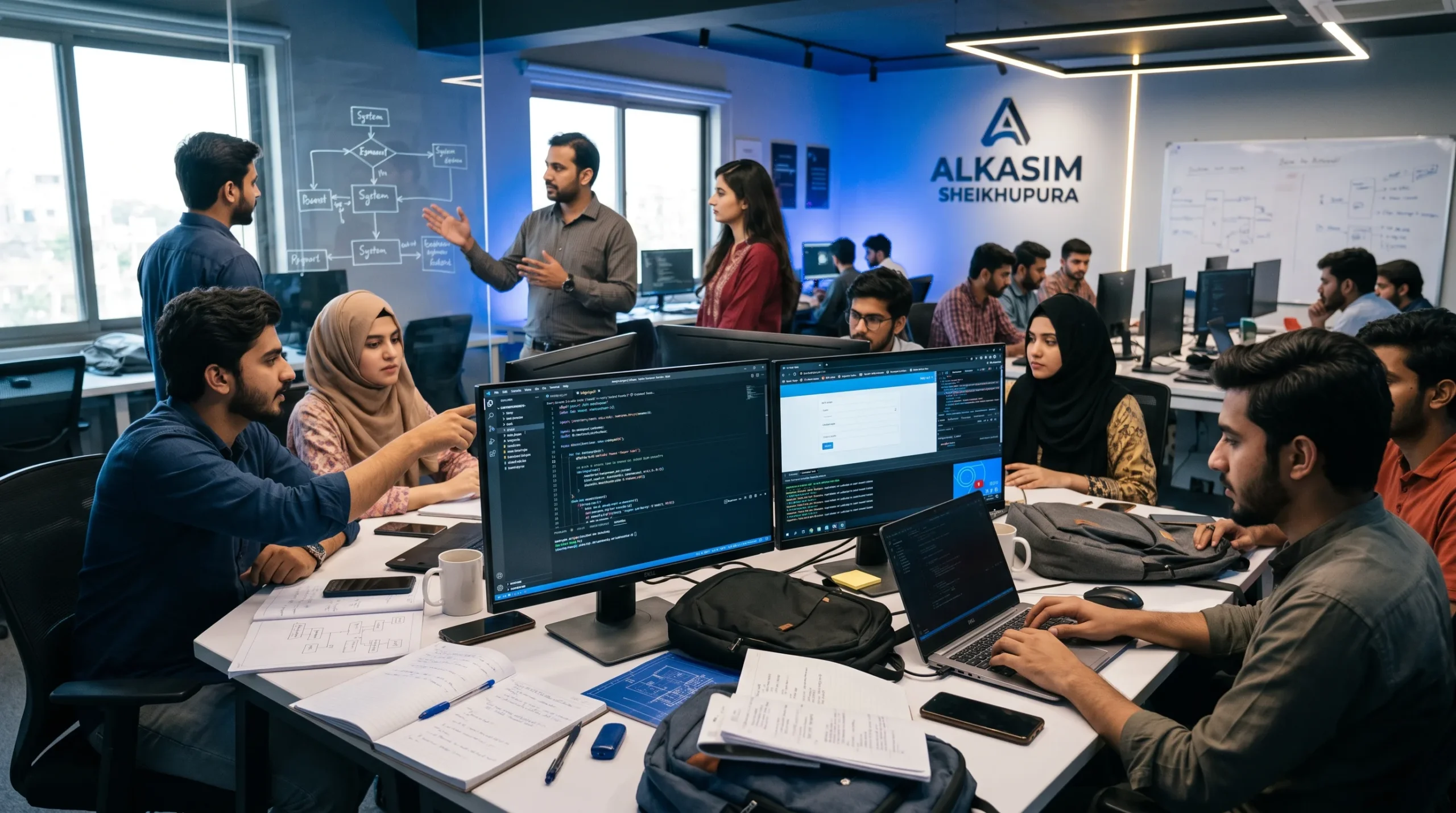
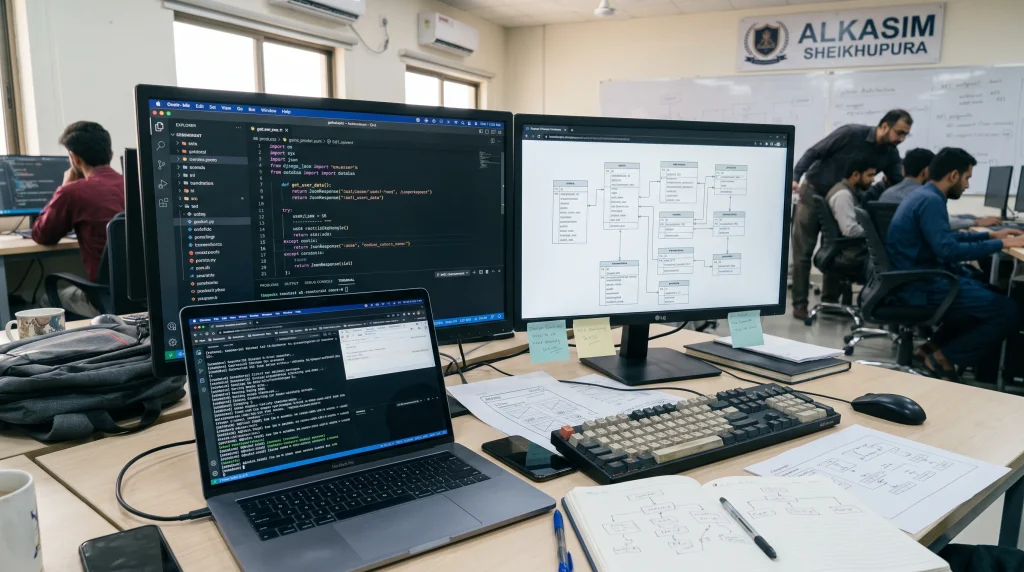
Naturally, this price difference sparks immense curiosity, along with understandable skepticism. In the educational sector of Pakistan, people often assume that a lower price must mean inferior quality, unqualified instructors, cramped facilities, or outdated curriculum. Yet when people look closer at Alkasim, they observe modern development setups, active software mentorship, access to paid commercial software tools, and senior developers guiding students through real technical challenges.
This brings forward the central question that every student, parent, and local educator in Sheikhupura eventually asks:
The Fundamental Question Facing Alkasim
“If Alkasim offers professional courses at approximately 50% lower fees than other institutes in Sheikhupura, how does it earn money, manage its day-to-day operations, and maintain high training standards without operating at a continuous loss?”
This question is not just a passing query about pricing. It touches the very foundation of how technical education should function in a modern society. The purpose of this comprehensive article is to provide a complete, transparent, and factual answer to that question. By exploring the real story behind Alkasim, its distinct philosophy, its revenue-generating software projects, and its commitment to student welfare, we will explain why Alkasim has chosen an entirely different path from conventional educational institutes in Sheikhupura.
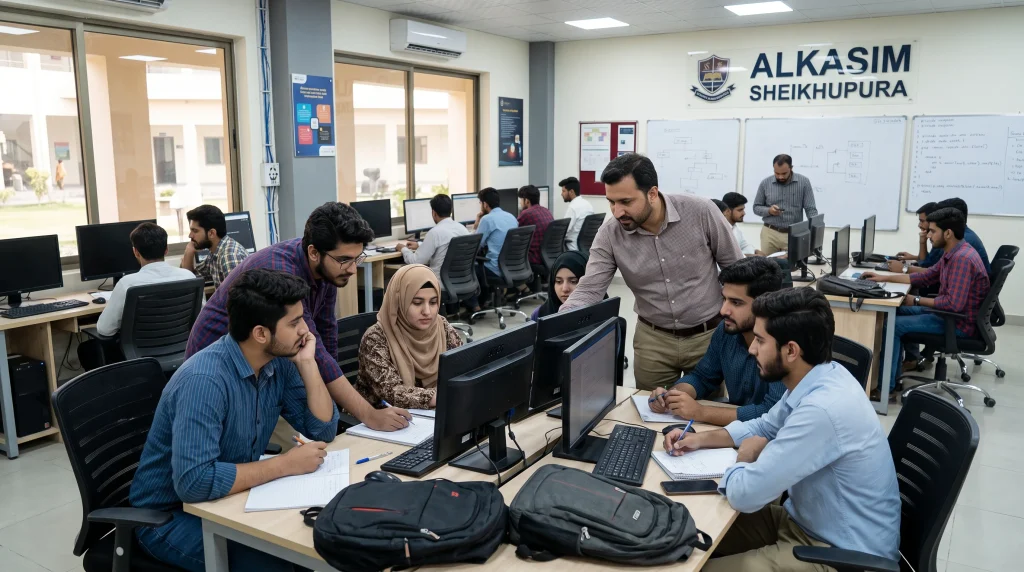
Why Is Alkasim Different from Other Institutes in Sheikhupura?
Direct Answer: In everyday local terms, people often ask in Punjabi and Urdu: “Alkasim Puray Sheikhupura May Other Institute Sy Kyun Different Ha?” Translated into clear English, the answer is straightforward: Alkasim is different because it is not merely a classroom-based computer academy that survives by extracting high course fees from students. Instead, Alkasim operates as an active software development and digital services initiative. While conventional institutes rely almost entirely on student fees to generate institutional profit, Alkasim generates its primary revenue by securing and delivering real-world software, web development, and freelancing projects to paying commercial clients.
To understand why this fundamental distinction matters so profoundly to young learners in Sheikhupura, one must first examine the environment in which most local computer training academies operate.
In a standard educational institute, the student is treated primarily as a commercial consumer. The academy rents a commercial building, purchases a few dozen computers, prints glossy advertisements, and creates an enticing course catalog. To cover high building rents, administrative salaries, electric bills, and significant promotional expenses, while still delivering a profit to the owners, the academy must charge students substantial monthly fees. The financial health of the academy depends entirely on how many students it can enroll each month.
Alkasim was founded on an entirely different philosophy. Rather than building a business around collecting tuition fees, Alkasim created an integrated model that unites practical software development with professional education.
Commercial Project Foundation
Alkasim actively engages in the commercial software market. By building live systems, crafting websites, and undertaking international freelancing contracts, Alkasim establishes a self-sustaining revenue stream independent of student fee collections.
Apprenticeship Over Lecture Rooms
Instead of listening to purely academic lectures from teachers who only read from textbooks, students at Alkasim learn inside an active development ecosystem. They witness how real software is conceptualized, architected, debugged, and delivered to paying clients.
Reinvestment in Students
Because Alkasim does not rely on student fees for company profits, the money collected from students is reinvested directly into their learning experience: paying dedicated teachers and purchasing commercial, paid tools that students use without extra charges.
When students in Sheikhupura compare this approach to the conventional academies around them, the contrast becomes immediately apparent. At Alkasim, education is not an abstract theory separated from the real world; it is a practical apprenticeship that prepares learners to enter the real market as competent, confident contributors.
The Big Question: How Does Alkasim Earn While Offering Affordable Courses?
When a student or parent hears that Alkasim charges approximately 50% lower fees than other institutes in Sheikhupura, the immediate reaction is often disbelief. People ask: “How can any institute maintain a physical campus, power desktop workstations, run air conditioning during intense Punjabi summers, pay high-speed broadband bills, and hire senior developers while charging only half the prevailing market rate?”
The answer lies in understanding the difference between a fee-dependent business model and a service-supported educational model.
Consider how a traditional computer institute survives financially. Its entire income statement looks like this:
Every expense—from building rent and electricity to owner profits and marketing campaigns—must be squeezed out of that single equation. If enrollment drops, the institute faces a crisis, prompting them to either raise fees or compromise on teaching quality.
Because the traditional institute relies 100% on student tuition fees, it has no choice but to keep those fees as high as the local market will tolerate. Furthermore, to maximize profit, the owners are often incentivized to cut instructional costs: hiring inexperienced junior instructors who accept low wages, refusing to purchase legal software licenses, and packing twenty or thirty students into crowded time slots.
Now consider Alkasim’s operational architecture. Alkasim does not view the classroom as its primary profit centre. Instead, Alkasim operates with a dual-engine model:
Client Projects & Software Services
Alkasim secures real software development contracts, web development projects, and freelancing assignments from local businesses in Sheikhupura and international clients abroad. This commercial work generates the main revenue that sustains the organization.
Affordable Training & Mentorship
Because institutional overhead is supported by commercial software earnings, Alkasim can reduce course fees by approximately 50%. This makes high-quality technical education accessible to talented students regardless of their financial background.
By decoupling the institute’s survival from student tuition fees, Alkasim solves an educational dilemma that has plagued Pakistani vocational training for decades. Students no longer have to bear the financial burden of the institute’s commercial profits. Instead, they enjoy an accessible, dignified learning environment funded by genuine technological productivity.
Understanding Alkasim’s Course Fee Model
To appreciate why Alkasim’s pricing strategy is both ethical and practical, it is helpful to look closely at the socio-economic reality of Sheikhupura.
Sheikhupura is a city filled with bright, ambitious, and hardworking young people. Many are the sons and daughters of factory workers, small shopkeepers, farmers from neighboring rural areas, and modest civil servants. These young men and women possess exceptional problem-solving intuition and a strong desire to build careers in information technology. However, when an institute demands a tuition fee of 15,000 or 25,000 PKR per month, many families simply cannot afford it without taking on high-interest loans or sacrificing household necessities.
Alkasim recognized this barrier early on. If Pakistan is to produce a generation of capable software developers, computer education cannot remain a luxury reserved exclusively for wealthy households. It must be accessible to anyone willing to work hard, practice diligently, and master the craft of programming.
By cutting course fees by approximately 50% compared to typical institutes in Sheikhupura, Alkasim achieves several vital objectives:
- Democratizing Technical Education: Talented students who were previously locked out of professional computer education due to high costs can now enroll and master modern programming skills.
- Encouraging Long-Term Commitment: Learning to code is not an overnight task; it requires months of sustained practice. When courses are affordable, students can continue their studies without being forced to drop out halfway through due to fee pressures.
- Cultivating an Inclusive Talent Pool: A broader, more diverse group of students enters the classroom, creating a vibrant learning culture where peer collaboration, problem-solving, and healthy intellectual competition flourish.
- Aligning Educational Goals with Integrity: The institute never treats students as revenue targets to be upsold on unnecessary certifications. The focus remains squarely on skill acquisition and competence.
Alkasim’s affordable fee structure is not a short-term promotional gimmick or an introductory marketing discount that will suddenly double after a few months. It is an intentional, foundational pillar of Alkasim’s operating philosophy, designed to ensure that quality education remains within reach of every ambitious mind in Sheikhupura.
How Student Fees Are Used for Learning Resources and Teachers
One of the most remarkable and transparent aspects of the model described by Alkasim is the way collected student fees are utilized.
In a typical computer academy, a substantial portion of student fees goes straight into the owner’s private bank account as net profit, or into expensive marketing campaigns designed to recruit the next batch of students. In contrast, according to the facts of the story, Alkasim does not retain the fees collected from students as its own institutional profit.
Instead, every rupee collected from students is reinvested directly back into the educational ecosystem through two vital channels:
1. Direct Distribution to Teachers & Mentors
The collected course fees are distributed among the teachers working at Alkasim rather than being held as corporate profit. This approach ensures that instructors are fairly compensated for their dedication, time, and classroom instruction.
In many conventional institutes, teachers are treated as poorly paid hourly workers while the owners capture the lion’s share of tuition fees. At Alkasim, instructors know that their hard work is directly recognized. This creates strong motivation, fosters genuine personal interest in student progress, and ensures that teachers view their role not as a mere job, but as an honorable mission of mentorship.
2. Purchasing Paid Professional Tools & Resources
Modern software development requires professional tools: commercial code editors, cloud server environments, premium API access, database testing suites, and specialized development libraries. In conventional academies, students are routinely told to use pirated software, cracked utilities, or severely restricted free trials.
Alkasim uses the fees collected from students to purchase legitimate, paid tools and learning resources that students require during their coursework. These resources are provided to enrolled students completely free of additional charges. Students never face unexpected lab fees, tool surcharges, or software license requests.
This reinvestment model establishes a clean, ethical cycle of education. When students pay their modest course fee, they have the confidence of knowing that their money is directly supporting the instructor standing in front of them and funding the professional tools right on their computer screens. Nothing is diverted to corporate enrichment. This open, student-first approach is one of the key reasons why Alkasim has earned widespread respect and trust across Sheikhupura.
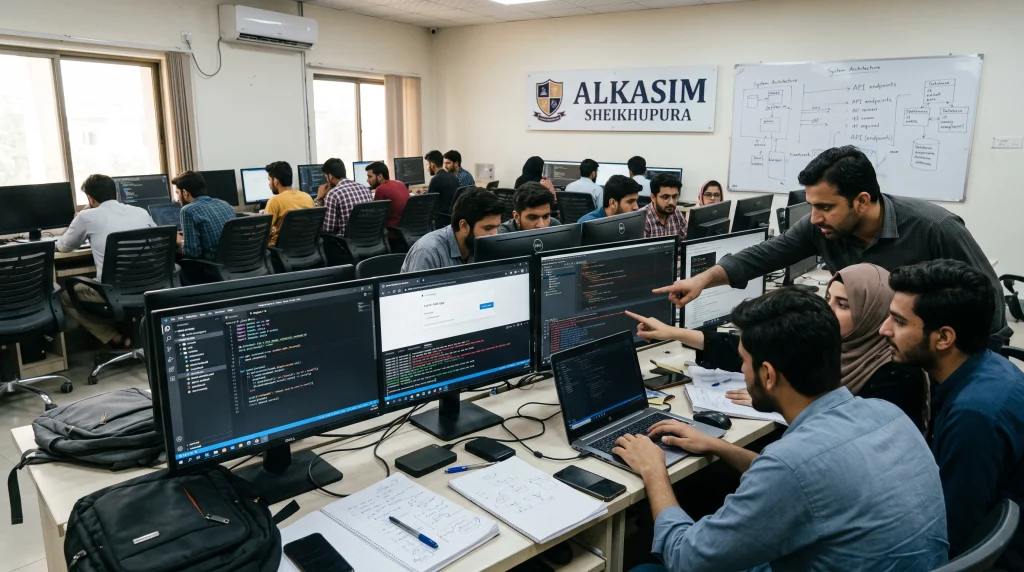
What Is the Main Source of Income of Alkasim?
Direct Answer: The main source of income of Alkasim is not student tuition fees. According to the operational model described by Alkasim, its primary revenue is generated through four commercial technological activities: (1) live project hunting and acquiring client contracts, (2) professional freelancing services on international and regional platforms, (3) commercial website development, and (4) custom software development and related technical services for businesses.
This revenue structure is the cornerstone of everything Alkasim stands for. While conventional academies view students as their sole economic lifeline, Alkasim operates as an active software agency and digital solutions provider. Revenue is earned by building functional, high-value digital products that solve real problems for commercial clients.
Let us examine each of these four core income streams in detail to understand how they work together to power the organization:
Live Project Hunting & Local Client Acquisition
Across Sheikhupura and neighboring districts of Punjab, thousands of small and medium-sized enterprises—retail shops, salons, wholesale dealers, clinics, schools, and private transport firms—continue to manage their businesses using paper notebooks, handwritten receipts, and manual ledgers. Alkasim actively seeks out these businesses, analyzes their operational bottlenecks, and offers custom digital software tailored specifically to their day-to-day operations.
These commercial software contracts represent substantial, direct revenue. Businesses gladly pay for software that saves them time, prevents inventory loss, tracks daily cash flow, and eliminates billing errors.
Professional Freelancing Services
The digital economy is truly global. Through major international freelancing marketplaces such as Upwork, Fiverr, and direct business connections, Alkasim’s senior technical contributors undertake complex software engineering, automation scripts, backend database management, and custom coding assignments for international clients.
By exporting technological services to clients across North America, Europe, the Middle East, and other regions, Alkasim brings foreign earnings directly into Sheikhupura. This global freelance income provides strong financial stability independent of local market fluctuations.
Commercial Website Development
In the modern business era, an organization without a professional website is virtually invisible. Alkasim designs, codes, deploys, and maintains modern, responsive web applications for commercial clients.
These projects range from dynamic corporate portals and e-commerce storefronts to secure customer registration systems and web-based administrative dashboards. Website development contracts generate both upfront project delivery fees and recurring revenue through ongoing maintenance, technical updates, and hosting management.
Custom Software & Technical Services
Many enterprises require specialized software tools that cannot be purchased as off-the-shelf products. Alkasim develops tailored desktop applications, cloud-connected databases, inventory tracking tools, and Point of Sale (POS) systems engineered specifically around the unique workflows of individual businesses.
Delivering end-to-end technical services—from initial requirement gathering and system architecture to deployment, user training, and long-term technical support—creates a reliable, professional revenue stream based on delivered value.
It is vital to understand that this project revenue is earned through professional services delivered to clients, not automatically through course enrollment. Students do not fund the company’s expansion; successful software projects fund it. This healthy separation allows the educational side of Alkasim to remain focused on its core mission: delivering affordable, high-quality instruction.
How Live Project Hunting Works: From Problem to Production
The phrase “live project hunting” might sound technical or unfamiliar to an average reader, but its underlying concept is grounded in everyday commercial common sense. In simple terms, live project hunting is the systematic process of finding businesses that have operational problems and solving those problems by building custom software.
In a developing industrial city like Sheikhupura, business owners face daily headaches. A retail store manager spends hours every evening counting physical stock to find out what sold during the day. A busy salon loses track of client appointments and struggles to calculate staff commissions accurately. A wholesale distributor misplaces paper invoices and experiences cash flow discrepancies.
Alkasim’s live project hunting methodology follows a disciplined, step-by-step cycle that transforms these everyday frustrations into successful software contracts:
Market Research & Problem Identification
The process begins by observing local industries, service businesses, and commercial hubs in Sheikhupura. The team identifies sectors where manual record-keeping is causing financial loss, customer delays, or operational stress.
Consultative Discovery with Business Owners
Rather than pushing generic, one-size-fits-all software, the team visits the business owner and conducts a consultative discussion. They ask practical questions: How do you record daily sales? How do you track staff performance? Where do errors most frequently happen? What reports do you need at the end of each month?
System Architecture & Requirement Specification
Once the business owner’s pain points are thoroughly understood, senior developers translate those real-world needs into technical specifications: database schemas, user permission levels, transaction workflows, and interface wireframes.
Iterative Development & Internal Quality Testing
The development team writes clean, modular, and maintainable code. The software undergoes rigorous internal testing to ensure that calculations are accurate, edge cases (such as refunds or duplicate entries) are handled gracefully, and the system performs reliably under heavy daily use.
Deployment, Staff Onboarding & On-Site Support
The completed system is installed on the client’s premises or hosted on a secure cloud server. The team trains the client’s staff, monitors real-time operations during the initial launch, and provides prompt on-ground support whenever questions arise.
When students at Alkasim see this workflow unfold in real time, software development ceases to be an abstract academic subject. They see that software is a living tool created to solve real human problems, create commercial value, and generate legitimate enterprise revenue.
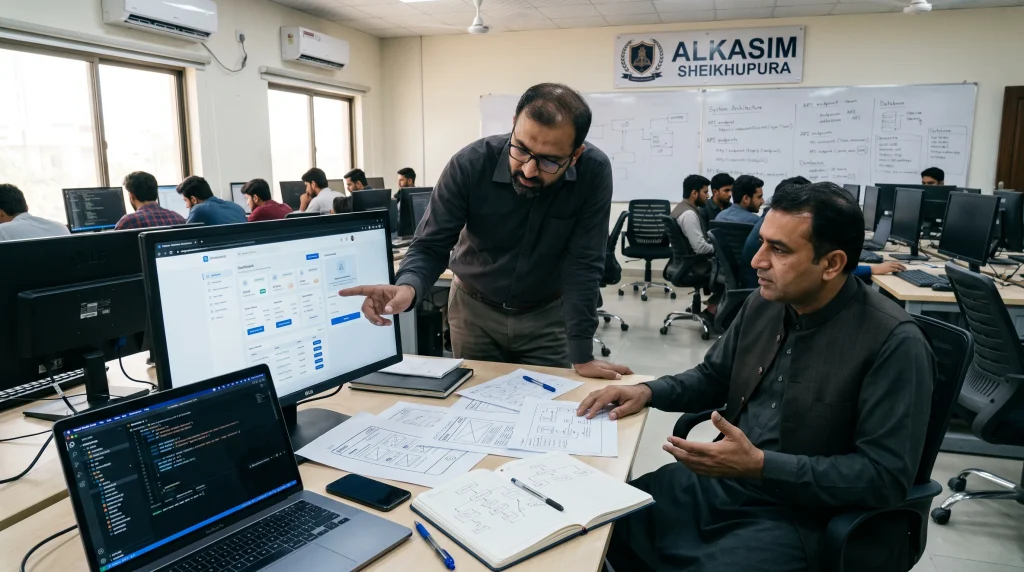
The Role of Freelancing and Commercial Web Development
While local projects in Sheikhupura provide an immediate, tangible testing ground, Alkasim also maintains an active footprint in the broader freelancing and web development marketplace.
Pakistan is currently ranked among the top countries globally in terms of freelance workforce volume. However, there is a painful paradox inside this statistic. Thousands of young Pakistani students create profiles on freelancing websites every year, yet the vast majority never win a single contract. Why does this happen?
The reason is simple: most students have only been taught basic, generic concepts in classroom academies. When an international client on Upwork posts a project requirement such as integrating a payment gateway, debugging a broken database query, or creating an automated Python data pipeline the average academy graduate has no idea how to proceed. They have never interacted with a real client, never worked with a live API, and never managed version-controlled repositories.
At Alkasim, commercial freelancing is not treated as a theoretical topic discussed in a single weekend seminar. It is an active business operation that directly informs the educational curriculum:
Commercial Web Engineering
Building modern websites requires far more than basic HTML and CSS styling. Alkasim takes on commercial web projects that require full-stack capabilities: dynamic backend logic, secure user authentication, database normalization, fast page load speeds, and mobile-first responsive design.
By delivering these projects to clients, Alkasim continuously tests its technical knowledge against international web standards. Students observe the exact technologies, development frameworks, and deployment workflows currently demanded by commercial businesses.
Active Freelance Execution
Alkasim’s senior developers regularly navigate international client communications, proposal writing, scope management, milestone setting, and deadline delivery.
Students learn how to interpret ambiguous client briefs, ask clarifying questions, estimate project timelines realistically, and present deliverables professionally. This real-world exposure demystifies freelancing, transforming it from a distant dream into an attainable, structured career path.
Because Alkasim generates active revenue from these international and domestic services, the institute remains financially healthy and resilient. More importantly, the classroom lessons are never outdated; they evolve continuously in response to real commercial market forces.
Bridging the Divide: How Alkasim Connects Education with Real Client Work
One of the greatest tragedies of modern technical education in Pakistan is the artificial separation between the classroom and the workplace. A student can spend six months in a typical computer institute, pass every exam with high marks, receive a colorful certificate, and yet be completely unable to write a useful program on their first day at an actual software company.
This happens because conventional institutes teach coding as an academic ritual rather than a practical craft. Students are asked to write toy programs: printing a pattern of stars on the screen, calculating the factorial of a number, or building a static website about their favorite hobby. These exercises teach basic syntax, but they teach nothing about the realities of software engineering:
- Zero Exposure to Dirty Data: In textbooks, inputs are always perfect. In real life, users type numbers into name fields, leave required fields blank, and upload corrupted files.
- Zero Version Control: Traditional academies rarely teach Git or collaborative coding. Students write single-file scripts on their personal laptops without ever learning how multiple developers contribute to a unified codebase.
- Zero Client Accountability: When an academic exercise fails, the student gets a slightly lower grade. When commercial software fails, a business loses money and customers walk away.
Alkasim addresses this structural failure through its Live Project Model. Instead of confining students to simulated exercises, Alkasim builds an apprentice-style bridge connecting the learning environment with real production software:
- Foundation Mastery: Students build a solid foundation in core programming logic, clean syntax, database principles, and fundamental web technologies.
- Codebase Observation: Students are introduced to real, production-level codebases developed by senior engineers. They learn how to read, navigate, and analyze complex commercial code.
- Supervised Contribution: Under the careful supervision of senior mentors, capable students contribute to specific, modular tasks within active client projects.
- Production Delivery: Students witness how software is tested, deployed to servers, and handed over to clients, gaining invaluable end-to-end commercial insight.
This apprentice-style immersion ensures that learning at Alkasim is grounded in commercial reality from day one.
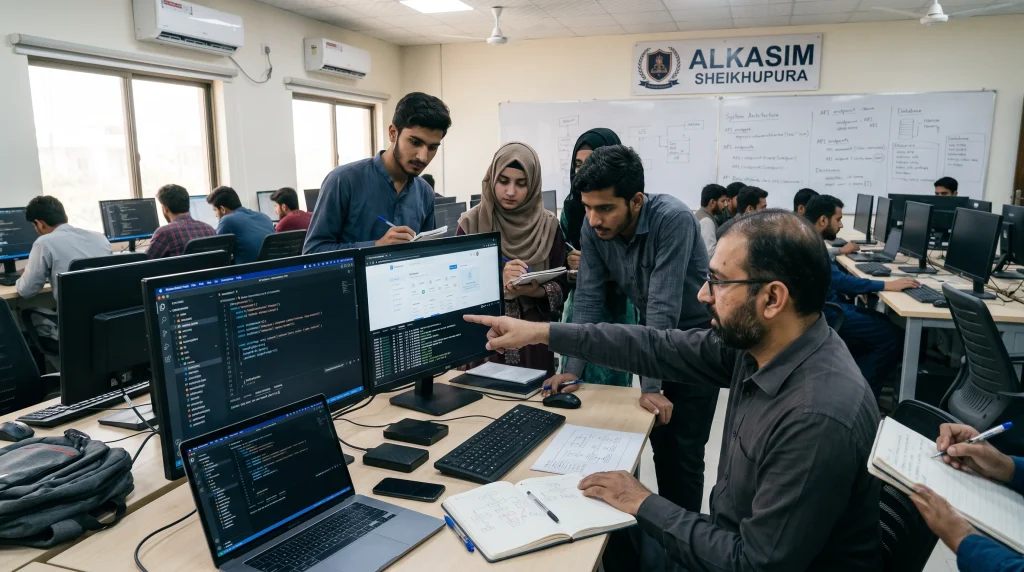
How Students May Benefit from Participating in Live Projects
When an educational institute opens the doors of real commercial projects to its learners, the educational benefits are transformative. Students cease to be passive consumers of lectures and become active participants in the software creation process.
According to the story, Alkasim involves students in live projects, giving them opportunities to learn through practical assignments and potentially participate in income-generating work. Let us explore the tangible educational and professional advantages this model provides:
Real-World Problem-Solving
Students learn how to think like engineers. Instead of memorizing abstract algorithms, they solve concrete operational issues: how to prevent duplicate invoice numbers, how to calculate sales tax accurately, and how to structure database queries for sub-second search speeds.
Professional Team Collaboration
Modern software is rarely built by a lone individual. Through live projects, students learn version control workflows with Git and GitHub, handle code reviews, communicate within team branches, and understand how modular code merges into a single application.
Building a Verifiable Portfolio
In the IT industry, a paper certificate without code proof is virtually useless. When Alkasim students apply for jobs or pitch freelance clients, they can point to real, functioning software systems and explain their exact role in building them. This tangible evidence immediately sets them apart from typical applicants.
Understanding Client Expectations
Students learn that building software is only half the battle; the other half is satisfying the customer. They learn how to interpret feedback, handle scope adjustments, and ensure the final product matches what the business actually needs.
Understanding the Practical Earning Horizon
In discussing student earning potential, honesty and ethical transparency are paramount. Some promotional academies across Pakistan make extravagant claims, promising that every student who enrolls will instantly earn a guaranteed monthly salary. Alkasim does not make such reckless or fabricated promises.
At Alkasim, the approach is clear: it is an opportunity to participate in commercial projects, not a legally or financially guaranteed fixed income.
Earning opportunities are earned through demonstrated merit, dedication, skill mastery, and reliability. When a student proves their capability by mastering fundamentals, writing clean code, and adhering to deadlines, senior developers can assign them modular tasks or components within live commercial client projects. When students successfully deliver billable work that meets client standards, they have the opportunity to share in the project’s financial rewards.
This distinction is crucial: income in the software industry is a reward for delivered competence and real value, not a prize for merely sitting in a classroom. By maintaining this realistic, professional standard, Alkasim prepares students for the actual economic realities of the global technology market.
Which Was the First Project of Alkasim in Sheikhupura?
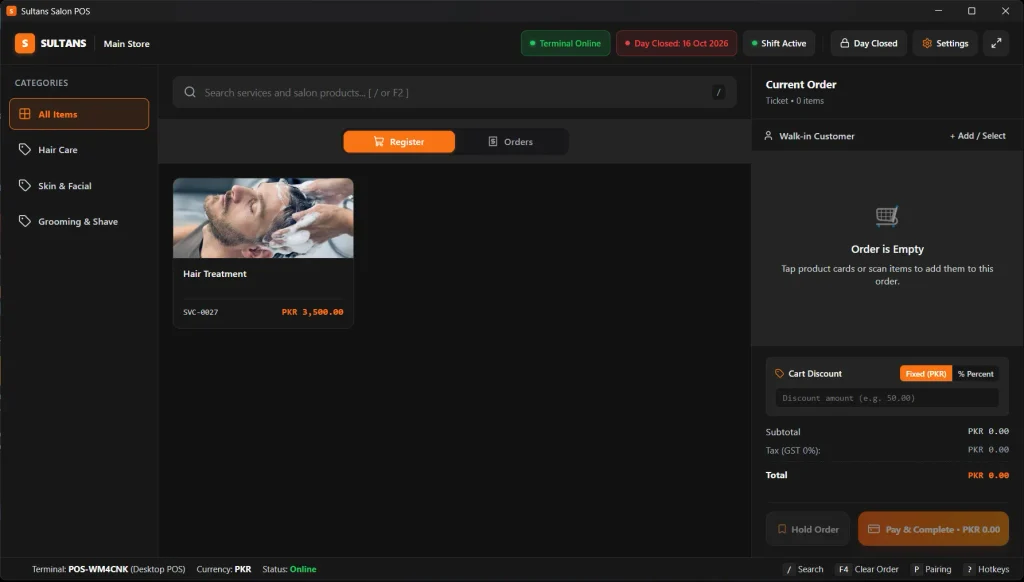
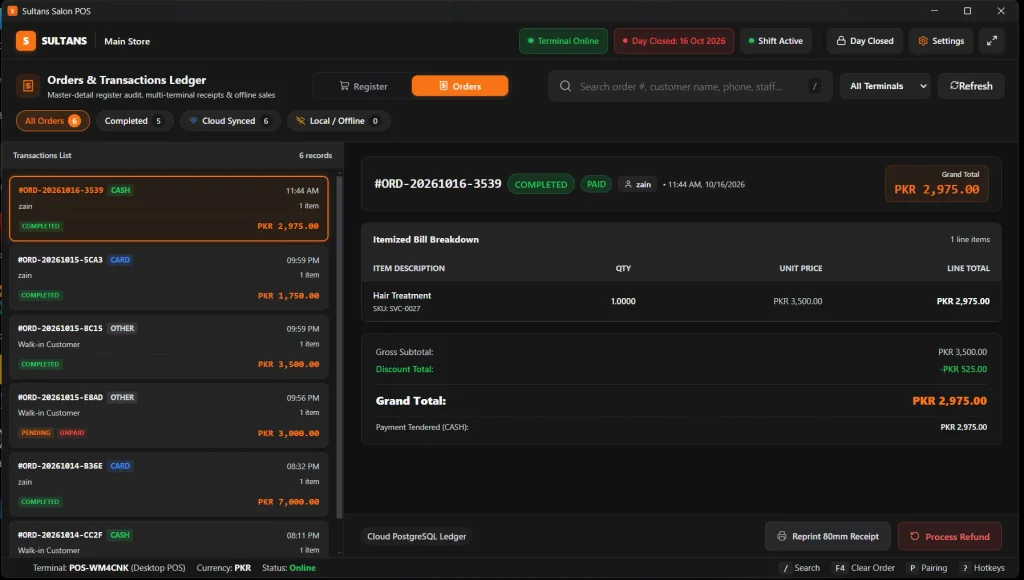
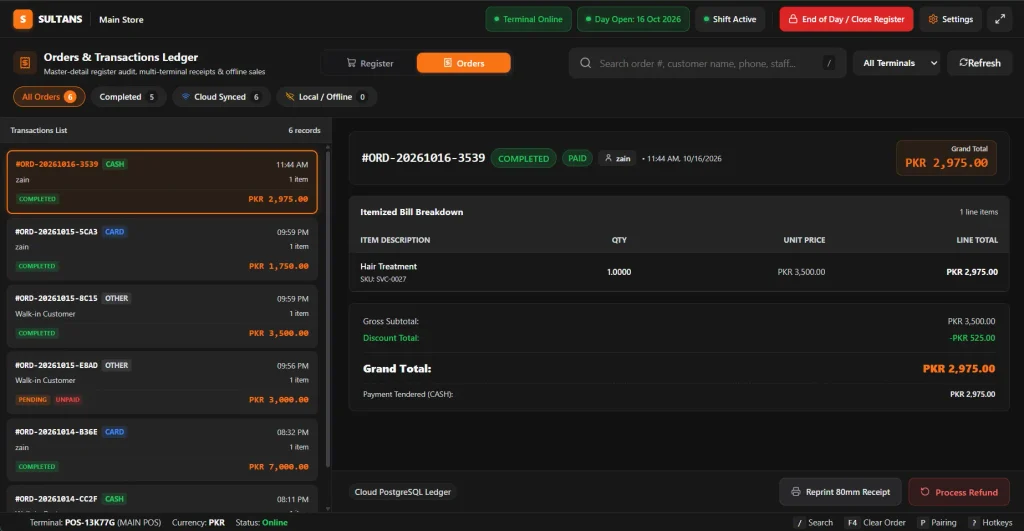
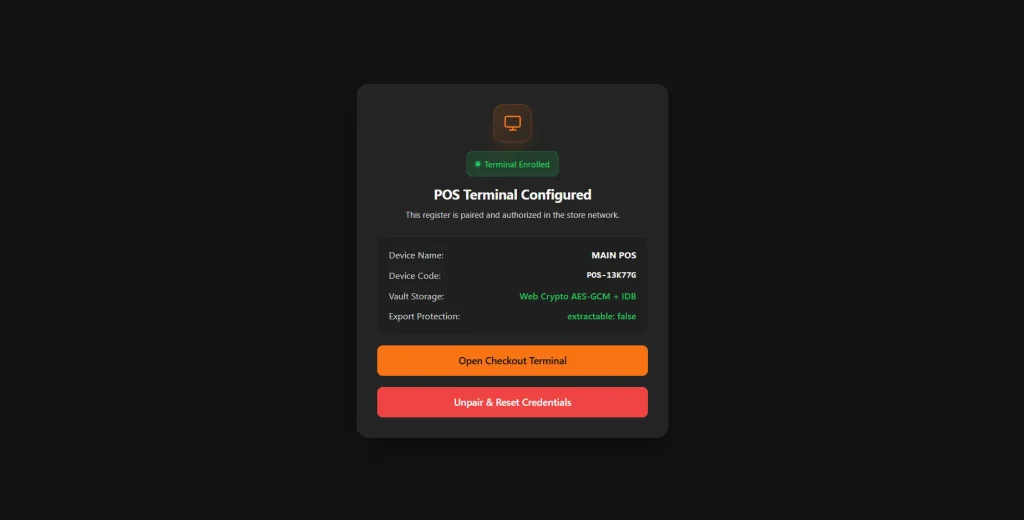
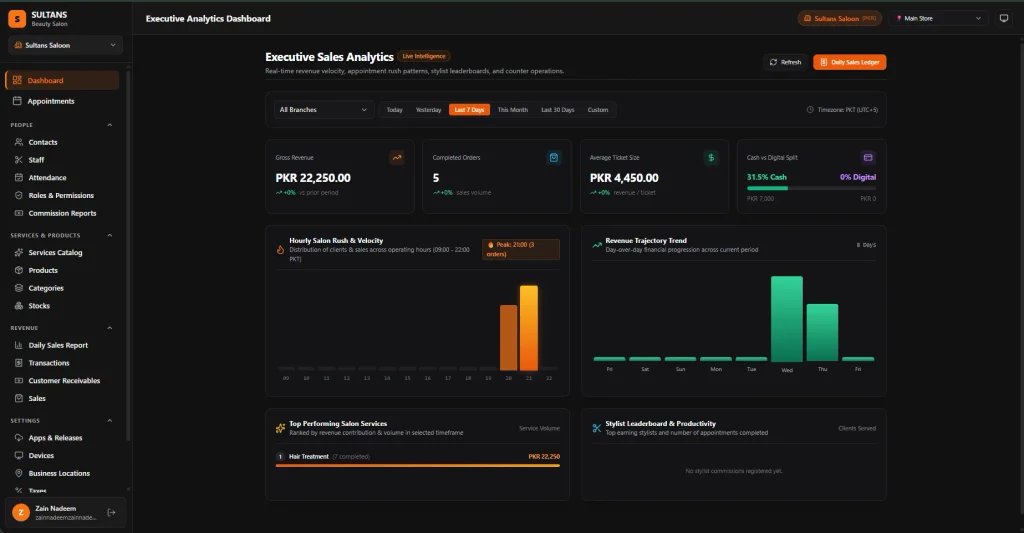
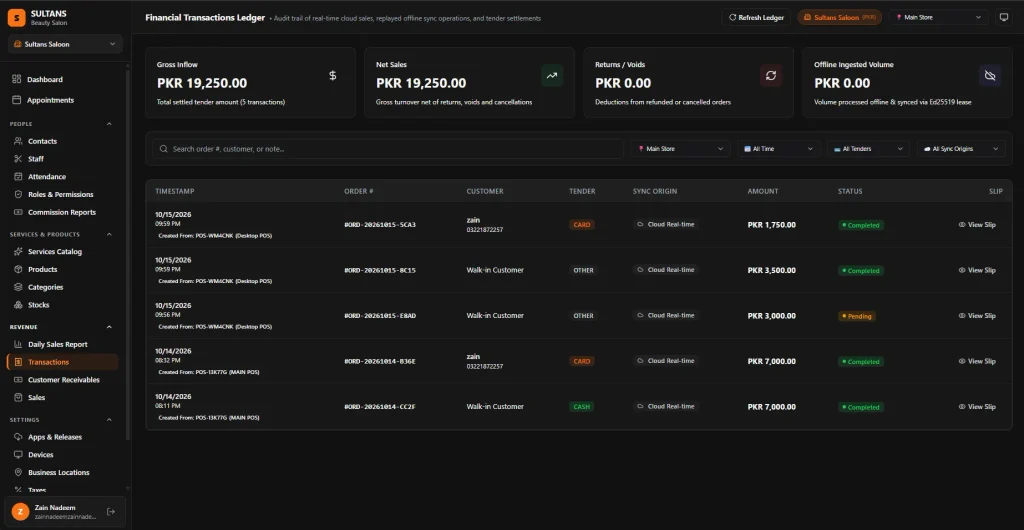
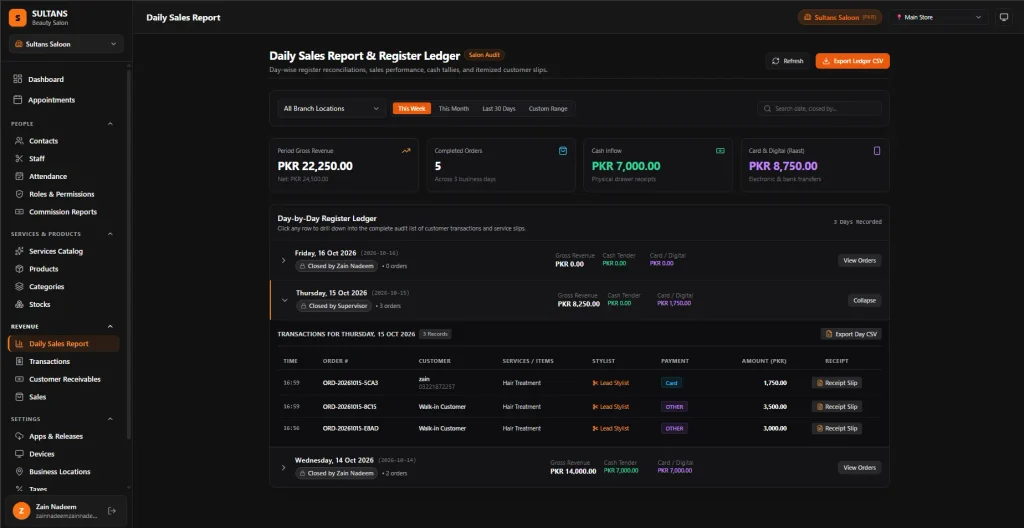
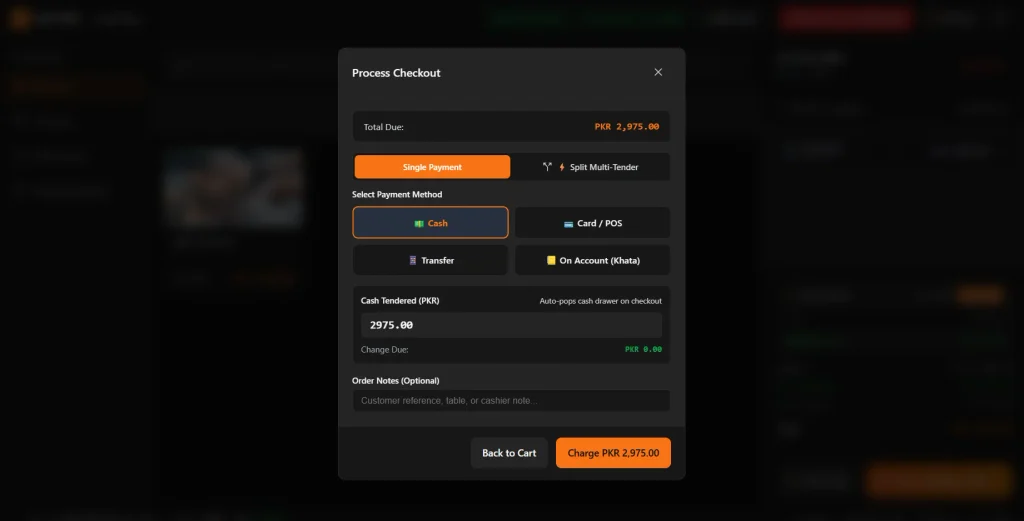
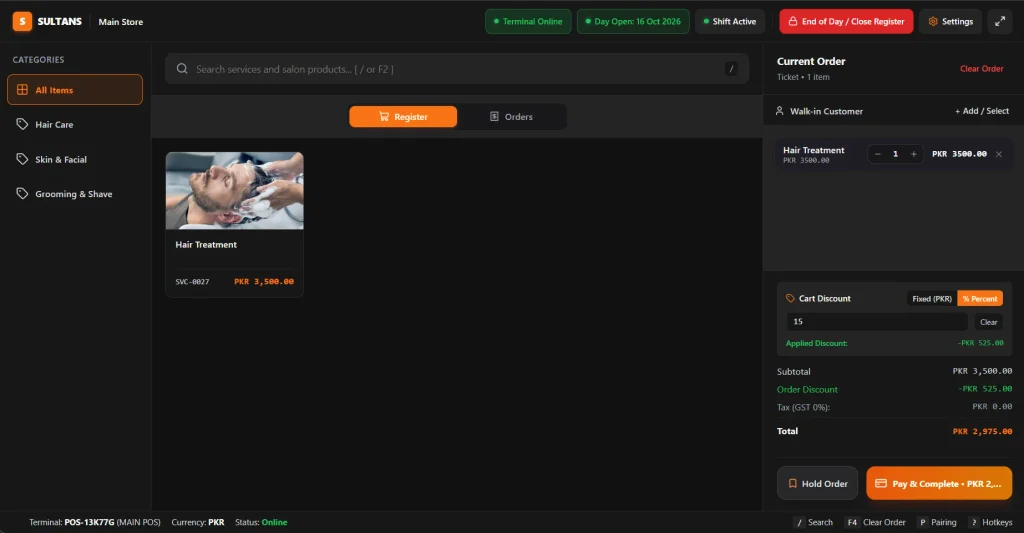
Direct Answer: The first live project of Alkasim in Sheikhupura was the development and successful deployment of a customized Point of Sale (POS) system for Sultan Saloon. This landmark project proved that an educational institute could successfully build production-grade commercial software for local businesses in Sheikhupura while establishing a real-world case study for its students.
In the history of any technology enterprise, the first commercial delivery carries immense symbolic and practical importance. For Alkasim, the Sultan Saloon project was not just a software contract; it was the definitive proof-of-concept for its entire dual-engine business model.
Before this project was undertaken, many people in Sheikhupura wondered whether a local institute could actually build and deliver software that a thriving commercial business would depend upon every single day. Skeptics wondered whether local businesses would trust custom software developed in Sheikhupura, or whether they would assume that only expensive software houses in Lahore or Karachi could build reliable business tools.
The Sultan Saloon project silenced those doubts. By identifying a prominent local service business with complex operational workflows and delivering a tailored digital solution that met their exact daily needs, Alkasim demonstrated that practical engineering capability exists right here in Sheikhupura.
The Sultan Saloon Point of Sale (POS) Initiative
- Client Name: Sultan Saloon
- Location: Sheikhupura, Punjab, Pakistan
- Software Type: Customized Point of Sale (POS) & Business Management System
- Lead Engineer: Sir Zain Nadeem (Senior Software Developer & Contributor at Alkasim)
- Core Technology Focus: Python-based development team architecture
- Primary Purpose: Modernize customer billing, track retail grooming products, streamline service recording, and provide automated daily sales reports
The successful completion of the Sultan Saloon POS project marked a historic turning point. It transformed Alkasim from an ambitious concept into a proven operational reality. For students entering Alkasim’s classrooms, it provided something priceless: a tangible, locally developed commercial system operating in their own city that they could study, dissect, and learn from.
The Sultan Saloon POS System: A Practical Example of Local Digital Transformation
To understand why the Sultan Saloon project is so meaningful, it is helpful to look at the day-to-day operational realities of a bustling salon and grooming business in Pakistan.
A modern salon like Sultan Saloon is a high-volume, multi-faceted operation. On any given day, dozens of customers enter for haircutting, beard styling, specialized grooming treatments, and skincare services. Concurrently, the business sells retail grooming products such as hair waxes, specialty shampoos, beard oils, and skin treatments.
Before implementing custom digital software, managing an operation of this nature with paper notebooks or generic spreadsheets creates constant operational friction:
Operational Challenges at Sultan Saloon
- Manual Receipt Calculations: During peak weekend rushes, reception staff had to manually write paper receipts, calculate service charges, and apply discounts, leading to mental fatigue and accidental calculation errors.
- Inventory Discrepancies: Tracking retail grooming bottles and jars on shelves manually often resulted in misplaced stock, untracked usage, or sudden shortages.
- Staff Commission Disputes: Different barbers and stylists perform different services. Calculating each staff member’s daily or weekly service share from paper slips was time-consuming and prone to miscounting.
- Lack of End-of-Day Clarity: At closing time, the business owner had to spend substantial time tallying register cash against paper notes to determine exact net earnings.
Custom POS Software Solutions
- Single-Click Fast Billing: A clean, touch-friendly checkout interface that allows reception staff to select services, add retail products, and generate an itemized thermal receipt in seconds.
- Real-Time Stock Management: Every time a bottle of grooming wax or styling cream is sold, the system automatically decrements the stock count and alerts management when inventory runs low.
- Automated Service Allocation: The POS system records which stylist performed each treatment, instantly updating commission records without manual recalculation.
- Instant Financial Reporting: With a single click, the system generates comprehensive daily, weekly, and monthly revenue summaries, categorizing income by cash, card, and specific service lines.
By tailoring the POS software specifically to Sultan Saloon’s workflow, Alkasim provided a solution that generic, mass-market software could never match. The staff did not need extensive computer training to use it, and the owner gained total operational visibility over every transaction taking place in the business.
Who Is Sir Zain Nadeem, and What Was His Role in Alkasim’s First Project?
Behind every successful software milestone stands an engineering mind capable of translating ideas into functional, reliable code. In the story of Alkasim’s first live project, that central engineering role was carried out by Sir Zain Nadeem.
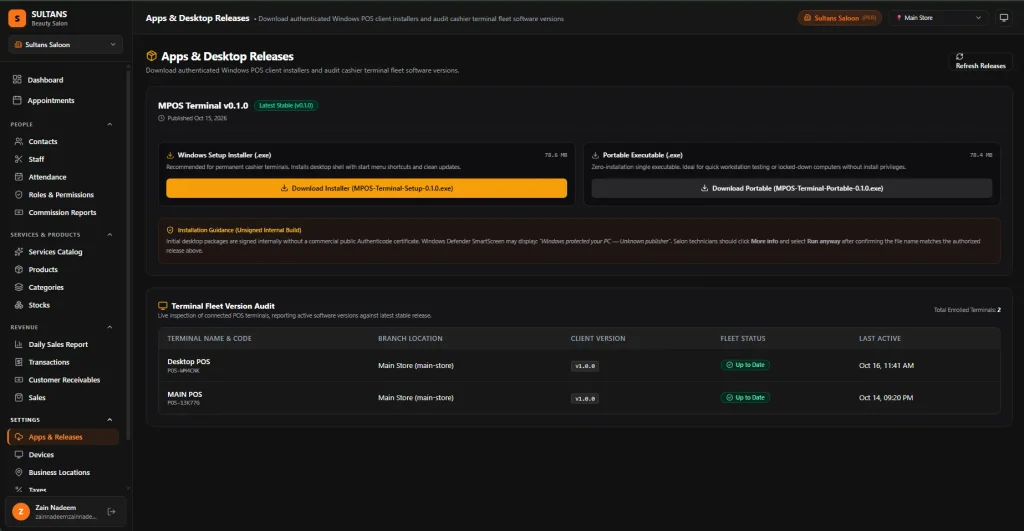
According to the facts provided in the story, Sir Zain Nadeem is a senior software developer and contributor at Alkasim, working as an integral part of Alkasim’s Python-based development team. He was the developer who completed the Sultan Saloon Point of Sale (POS) system, guiding it from concept through architecture, programming, testing, and final on-site implementation.
Sir Zain Nadeem
Senior Software Developer & Contributor at AlkasimAs a senior engineer within Alkasim’s Python-based development division, Sir Zain Nadeem focuses on building robust, scalable business applications and mentoring aspiring developers. His engineering execution on the Sultan Saloon POS system established the high architectural standards that define Alkasim’s commercial and educational software projects.
Sir Zain Nadeem’s involvement illustrates one of the most decisive differences between Alkasim and typical computer academies in Sheikhupura:
In conventional computer academies, instructors are often recent graduates with little or no commercial industry experience. They teach what they read in academic books, and they have never built a production application that handles real customer money or endures the stress of daily business transactions.
At Alkasim, instructors and contributors like Sir Zain Nadeem are actively engaged in writing production software. When Sir Zain explains database normalization, transactional integrity, or user interface responsiveness to students, he is not quoting a theoretical textbook; he is sharing the exact engineering principles he implemented in systems like the Sultan Saloon POS software.
This connection between active commercial development and student mentorship elevates the entire learning experience. Students can ask practical questions about real production hurdles such as how to handle printer driver integrations, how to prevent database locks during simultaneous transactions, or how to secure client data and receive authoritative answers based on real engineering practice.
Inside a Point of Sale (POS) System: What It Is, How It Works, and Why It Matters
In simple, everyday terms, the “point of sale” is the exact physical or digital spot where a customer makes a payment for goods or services. Whenever you purchase groceries at a modern mart, pay for a haircut at a salon, or buy medicine at a pharmacy, the computerized register where the cashier rings up your bill is running a Point of Sale (POS) system.
A POS system is far more than a digital cash drawer or an electronic calculator. When engineered properly, it functions as the central nervous system of a retail or service business:
- Transaction & Billing Module: Calculates itemized service and product totals, handles discounts and taxes, supports multiple payment methods (cash, mobile wallets, debit/credit cards), and generates digital or thermal paper receipts for customers.
- Inventory & Stock Tracking: Keeps a continuous, real-time count of physical products on shelves. When a product is sold, the inventory count updates instantly. When stock levels drop below a pre-set threshold, the system alerts managers to reorder before supplies run out.
- Staff Management & Access Controls: Assigns distinct user roles and permissions. A cashier can process billing, but only a manager or owner can authorize discounts, issue refunds, or view sensitive financial profit margins.
- Analytics & Business Intelligence: Generates comprehensive reports showing peak customer hours, most popular services, highest-selling retail products, and daily net revenue. This enables business owners to make informed commercial decisions rather than relying on guesswork.
Why does developing a POS system serve as such a masterclass for software students? Because building a POS system touches every fundamental pillar of software engineering:
- Data Integrity: The database must be completely reliable. If power cuts out mid-transaction, the software must ensure that financial records are not corrupted or double-counted.
- User Interface Simplicity: Cashiers and salon staff are not computer programmers. The interface must be so intuitive that anyone can master it within minutes of training.
- Hardware Interfacing: The software must communicate seamlessly with physical devices such as barcode scanners, cash drawers, and thermal receipt printers.
By dissecting the Sultan Saloon POS system, students at Alkasim learn these critical software engineering disciplines through a tangible, working example rather than abstract textbook definitions.
Why Real Projects Can Be Invaluable for Student Career Development
There is a profound difference between solving an academic homework assignment and contributing to a live software project.
When a student writes code for a classroom quiz, the stakes are minimal. If the code has a hidden bug that crashes under certain inputs, the teacher might deduct two marks and hand the paper back. The student moves on, having learned only that an error occurred.
When code is written for a live commercial system like the Sultan Saloon POS software, the standards are fundamentally different. If a bug slips into production:
Academic Toy Assignment
- Static, isolated exercise seen only by the teacher.
- No real users, no real financial transactions.
- Edge cases, crash scenarios, and dirty data are largely ignored.
- Code is deleted or abandoned once the semester ends.
- Provides zero demonstrable portfolio value to employers.
Live Commercial Project
- Living software utilized daily by real employees and business owners.
- Tracks actual money, inventory, and legal customer transactions.
- Every edge case must be caught and handled gracefully to prevent business disruption.
- Code must be documented, maintainable, and built for long-term reliability.
- Provides verifiable proof of professional competence during technical job interviews.
When students at Alkasim observe the development of systems like the Sultan Saloon POS system, their understanding of coding matures rapidly. They discover that clean code is not about showing off complicated syntax; it is about writing clear, resilient, and understandable logic that serves human users.
This shift in mindset from “student submitting an assignment” to “software professional solving an operational problem” is the single greatest competitive advantage an aspiring developer can gain. It is the reason why Alkasim’s project-driven approach produces learners who are ready to make meaningful contributions in the professional marketplace.
Affordable Courses Versus Project-Based Revenue: The Sustainable Flywheel
When observing Alkasim from the outside, some observers mistakenly view its affordable courses and its commercial software projects as two separate, unrelated activities. In reality, they are two halves of a single, elegantly balanced economic flywheel.
In economics, a flywheel is a system where each component accelerates and strengthens the other. At Alkasim, the relationship between affordable student courses and commercial software development works in a virtuous, self-reinforcing cycle:
Step 1
Affordable 50% Lower Fees
By lowering the barrier to entry, Alkasim attracts a wider, highly motivated pool of students from across Sheikhupura who are eager to learn.
Step 2
Reinvestment in Tools & Mentors
Collected fees are distributed to teachers and used to provide paid professional tools, fostering an inspiring, well-equipped learning environment.
Step 3
Talent Discovery & Practical Training
Through rigorous foundational training, dedicated learners stand out and demonstrate their readiness to handle modular coding assignments.
Step 4
Live Project Participation
Capable students assist senior developers on active client contracts, gaining real experience and earning project-based compensation opportunities.
Step 5
Commercial Project Revenue
Delivered software and freelancing services generate enterprise revenue, funding facilities and keeping course fees permanently affordable.
Notice how fundamentally this differs from the traditional academy model. In a traditional institute, the school wants students to stay dependent on lectures for as long as possible to collect more monthly fees. The longer a student takes to learn, the more tuition the academy extracts.
At Alkasim, the incentives are aligned in the exact opposite direction. The sooner a student becomes a capable, disciplined developer, the sooner they can contribute to live commercial projects, assist senior developers, and create value for clients. Alkasim succeeds when its students succeed. This alignment of interest is the greatest guarantee of instructional quality a learner could ever hope for.
Alkasim’s Approach Compared with a Conventional Institute Model
To provide complete clarity for students, parents, and local educators, it is helpful to place the model described by Alkasim directly alongside the conventional computer academy model commonly found in Sheikhupura.
This comparison is presented fairly and professionally. It is not intended to suggest that every private institute in Sheikhupura operates identically, but rather to highlight the distinct structural differences in how Alkasim approaches fees, revenue, instructors, and student outcomes.
| Operational Feature | Conventional Institute Model | The Model Described by Alkasim |
|---|---|---|
| Primary Income Source | Dependent almost entirely on student tuition fees to fund operations, overhead, and company profits. | Generates primary revenue from live client software development, commercial web development, and freelancing services. |
| Course Fee Level | Charged at full market rates (often 10,000 to 25,000+ PKR per course) to sustain business profitability. | Offered at approximately 50% lower fees to make quality technical education accessible to all talented learners. |
| Utilization of Student Fees | Retained largely as institutional profit, building rent, and promotional marketing expenses. | Distributed among working teachers and reinvested in paid professional tools and resources for student use. |
| Access to Professional Tools | Students frequently use pirated software, cracked versions, or limited free trials with watermarks. | Paid, legal development tools and resources are purchased through fee reinvestment and provided without extra charges. |
| Instructor Profile | Often recent graduates or academic teachers with minimal or no commercial software industry experience. | Senior practicing developers (such as Sir Zain Nadeem) who actively build and deploy production software for clients. |
| Nature of Practical Work | Synthetic, toy classroom exercises (e.g., printing numbers, basic calculators) with no real users. | Real commercial codebases and live systems (e.g., Sultan Saloon POS) solving tangible business challenges. |
| Earning Pathways for Students | Rarely provides any direct earning connection; students must navigate the freelance market completely on their own. | Provides opportunities for capable students to participate in live commercial projects and earn project-based compensation. |
| Core Philosophy | Educational consumerism: students are customers who pay fees in exchange for lectures and a paper certificate. | Apprenticeship incubator: students are future engineering contributors being prepared for the commercial digital economy. |
This comparison demonstrates that Alkasim’s difference is not merely superficial. It is an entirely different operational paradigm designed to elevate technical training in Sheikhupura from passive memorization to active, professional capability.
How Businesses and Students in Sheikhupura Both Benefit from This Approach
The unique advantage of Alkasim’s live project model is that it creates a harmonious relationship between two groups that have historically been disconnected in Sheikhupura: local commercial businesses and young technical students.
Consider the dilemma faced by a local business owner in Sheikhupura whether they manage a clinic on Lahore Road, a fabric store in the main bazaar, an auto-parts distributor, or a grooming salon like Sultan Saloon. When they decide to digitize their operations, they face severe obstacles:
- Exorbitant Big-City Pricing: Software agencies in Lahore or Islamabad routinely quote enterprise fees that small or medium enterprises simply cannot justify.
- Zero Local Support: If a business buys generic software online and a printer fails or the database locks up on a Saturday morning, getting an engineer to visit Sheikhupura in person is nearly impossible.
- Inflexible Workflows: Off-the-shelf software packages are often built for foreign markets, with complicated tax structures and English-only workflows that local staff find confusing.
Alkasim solves this local business dilemma by offering custom-tailored, locally supported software development services at fair, competitive rates. Because Alkasim’s engineering team is based right in Sheikhupura, business owners enjoy face-to-face consultations, responsive on-site onboarding, and immediate technical support whenever needed.
Simultaneously, the students benefit immensely from this localized business connection:
For the Local Sheikhupura Business
Receives customized, reliable software (like the Sultan Saloon POS system) tailored precisely to their operations, backed by responsive local developers who understand their business environment.
For the Ambitious Alkasim Student
Gains direct exposure to active commercial systems operating within their own city, learning how technology drives real businesses and earning practical experience that employers value.
By bridging this gap, Alkasim does more than teach coding; it strengthens the economic fabric of Sheikhupura, proving that technological innovation does not have to be imported from outside cities when local talent can be nurtured to solve local problems.
The Technology Stack at Alkasim: Why Python, Web Development, and Business Tools Matter
In software engineering, a “technology stack” refers to the combination of programming languages, frameworks, libraries, database engines, and development tools used to build an application.
At Alkasim, the curriculum is not designed around whatever happens to be easiest to teach from an old textbook. It is carefully structured around the technologies that power real commercial software projects and dominate global freelancing platforms.
Core Engine
Python Development Ecosystem
Python is one of the most widely used and versatile programming languages in the world today. It is also the core language used by Alkasim’s development team, where senior engineers like Sir Zain Nadeem build robust commercial software.
Python offers a clean, readable syntax that allows beginners to master fundamental programming logic quickly without getting lost in overly complex boilerplate code. At the same time, Python is powerful enough to handle massive enterprise databases, data analytics, artificial intelligence modules, automation scripts, and high-performance web backends.
Web Architecture
Modern Full-Stack Web Development
The web is the primary delivery vehicle for modern applications. Alkasim trains students in the full web development lifecycle: semantic HTML5, modern CSS3 styling, responsive grid frameworks, and JavaScript for interactive frontend experiences.
On the backend, students learn how web servers communicate with databases via REST APIs, how to implement secure user authentication, and how to deploy web applications to cloud servers so they are accessible to users anywhere in the world.
Data Integrity
Relational Databases & Transaction Systems
Every business software system especially Point of Sale (POS) software relies on a secure, dependable database. Students learn relational database management, data normalization, SQL query optimization, and transaction handling.
Understanding how to protect data from accidental corruption, how to execute atomic transactions, and how to back up business records safely prepares students to build mission-critical enterprise applications.
By mastering this practical technology stack, students at Alkasim acquire skills that are in immediate demand both by software companies across Pakistan and by international clients seeking skilled freelancers on Upwork and Fiverr.
Important Things Students and Parents Should Understand Before Enrolling
Choosing where to invest your time, energy, and financial resources is one of the most important decisions an aspiring professional or parent can make. At Alkasim, transparency and honesty are valued above marketing slogans.
Before prospective students enroll in any course at Alkasim, there are several foundational realities that should be clearly understood:
1. Affordable Fees Do Not Mean an Effortless Journey
Because Alkasim offers courses at approximately 50% lower fees, some people might assume that the coursework is casual or undemanding. That assumption is completely mistaken. Learning to write clean, professional code is intellectually demanding. It requires sustained concentration, hours of typing at a keyboard, reading documentation, and persevering through frustrating syntax errors and bugs.
2. Earning Opportunities Are Earned on Merit, Not Given by Default
Alkasim offers opportunities to participate in live commercial projects, but this is not an unconditional financial guarantee or a monthly welfare stipend. Simply paying a course fee and sitting in class does not entitle a student to commercial project assignments. Senior developers only entrust client code to students who demonstrate discipline, technical competence, and reliability.
3. There Are No Magic Shortcuts in Software Engineering
The internet is full of deceptive advertisements promising that anyone can become a high-earning software engineer in two weeks with zero prior knowledge. Real professional development takes time. At Alkasim, students are expected to attend classes punctually, complete practical exercises, ask questions when they get stuck, and spend time outside class practicing their code.
When students enter Alkasim with this mature, committed mindset, the results can be extraordinary. Alkasim provides the environment, the mentorship of senior developers like Sir Zain Nadeem, the paid tools, and the real project examples; the student provides the curiosity, dedication, and effort.
The Step-by-Step Learning and Project Journey at Alkasim
To understand how a beginner with zero prior programming background evolves into a capable software contributor at Alkasim, it is helpful to look at the structured, five-stage progression every student experiences:
Stage 01
Foundational Logic & Programming Fundamentals
Students begin by mastering the core building blocks of computational thinking. Using Python, learners explore data types, conditional branching, loops, functions, and error handling. The focus is on writing clean, readable, and logical code rather than memorizing confusing definitions.
Stage 02
Database Architecture & User Interface Engineering
Students learn how data is structured and stored safely in relational databases. They master SQL queries, table relationships, and data validation rules. Concurrently, they study user interface design, learning how to build responsive web and desktop layouts that everyday business users can navigate effortlessly.
Stage 03
Deconstructing Real Production Systems
Instead of building generic toy exercises, students examine production codebases such as the architecture behind the Sultan Saloon Point of Sale (POS) system. Guided by senior mentors, students inspect how transactions are processed, how receipts are generated, and how error exceptions are handled in real commercial environments.
Stage 04
Supervised Live Project Modular Contributions
Learners who demonstrate competence and dedication are introduced to active development streams. Under the supervision of senior developers like Sir Zain Nadeem, students contribute to modular tasks: building secondary interface screens, writing data validation utilities, testing software for edge-case bugs, and assisting on active client milestones.
Stage 05
Portfolio Finalization & Freelance Career Launch
Graduates assemble a portfolio showcasing real code, active GitHub repositories, and working application demos. They receive hands-on guidance on setting up professional profiles on international freelancing platforms (such as Upwork and Fiverr), writing persuasive client proposals, and preparing for technical job interviews.
This systematic journey ensures that when a student completes their training at Alkasim, they possess genuine competence, practical problem-solving capability, and the confidence to succeed in the modern digital economy.
How Students and Local Businesses Can Connect with Alkasim
Whether you are an ambitious student eager to build a career in technology or a local business owner in Sheikhupura seeking to modernize your operations, connecting with Alkasim is straightforward and welcoming:
🎓
For Prospective Students & Parents
If you want to master Python, explore web development, learn commercial software engineering, or enter the world of freelancing, Alkasim invites you to explore our course catalog and visit our campus.
- Visit the official website: https://alkasim.pro/
- Review current course schedules, affordable fee structures, and lab timings.
- Meet our instructors and senior developers in person to discuss your career goals.
- Tour our practical development environment and explore the paid tools provided to learners.
🏢
For Sheikhupura Business Owners
If your retail shop, salon, manufacturing facility, clinic, or distribution hub is struggling with manual paperwork, misplaced inventory, or unorganized sales records, Alkasim’s software team is ready to assist you.
- Schedule a consultative requirement session with our software development team.
- Explore custom Point of Sale (POS) systems engineered specifically for your workflow.
- Commission professional website development, customer portals, or management software.
- Enjoy dedicated on-ground local support right here in Sheikhupura without big-city pricing.
By bringing learners and business owners together under a single technology ecosystem, Alkasim continues to serve as an engine of innovation, economic empowerment, and digital modernization throughout Sheikhupura.
Conclusion: Understanding Alkasim’s Different Business Model
When people across Sheikhupura ask: “Alkasim Puray Sheikhupura May Other Institute Sy Kyun Different Ha?” (“Why Is Alkasim Different from Other Institutes in Sheikhupura?”), the answer is not found in marketing slogans or empty promises. It is rooted in a fundamental, transparent rethinking of how education and industry should interact.
Conventional computer academies in Sheikhupura operate on a model that treats the classroom as a profit extraction centre. They must charge high fees because student tuition is their only lifeline. They are often forced to cut corners on teacher salaries and use pirated software to maintain corporate profits, leaving students with paper certificates but minimal practical capability.
Alkasim has proven that there is a better, more honorable, and far more sustainable way:
- Affordable 50% Lower Fees: Because Alkasim generates its primary income through live software development, commercial freelancing, and client website projects, it does not rely on student fees for company profits.
- Fee Reinvestment: Student fees are reinvested directly into the learning experience: distributed among hardworking teachers and used to provide paid, legitimate professional developer tools at no extra charge.
- Real-World Commercial Projects: From milestone achievements like the Sultan Saloon POS system developed by senior engineer Sir Zain Nadeem to active international freelance contracts, students learn inside a living software environment.
- Merit-Based Earning Opportunities: Capable, disciplined students have the opportunity to participate in commercial client milestones, learning how software translates into real-world economic value.
- Empowering the Local Community: Local businesses in Sheikhupura gain access to affordable, custom software with on-ground support, keeping digital investment right inside the city.
Alkasim is not just a place where you attend lectures; it is a collaborative software workshop where you learn to build the digital future. If you are ready to move beyond outdated textbook memorization and experience practical, project-based software education, we warmly invite you to explore our programs at https://alkasim.pro/ and discover the difference for yourself.
Frequently Asked Questions About Alkasim
Get direct, factual answers about our unique educational model, 50% lower fees, student fee reinvestment, commercial software projects, freelancing opportunities, and the Sultan Saloon POS system in Sheikhupura.
01 Why is Alkasim different from other institutes in Sheikhupura?
Alkasim is different from other institutes in Sheikhupura because it operates on a live project and software services model rather than relying primarily on student tuition fees. Conventional institutes survive by collecting high fees from students, whereas Alkasim generates its main revenue by delivering real software projects, web development, and freelancing services to commercial clients. This allows Alkasim to offer courses at roughly 50% lower fees, reinvest student fees into paid tools and teacher compensation, and train students on active production codebases.
02 How can Alkasim offer courses at approximately 50% lower fees?
Alkasim can offer courses at approximately 50% lower fees because it does not rely on student fees to cover institutional profits, commercial building leases, or expensive advertising campaigns. Because Alkasim generates commercial revenue through client software contracts, website engineering, and global freelancing, it can decouple its operational survival from classroom tuition. This makes high-quality technical education affordable and accessible to families across Sheikhupura.
03 What is the main source of income of Alkasim?
The main source of income of Alkasim is commercial technology services delivered to clients. Specifically, according to the facts of the story, Alkasim’s primary revenue comes from four activities: (1) live project hunting and acquiring commercial client projects, (2) professional freelancing services on international platforms, (3) commercial website development, and (4) custom software development and related technical services.
04 Does Alkasim mainly depend on student course fees?
No, Alkasim does not mainly depend on student course fees to fund its business operations. Unlike traditional computer academies that face financial crises if student enrollment drops, Alkasim’s primary economic engine is its commercial software development and freelancing contracts. Course fees are kept low and are used to support teachers and provide student tools rather than funding corporate profits.
05 How does Alkasim use the fees collected from students?
According to the story, Alkasim uses the fees collected from students entirely to support the educational process. The collected fees are distributed among the teachers working at Alkasim to fairly compensate them for their mentorship, and they are used to purchase legitimate, paid development tools and learning resources that students require during their coursework. The fees are not retained as Alkasim’s institutional profit.
06 Does Alkasim provide access to paid learning tools?
Yes, Alkasim provides enrolled students with access to legitimate, paid professional software tools and resources without any extra or hidden charges. While traditional academies often force students to use pirated software, cracked utilities, or restrictive free trials, Alkasim uses collected course fees to purchase commercial licenses and tools so students learn inside an authentic, professional engineering environment.
07 How does Alkasim generate revenue from live projects?
Alkasim generates revenue from live projects by delivering functional, high-value custom software, web applications, and digital systems to commercial businesses that pay for these professional services. Revenue is earned through agreed client contracts, project milestones, system deployment, and ongoing technical maintenance agreements, rather than through student tuition.
08 What is live project hunting?
Live project hunting is the proactive process of identifying businesses that face operational challenges—such as manual paperwork, inventory discrepancies, or inefficient customer tracking—and proposing custom digital software solutions. Alkasim’s team visits businesses, analyzes their workflow bottlenecks, defines system requirements, and secures commercial software contracts to solve those operational issues.
09 Does Alkasim work on freelancing projects?
Yes, Alkasim actively works on freelancing projects. Alkasim’s senior technical contributors take on commercial contracts through global freelance marketplaces such as Upwork and Fiverr, as well as direct international business engagements. These projects include software development, web applications, Python automation scripts, and database optimization, bringing foreign exchange into the local economy.
10 Does Alkasim provide web development services?
Yes, Alkasim provides comprehensive commercial website development services. The team designs, engineers, launches, and maintains responsive websites, e-commerce platforms, customer registration portals, and custom web applications for businesses in Sheikhupura and beyond. Web development projects generate both upfront delivery revenue and recurring maintenance income.
11 Which was Alkasim’s first live project in Sheikhupura?
According to the official story, the first live project of Alkasim in Sheikhupura was a customized Point of Sale (POS) system developed for Sultan Saloon. This project served as the initial proof-of-concept for Alkasim’s dual model, proving that local businesses in Sheikhupura could rely on Alkasim for production-grade software.
12 What is the Sultan Saloon POS project?
The Sultan Saloon POS project was a custom Point of Sale and business management software system built by Alkasim for Sultan Saloon, a prominent grooming salon in Sheikhupura. The system automated customer billing, managed product retail inventory, tracked stylist service allocations, and provided comprehensive daily revenue analytics for the salon management.
13 What does POS stand for?
POS stands for ‘Point of Sale’. It refers to the computerized hardware and software system used in retail shops, salons, restaurants, and businesses to process customer checkouts, record sales transactions, track product inventory, print itemized receipts, and manage daily financial accounting.
14 Who developed the Sultan Saloon POS system?
The Sultan Saloon POS system was completed by Sir Zain Nadeem, a senior software developer and contributor at Alkasim who works as an integral part of its Python-based development team.
15 Who is Sir Zain Nadeem at Alkasim?
Sir Zain Nadeem is a senior software developer and key contributor at Alkasim. He works within Alkasim’s Python-based development division, where he builds commercial client applications (such as the Sultan Saloon POS system) and provides hands-on mentorship to aspiring developers learning at the institute.
16 What is the role of a senior software developer in a project?
In a software project, a senior software developer is responsible for system architecture, database design, core coding, code quality reviews, and ensuring that the software reliably satisfies the client’s business requirements. At Alkasim, senior developers also serve as practical mentors, demonstrating to students how production-level code is structured, debugged, and maintained.
17 How can students benefit from live projects?
Students benefit from live projects by gaining practical, real-world experience that cannot be learned from textbooks alone. They learn how to read production codebases, use collaborative version control tools like Git, solve real business problems, handle client requirement adjustments, and build a verifiable portfolio of working applications that sets them apart in technical job interviews.
18 Can students earn money by participating in live projects?
Yes, students have the opportunity to earn money by participating in live projects, but this is earned on merit rather than guaranteed automatically. When students demonstrate technical competence, discipline, and reliability, senior developers can assign them modular components within commercial client contracts. When students successfully deliver billable work meeting client standards, they participate in project-based earnings.
19 Does every Alkasim student receive paid work?
No, not every student automatically receives paid work. Alkasim provides the opportunity to participate in live projects, but commercial assignments are awarded based on individual merit, skill mastery, punctuality, and code quality. Commercial clients expect flawless deliverables, so students must prove their readiness before being assigned billable project tasks.
20 How is project-based learning different from classroom-only learning?
Classroom-only learning focuses on passive lectures, memorizing syntax, and completing synthetic, toy exercises that have no real users or commercial value. Project-based learning, in contrast, immerses students in the creation of living software systems. Students write code that handles real data, collaborate with team members, solve unexpected bugs, and see how software directly impacts a business.
21 Why can live projects be useful for learning software development?
Live projects are useful because software engineering is a practical craft, much like architecture or medicine. Working on real projects teaches students how to handle dirty user input, prevent database errors, write maintainable modular code, and adhere to production deadlines. It bridges the gap between academic theory and real-world employment.
22 How does Alkasim connect students with real-world work?
Alkasim connects students with real-world work by integrating its commercial software agency directly with its educational classrooms. Instead of keeping commercial projects hidden, Alkasim allows qualified students to observe production codebases, assist senior engineers with testing and modular feature development, and learn directly from practicing developers.
23 How can businesses benefit from software development services?
Businesses benefit from software development services by automating repetitive manual tasks, eliminating calculation errors, preventing inventory loss, accelerating customer checkout, and gaining real-time financial reporting. Custom software tailored to a business’s exact workflow improves customer satisfaction and significantly boosts operational profitability.
24 What should students know before enrolling at Alkasim?
Students should know that learning to code requires genuine dedication, logical thinking, patience, and active daily practice. While Alkasim offers affordable fees and an inspiring environment, there are no shortcuts to becoming a software developer. Earning opportunities and project participation are based on demonstrated competence and hard work.
25 How can someone learn more about Alkasim’s courses and projects?
Anyone interested in learning more can visit Alkasim’s official website at https://alkasim.pro/, where they can explore current course offerings, fee details, and project updates. Prospective students and local business owners are also encouraged to visit the campus in Sheikhupura to consult directly with instructors and technical staff.
26 Why does Alkasim emphasize Python in its development team?
Alkasim emphasizes Python because it is one of the most versatile, powerful, and in-demand programming languages globally. Python’s clear and readable syntax makes it ideal for teaching programming fundamentals, while its rich ecosystem enables senior engineers like Sir Zain Nadeem to build sophisticated desktop software, backend web APIs, data automation pipelines, and enterprise business applications.
27 Can local businesses in Sheikhupura hire Alkasim for custom software?
Yes, local businesses in Sheikhupura can hire Alkasim for customized software development, Point of Sale (POS) systems, inventory tools, and commercial websites. Alkasim provides tailored solutions with in-person consultative discovery and responsive, on-ground technical support right in Sheikhupura.