

1. Why Is Abdullah Butt Focusing on Practical Education in Pakistan?
Walk into almost any university convocation hall across Punjab, Sindh, or Khyber Pakhtunkhwa, and you will see proud families celebrating years of hard-earned academic effort. Walk out onto the job market three months later, and many of those same graduates face a frustrating wall. Employers ask what software they have shipped, which client briefs they have handled, or how they solve an unexpected technical failure. Too often, a transcript filled with high grades offers no answer to those questions.
This gap between classroom credentials and workplace capability explains the central question: Why Is Abdullah Butt Focusing on Practical Education in Pakistan? Rather than dismissing formal schooling, his educational perspective addresses what formal schooling routinely leaves unfinished. Academic degrees introduce students to terminology, concepts, and structured study habits. Yet when young professionals step into a software house, a marketing team, or an independent freelance practice, theory by itself cannot build a functional product or satisfy a paying client.
Economic research confirms that this disconnect is not an isolated complaint among employers. According to Knowledge Brief No. 100 by the Pakistan Institute of Development Economics, graduate unemployment in Pakistan runs nearly three times higher than the country’s overall unemployment rate. Analyzing data from the Pakistan Bureau of Statistics Labour Force Survey, PIDE researchers found that graduate unemployment reached 16.1 percent in the 2020 to 2021 period. Even more striking, unemployment among engineering graduates climbed from 11.2 percent to 23.5 percent in just two years, while computer science graduates saw unemployment rise from 14.2 percent to 22.6 percent.
Those figures point to a sobering reality. Simply expanding degree enrollment does not automatically create capable practitioners. Data inside the same PIDE brief reveals that the mismatch extends well beyond major cities and technology degrees. Rural graduate unemployment reached 22 percent compared with 12 percent in urban centers, while agriculture degree unemployment jumped from 11.4 percent to 29.4 percent over two years despite agriculture anchoring Pakistan’s rural economy. A student studying computer science may pass written exams on database normalization and still struggle to connect a live database to a web application or diagnose a broken server response. A design student may memorize color theory definitions and still feel lost when an actual business owner asks for a brand identity that works across packaging, print, and mobile screens.
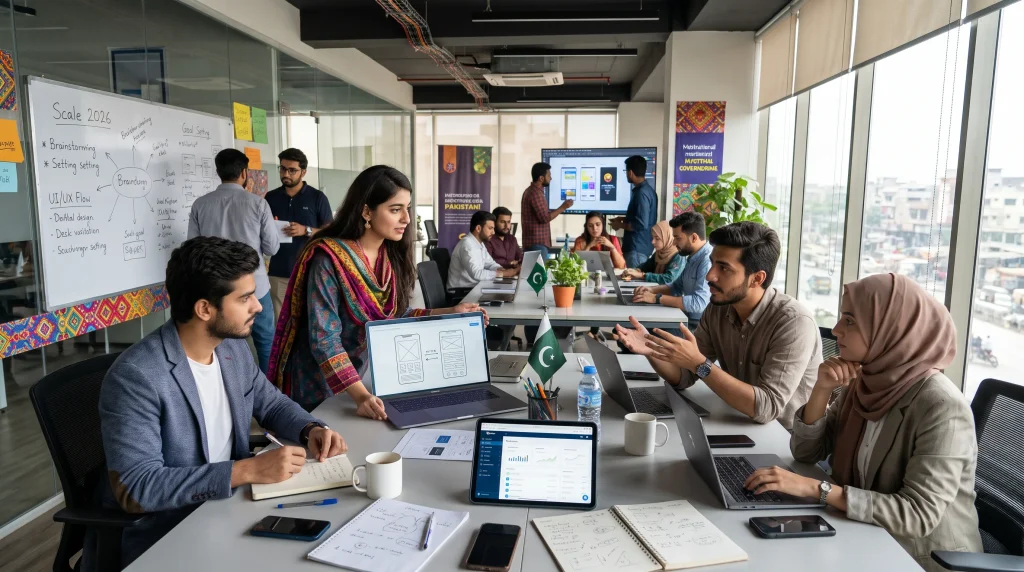
Recognizing this everyday struggle among youth in Sheikhupura and across the country, Abdullah Butt centered his teaching and institutional work around execution. At Alkasim Group of Owners, students do not sit passively listening to slides for months. They build websites, design client assets, write search-focused articles, manage campaigns, and learn how real projects operate under authentic deadlines. Practical education bridges the space between knowing what a concept means and knowing how to deliver value with it.
2. Abdullah Butt’s Vision for Practical Education in Pakistan
To understand Abdullah Butt’s Vision for Practical Education in Pakistan, it helps to look at how he views the purpose of learning itself. Education, in his framework, was never meant to end with a framed certificate on a living room wall. Its genuine purpose is to equip a young person to solve real problems, contribute useful work to society, and stand on their own feet financially with integrity.
Having worked both as an academic lecturer in business administration and as the founder of an active digital agency and training platform, Abdullah Butt witnessed both sides of the divide firsthand. Inside conventional classrooms, capable students often grew anxious as graduation approached. Many had spent sixteen years following syllabi, memorizing past papers, and chasing grade point averages, yet few felt confident applying for skilled roles or pitching a service to a local company.
How Real-World Experience Shaped His Perspective
His emphasis on Skills-Based Education in Pakistan also grew out of personal observation inside local student communities in Sheikhupura. Early in his career, Abdullah Butt invested time learning web technologies such as HTML, CSS, and JavaScript alongside digital marketing while closely observing how young Pakistanis searched for online income. Seeing peers lose money and confidence in misleading promotional schemes reinforced a lasting conviction: sustainable online work comes only from genuine, marketable competence and transparent client value.
That conviction directly shaped how Alkasim Group of Owners operates today. Rather than selling vague promises of quick earnings, the curriculum trains learners in durable technical crafts, client communication, and ethical business judgment so every step rests on verifiable work.
Combining Theory With Real Execution
Abdullah Butt’s educational philosophy does not ask students to abandon formal academics. Conceptual understanding matters. Knowing why a market behaves in a certain way, how accounting rules protect a business from cash flow mistakes, or why clean software architecture prevents future failures gives professionals long-term depth. His concern begins when theory consumes 100 percent of a student’s time and practical application gets postponed until after graduation.
In his model, theory and practice run side by side. When a student learns the principles of marketing or software logic, the very next step is testing that concept on an actual task. That immediate cycle of study, application, feedback, and correction cements understanding far faster than reading chapters in isolation.
Building Self-Reliance Instead of Dependency
Another core element of Alkasim’s educational vision is shifting how young Pakistanis view their career options. Traditional schooling subtly trains students to wait for someone else to hire them. Graduates submit hundreds of resumes to a narrow pool of corporate or government offices, often accepting underpaid roles unrelated to their studies simply out of exhaustion.
Practical capability changes that power dynamic. When students master tangible digital skills, understand how clients make purchasing decisions, and learn the mechanics of running small projects, they stop viewing a job interview as their single lifeline. They gain the option to work with local firms, serve international clients remotely, collaborate in agency teams, or launch independent ventures built around real market needs.
Extending Practical Opportunity Beyond Major Metropolitan Centers
In Pakistan, advanced bootcamps, corporate incubators, and industry events cluster heavily inside Karachi, Lahore, and Islamabad. Students living in secondary industrial and agricultural districts like Sheikhupura frequently face a painful choice: spend steep monthly sums on hostel accommodation and commuting, or settle for outdated local theory classes. By anchoring practical digital mentorship directly inside Sheikhupura while connecting learners to online collaboration workflows, Abdullah Butt’s vision reduces geographic barriers so talented youth outside mega-cities can build competitive portfolios close to home.
3. Why Pakistan Needs Practical Education Across Growing Industries
Asking Why Pakistan Needs Practical Education moves the conversation beyond any single educator or city. Pakistan possesses one of the youngest populations in South Asia, with millions of youth entering working age every decade. Whether that demographic wave drives national prosperity or deepens underemployment depends largely on what those young people can actually do when they enter the workforce.
The Macroeconomic Evidence Behind the Skills Gap
Global and domestic institutions have documented this gap for years. In its landmark study Pakistan: Skills Assessment for Economic Growth, the World Bank evaluated workforce readiness using the STEP framework, which organizes employability into cognitive, socio-behavioral, and job-relevant technical skills. The assessment showed that weak technical proficiency and missing workplace behaviors hold back firm productivity across sectors.
Institutional linkages between universities and employers remain fragile as well. PIDE’s 2023 graduate unemployment brief notes that Pakistan ranks 63rd out of 163 countries on the World Bank University-Industry linkages index, trailing regional neighbors such as India at 26th and Sri Lanka at 53rd. When curriculum committees rarely consult software companies, manufacturing managers, or digital agencies, academic programs naturally drift behind industry standards.
The Pakistan Software Houses Association has repeatedly highlighted a similar bottleneck in the technology sector. Even while Pakistan’s digital services sector continues to expand, software houses struggle to absorb fresh graduates straight out of university because many lack production coding habits, debugging fluency, version control experience, and team workflow familiarity.
Digital Growth and Regional Opportunity
At the same time, demand for capable digital talent continues to widen. Industry initiatives tracked through Tech Destination Pakistan, national online capacity programs like DigiSkills.pk, and vocational standards led by the National Vocational and Technical Training Commission demonstrate growing recognition across Pakistan that practical, market-aligned skills create export value and domestic resilience.
Wait too long to modernize training, and youth outside major metropolitan centers pay the steepest price. Students in cities like Sheikhupura, Gujranwala, Sialkot, Multan, and Sargodha often possess the same intellectual drive as peers in Lahore or Islamabad, yet they have fewer local corporate offices offering structured apprenticeships. Practical training hubs inside these regional cities give local learners a direct bridge into national and global digital work without forcing families to bear the heavy cost of relocating to mega-cities.
Why Basic Computer Familiarity Is No Longer Enough
A common misconception among students and families is assuming that everyday smartphone or office-software familiarity counts as digital job readiness. Knowing how to format a document or post on social apps is baseline literacy, not a specialized trade. Growing companies and international clients look for practitioners who understand production tools, measurable outcomes, and industry conventions. A business hiring a web specialist expects clean responsive code, logical navigation, and basic security hygiene rather than a slow template dropped online without testing. Similarly, an e-commerce merchant hiring a digital marketer expects clear audience segmentation, honest conversion tracking, and budget discipline rather than boosted posts chosen by guesswork. Practical education raises learners from casual technology users to dependable digital builders.
- Small and medium enterprises need ready contributors: Local businesses increasingly want websites, search visibility, social media presence, and inventory systems, but cannot afford to train fresh hires from scratch for six months.
- Remote work rewards demonstrable output: International clients and distributed teams hire based on portfolios, problem-solving ability, and communication clarity rather than university prestige alone.
- Female participation benefits from flexible digital skills: PIDE data shows female graduate unemployment reached 33.8 percent in 2020 to 2021, and reached 51.5 percent among female computer science graduates. Practical remote-ready skills create viable career paths that fit local social and logistical realities.
- Economic diversification depends on builders: Moving beyond low-value labor requires citizens who can design products, automate workflows, market services, and manage small ventures efficiently.
4. Practical Learning vs. Traditional Learning: How They Differ and Work Together
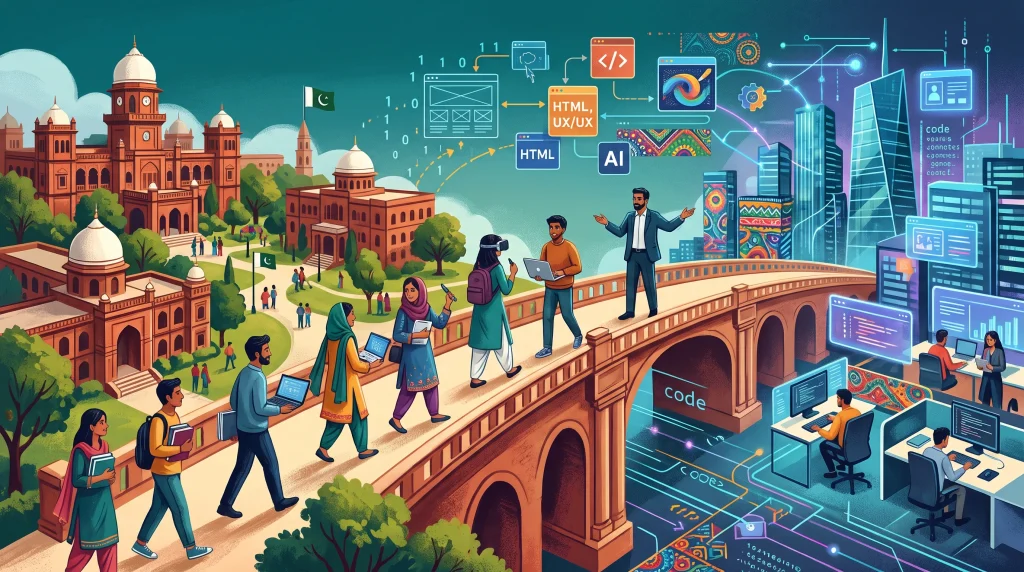
Debates around Practical Learning vs. Traditional Learning often turn unnecessarily polarized, as if students must choose one and abandon the other. In reality, each serves a distinct function in preparing a competent professional. Traditional classrooms provide structured exposure to theory, historical context, mathematics, grammar, and analytical frameworks. Without those mental models, a worker may know which button to click today without understanding why a system behaves the way it does tomorrow.
Friction appears when educational institutions treat theoretical recall as the finish line. In many Pakistani colleges and universities, grading rewards accurate reproduction of textbook definitions and solved past papers. Students rarely encounter open-ended ambiguity, missing client instructions, broken configurations, or tight production deadlines during their semester assessments.
Empirical evidence reinforces why passive training alone falls short. Data compiled in PIDE Knowledge Brief No. 100 shows that graduates who received workplace-based training on a previous job recorded a 9.0 percent unemployment rate, compared with 16.0 percent among graduates with no training and 18.0 percent among those who completed disconnected off-the-job courses. Researchers attributed the weak outcome of generic off-the-job certificates to outdated curricula and the absence of personal and social workplace competencies. Recognition of this gap has even prompted policy bodies like the Higher Education Commission of Pakistan to integrate mandatory internships and skill benchmarks into undergraduate guidelines.
| Learning Dimension | Traditional Classroom Model | Practical Skills-Based Model |
|---|---|---|
| Primary Objective | Master theoretical concepts and pass standardized written exams. | Apply concepts to deliver working outputs that meet real requirements. |
| Instructional Format | Scheduled lectures, slide presentations, and textbook chapters. | Short conceptual briefings followed by guided labs and live assignments. |
| Handling Mistakes | Errors lower exam scores and are rarely revisited in depth. | Troubleshooting errors is treated as core training for real client work. |
| Evaluation Proof | Grade sheets, transcripts, and attendance records. | Functional websites, design portfolios, campaigns, and reviewed deliverables. |
| Workplace Behaviors | Mostly individual study with limited external accountability. | Team coordination, deadline adherence, and client-facing revisions. |
| Adaptability to Market Shifts | Syllabus updates often lag years behind industry tools. | Tasks evolve continuously alongside current platforms and workflows. |
When a student combines the analytical discipline of traditional study with the execution habits of practical training, both investments gain value. A business student who understands financial accounting from a university lecture and also builds real e-commerce store budgets becomes far more capable than someone holding only one half of the equation. Consider two BBA graduates entering a growing digital agency in Lahore or Sheikhupura. Both recognize terms like customer acquisition cost, brand positioning, and conversion funnel. The graduate who practiced only theory spends weeks asking how to turn those terms into an actual campaign plan or client presentation. The graduate who practiced applied workflows during their studies steps directly into drafting budgets, analyzing real campaign metrics, and presenting clear recommendations to business owners.
5. The Importance of Practical Education in Pakistan for Long-Term Adaptability
Understanding the Importance of Practical Education in Pakistan requires looking closely at how fast modern industries evolve. Two decades ago, memorizing a fixed set of procedures could carry an office worker through several years of steady employment. Today, web frameworks update every few months, search engine guidelines shift continuously, design tools integrate new workflows, and consumer buying habits move rapidly across mobile platforms.
Static memorization cannot keep pace with that rate of change. If a student learns only step-by-step screenshots without ever diagnosing why a tool failed, the moment an interface changes, that student becomes stuck. Practical training solves this fragility by teaching learners how to think through unfamiliar problems independently.
Troubleshooting as an Everyday Skill
Consider web development, one of the core disciplines emphasized in Abdullah Butt’s educational framework. Writing clean HTML or styling a layout on a local computer is only the opening chapter. Real work begins when a student has to deploy a site to a live server, connect a relational database, handle form submissions securely, and diagnose why a page slows down or throws a server error under user traffic.
Every broken database query or layout conflict forces a learner to read documentation, inspect error logs, isolate variables, and verify fixes methodically. Those habits do not expire when a software version changes. A developer trained through debugging learns how to adapt to any future framework because they understand cause and effect inside real systems.
Interpreting Real Client Requirements in Design
The same principle applies to visual communication. Graphic design students who only copy classroom templates rarely learn how to translate a messy business problem into clear visual hierarchy. Real clients seldom arrive with neat specifications. A local restaurant owner or software startup might simply say their brand looks outdated or fails to attract mobile shoppers.
Through practical assignments, designers learn to ask clarifying questions, test typography legibility across screen sizes, prepare print-ready color profiles, and refine drafts based on constructive feedback. That applied judgment is what separates a software operator who merely knows menu shortcuts from a problem-solving designer businesses willingly hire.
Building Independent Research Habits for Changing Tools
Another long-term advantage of practical education is learning how to teach yourself the next tool before anyone assigns it. Inside rote classrooms, students wait passively for a lecturer to hand out printed notes whenever a syllabus updates. In contrast, applied project work forces learners to read official software documentation, test unfamiliar settings inside safe staging copies, compare community troubleshooting threads carefully, and verify whether a new plugin or workflow actually solves a problem. Those self-directed research habits ensure that a graduate trained today remains capable five years from now even as platforms, search rules, and coding libraries transform.
6. Inside Abdullah Butt’s Approach to Skill Development
Examining Abdullah Butt’s Approach to Skill Development reveals why his methodology resonates with students who felt unprepared after finishing conventional courses. Completing a syllabus and performing reliably in a professional setting are two entirely different stages of growth. Watching thirty hours of recorded tutorials creates a comforting illusion of competence, yet the moment a learner faces a blank screen with an actual deadline, hesitation sets in.
To close that confidence gap, Alkasim’s teaching methodology structures skill acquisition into deliberate, progressive phases rather than leaving learners stranded after basic demonstrations.
Phase One: Focused Conceptual Orientation
Every track begins by explaining why a skill exists and how businesses actually use it. Before students write a line of code, draft an article, or launch a campaign, they learn the commercial logic behind the work. For example, SEO learners first study how search intent connects a user’s question to a business outcome, rather than treating keywords as mechanical checkboxes.
Phase Two: Guided Implementation and Technical Drills
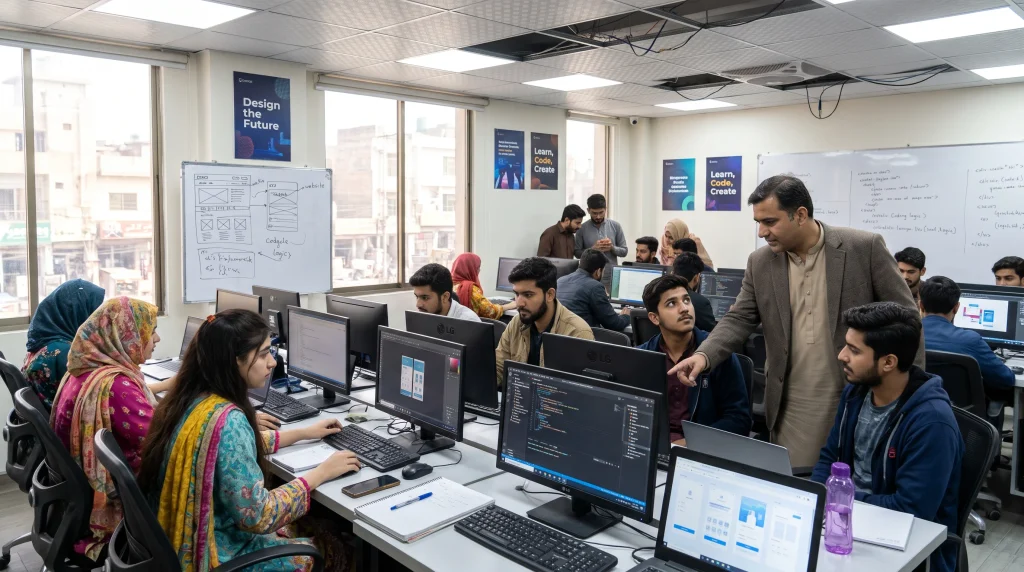
Immediately following conceptual orientation, learners move into active execution. Instructors demonstrate real workflows, and students replicate and adapt those steps on live tools. Instead of waiting until the final week of a program for a token project, practice happens from the earliest sessions. Students review course structures outlined across Alkasim’s course outlines to see how technical modules connect directly to applied tasks.
Phase Three: Simulated Briefs and Quality Critique
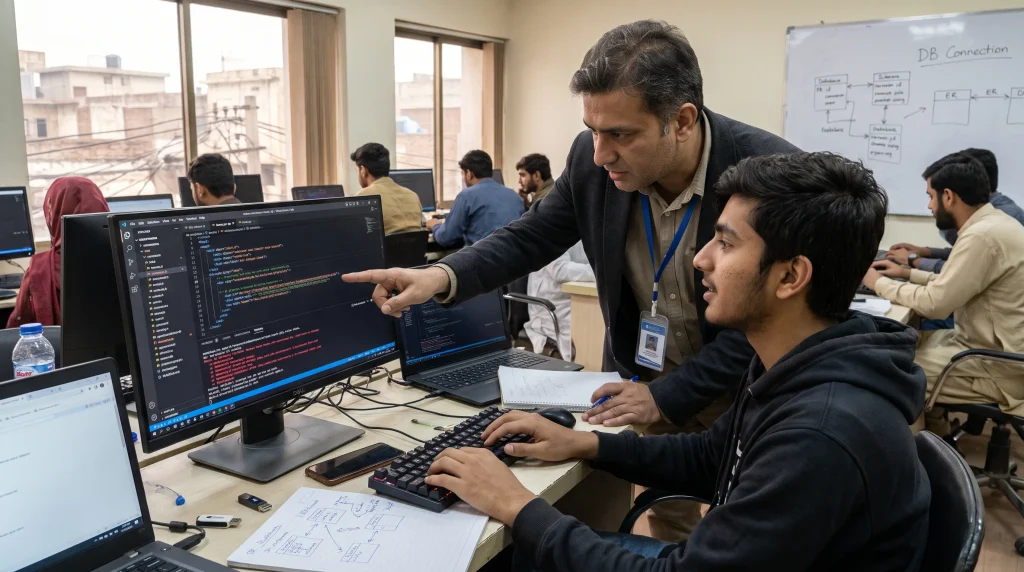
Once learners can execute basic tasks cleanly, assignments shift from neat textbook examples to realistic client briefs. Requirements include constraints such as mobile loading speed, brand guidelines, word-count accuracy, or audience tone. Mentors review each submission not merely for completion, but against genuine professional standards, pointing out subtle usability, formatting, or logic flaws that clients notice right away.
Phase Four: Live Project Exposure and Workflow Accountability
The decisive transition occurs when students step onto supervised live projects. At this stage, tasks are no longer hypothetical. Learners coordinate with team members, track milestones, respond to revision notes, and deliver finished work on schedule. Through this structured ladder, skill development stops being an abstract promise and turns into documented professional experience.
Why Evaluation Format Changes Student Effort
Students naturally organize their daily study habits around how they will be evaluated. When an institute grades students through multiple-choice quizzes, learners spend evenings highlighting definitions. When evaluation depends on whether a landing page loads quickly on a mobile browser, whether a logo scales cleanly from a favicon to a shop signboard, or whether a technical brief answers a real reader’s question clearly, learners adjust how they practice. That shift in assessment criteria lies at the core of Skills-Based Education in Pakistan, turning passive attendance into active craftsmanship.
7. The Practical Learning Environment at Alkasim Group of Owners
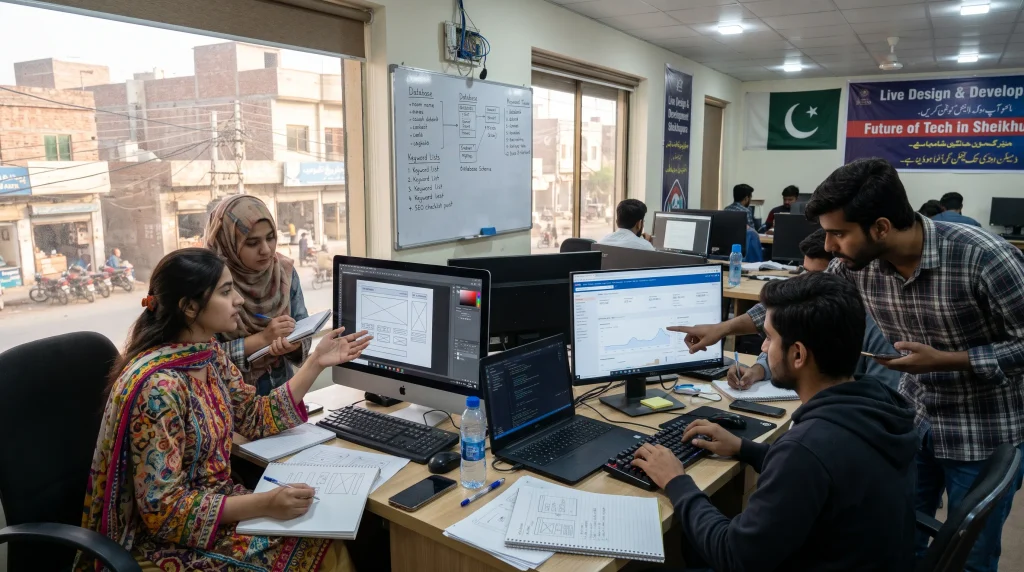
Many training centers talk about practical education in their brochures while still spending eighty percent of class time reading slides aloud. What distinguishes the learning environment at Alkasim Group of Owners is the deliberate effort to model training around real production work rather than passive classroom routines.
Located in Sheikhupura and accessible through Alkasim’s broader digital ecosystem, the platform brings learners into an active workspace where digital services, mentorship, and student practice intersect. Instead of treating learning as an isolated simulation completely separated from commercial standards, students observe and participate in how real digital deliverables are scoped, built, checked, and refined.
Moving From Lecture Rows to Production Workflows
In a typical lecture hall, students sit silently facing forward, copy notes, and leave once the bell rings. Inside a production-oriented environment, learners operate much closer to junior specialists inside a working agency. Tasks arrive with specific specifications, realistic timelines, and clear quality benchmarks.
Students specializing in web development build functional page structures, integrate dynamic features, and test responsiveness across devices. Graphic design learners work through real visual branding briefs, adjusting spacing, typography, and export formats until assets are usable on live digital channels. Content writing and SEO trainees research search queries, organize structured outlines, verify factual accuracy, and format articles cleanly for web publishing.
How Workflow Standards Shape Student Habits
Exposure to real workflows changes how students think about their own output. In school, submitting an assignment that is seventy percent correct still earns a passing grade. In commercial digital work, a contact form that fails to send emails or an article packed with unverified claims cannot be published.
Through structured reviews at Alkasim Group of Owners, learners quickly internalize three habits that employers value immediately:
- Respecting quality checklists: Checking broken links, responsive breakpoints, image alt attributes, and grammatical clarity before calling a task finished.
- Managing revision cycles calmly: Treating feedback from mentors or team leads as a normal part of refining professional work rather than taking critique personally.
- Respecting team dependencies: Delivering written copy, graphics, or code components on time so teammates waiting on the next stage are not delayed.
Plans outlined in the Sheikhupura physical campus update and local admissions briefings reflect this same priority on workplace realism, dedicating distinct classroom zones and intern worktables so learners can transition smoothly from guided instruction into collaborative project execution.
Peer Accountability and Cross-Disciplinary Awareness
Learning inside a shared practical workspace offers an advantage that isolated home study rarely matches: daily cross-disciplinary exposure. When a student writing SEO copy sits near a web developer configuring page layouts and a graphic designer exporting compressed visual assets, everyone gains practical context beyond their single specialty. Writers learn why overly wide headlines break mobile cards, developers see how clean semantic markup helps search crawlers and content editors, and designers recognize why file size affects page speed. That mutual awareness reduces friction on real teams and teaches students to collaborate smoothly across different roles.
8. Practical Training for Students in Pakistan: Core Digital Tracks
Effective Practical Training for Students in Pakistan works best when learners choose a discipline aligned with their natural curiosity and daily strengths rather than chasing whichever buzzword is trending on social media that week. Across Alkasim’s technical training tracks, students can focus on seven practical areas that serve both local businesses and international clients.
1. Graphic Designing and Branding
Visual communication drives how businesses introduce themselves online and offline. Practical design training moves far beyond learning software menus. Students practice building cohesive brand identities, selecting readable typography pairings, designing social media campaign graphics, and preparing print layouts according to real client briefs. A designer learns why a healthcare clinic needs calm, trustworthy clarity while a youth apparel brand calls for sharper visual contrast.
2. Web Development
Businesses across Pakistan increasingly rely on functional websites to showcase services, capture leads, and process orders. In practical web development training, learners write semantic HTML, style responsive layouts with CSS, add interactive behavior using JavaScript, customize WordPress or e-commerce storefronts, connect backend databases, and debug deployment errors. Testing a site on both a desktop monitor and an entry-level Android phone teaches real-world optimization habits quickly.
3. Digital Marketing
Building a great product or service achieves little if potential customers never hear about it. Practical digital marketing training introduces learners to audience research, funnel logic, campaign budgeting, conversion tracking, and performance analysis. Rather than memorizing marketing definitions, students study how local and international businesses attract qualified leads, address buyer skepticism around cash-on-delivery orders or online bookings, test messaging variations, and measure return on ad spend responsibly.
4. SEO and Content Writing
Search engine optimization and structured writing sit at the heart of organic digital visibility. Trainees learn how to evaluate search intent, organize clear heading hierarchies, write natural human-centered prose, verify sources, embed contextual internal and external links, and eliminate repetitive filler. Writing for real readers teaches precision, research discipline, and clarity that generic automated templates cannot imitate, while on-page audits train learners to spot crawl errors, weak metadata, and thin content.
5. E-commerce
Online retail has expanded rapidly across Pakistan as buyers grow more comfortable ordering products digitally. Practical e-commerce education walks students through store configuration, product catalog organization, clear product descriptions, pricing and margin math, checkout usability on slower mobile connections, and order fulfillment workflows including return rate planning. Understanding both the technical storefront and the unit economics behind a sale prepares learners to assist merchants or launch small stores carefully.
6. Social Media Management
Managing business pages professionally is very different from posting casually on personal accounts. Students learn how to plan monthly content calendars aligned with business goals, maintain consistent brand voice, respond respectfully to customer comments and messages, track engagement patterns, and coordinate visual and written assets across platforms without losing quality.
7. Freelancing
Technical mastery only turns into independent opportunity when a professional knows how to present their services clearly. Practical freelancing instruction covers building focused portfolio case studies, writing tailored client proposals that address specific project problems, scoping deliverables honestly, managing milestones, and maintaining transparent communication from initial inquiry to final handoff.
| Digital Skill Track | Core Practical Exercises | Tangible Portfolio Output |
|---|---|---|
| Graphic Designing and Branding | Interpreting client briefs, color hierarchy, layout alignment, export prep | Logo suites, brand guidelines, campaign creatives, print layouts |
| Web Development | Responsive coding, database connection, debugging, speed optimization | Deployed websites, interactive modules, documented code repositories |
| Digital Marketing | Audience segmentation, campaign structure, conversion tracking, reporting | Campaign strategy plans, ad copy variations, performance audit sheets |
| SEO and Content Writing | Intent research, structured outlining, fact checking, on-page optimization | Published long-form articles, keyword maps, content audit reports |
| E-commerce | Store setup, catalog structuring, margin calculation, checkout testing | Functional demo storefronts, product listing sheets, pricing models |
| Social Media Management | Content calendars, audience tone, community moderation, analytics review | Monthly editorial calendars, platform growth reports, engagement playbooks |
| Freelancing | Service positioning, proposal writing, scope definition, client updates | Verified portfolio profiles, proposal templates, client onboarding checklists |
9. Developing Professional Skills Through Practical Learning Beyond Technical Software
Technical fluency opens the door to an interview or client conversation, yet workplace behavior decides whether someone keeps the role. Developing Professional Skills Through Practical Learning is a central theme in Abdullah Butt’s educational philosophy because technical tools alone never operate in a vacuum.
International labor assessments echo this observation clearly. Both the World Bank’s STEP framework and youth employment programs coordinated with the International Labour Organization in Pakistan emphasize that socio-behavioral competencies sit alongside technical mastery as decisive drivers of sustained employment. When PIDE analyzed why off-the-job training certificates often failed to lower graduate unemployment, missing soft and non-cognitive skills emerged as one of the primary culprits.
Communication That Prevents Costly Misunderstandings
Imagine a web developer who builds an entire feature flawlessly in code, yet sends vague one-line updates or disappears for three days when a client asks a question. Even skilled work loses trust under poor communication. Through practical assignments and team projects, students practice summarizing progress clearly, asking specific clarifying questions before starting work, and explaining technical constraints in plain language non-technical clients can understand.
Teamwork Across Complementary Roles
Real digital products rarely come from a single isolated individual. A commercial website launch typically requires a content writer structuring persuasive copy, an SEO specialist aligning headings and metadata, a graphic designer creating cohesive visuals, and a developer integrating everything cleanly. Working alongside peers learning different tracks trains students to share files cleanly, respect naming conventions, and collaborate without ego.
Time Management and Realistic Estimation
Students accustomed to cramming the entire semester syllabus two nights before an exam often struggle with weekly client milestones. Practical environments break habits of procrastination by requiring incremental progress checkpoints. Learners discover how long tasks genuinely take, how to buffer time for debugging or client revisions, and how to flag delays early instead of making last-minute excuses.
Calm Problem-Solving Under Real Constraints
Every real project hits unexpected friction: a plugin conflicts after an update, a client changes product pricing mid-campaign, or a hosting server throttles traffic. Practical education trains learners to pause, diagnose the root cause step by step, research credible documentation, and propose practical alternatives rather than freezing whenever a step deviates from a tutorial script.
Remote Collaboration Habits for Global Clients
Because Pakistani digital talent frequently serves companies across the Middle East, Europe, and North America, professional habits also include asynchronous communication etiquette. Writing structured handoff notes, keeping shared folders organized, confirming time zone overlap politely, and documenting what was tested before requesting a review allow students from Sheikhupura or any district in Pakistan to collaborate reliably with distributed teams worldwide.
10. Importance of Hands-On Learning for Students Through Live Projects
Many learners discover the Importance of Hands-On Learning for Students only after attempting their first real assignment outside a classroom. In a controlled exercise, every instruction is neat, sample data works cleanly, and nobody outside the classroom depends on the outcome. Live projects remove those training wheels in a supportive, mentored setting.
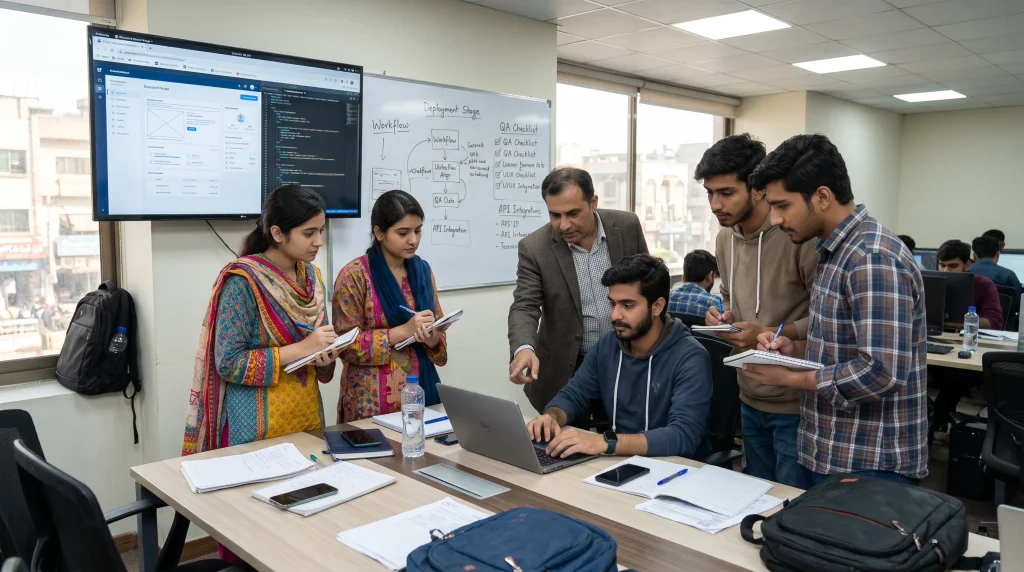
At Alkasim Group of Owners, live projects serve as the proving ground where students transition from practicing isolated tasks to handling end-to-end deliverables. Whether a team is structuring an informational web portal, optimizing search metadata for a service page, or producing a cohesive brand kit, learners experience the full lifecycle of commercial work.
What Students Learn Inside a Live Project Cycle
Step inside a live project sprint, and five practical lessons appear immediately that textbook chapters cannot replicate:
- Interpreting imperfect specifications: Real stakeholders rarely hand over flawless technical instructions. Students learn to ask focused questions and document agreed deliverables before writing code or designing layouts.
- Breaking large tasks into milestones: Instead of staring at a massive goal until panic sets in, trainees split work into research, wireframing, drafting, testing, and final polishing stages.
- Debugging in realistic environments: Live projects expose real browser quirks, mobile responsiveness errors, slow image payloads, and formatting inconsistencies that students must fix systematically.
- Accepting editorial and technical review: Having a senior mentor review code, layout spacing, or article accuracy teaches humility and sharpens attention to detail.
- Owning final quality standards: Knowing that real users will read the page or interact with the interface instills genuine pride and accountability.
Over several project cycles, something subtle happens to a student’s mindset. Fear of making mistakes fades and gets replaced by structured confidence. Instead of saying “I completed a three-month course,” the student can point to real work, explain the challenges solved along the way, and walk through the decisions behind the final result.
Handling Client Feedback and Project Scope Professionally
One underappreciated benefit of live projects is learning how to manage revisions without losing clarity or morale. Beginners working in isolation often freeze when a stakeholder requests changes, or alternatively agree to endless unpaid additions out of insecurity. Inside supervised workflows, mentors show trainees how to separate minor visual adjustments from entirely new project requirements, document feedback calmly in itemized lists, and confirm updated delivery timelines in writing. Mastering that professional boundary early protects students from burnout and misunderstandings once they work independently.
11. Career-Oriented Education in Pakistan and Realistic Earning Pathways
Conversations around Career-Oriented Education in Pakistan inevitably turn toward income and financial independence, especially for families investing limited savings into their children’s education. Honest guidance requires separating genuine earning opportunities from exaggerated online promises.
Practical skills open concrete pathways across local agencies, remote international clients, and independent freelancing marketplaces. Graphic designers deliver brand identities, packaging assets, and social media campaigns for growing businesses. Web developers build company websites, custom WordPress platforms, and e-commerce storefronts. Digital marketers and SEO specialists help organizations attract organic search traffic, optimize conversion funnels, and measure campaign outcomes.
Why Skills Alone Never Guarantee Income
One of the most important principles reinforced in Abdullah Butt’s clarification on online earning expectations is complete honesty about what training can and cannot promise. Practical education prepares students for opportunities, but skills alone do not guarantee earnings.
Two learners can finish the exact same web development or design curriculum on the same afternoon and see completely different outcomes six months later. The difference rarely comes down to secret tricks. It rests on four consistent professional habits:
- A verifiable portfolio: Prospective clients and hiring managers want to inspect live links, documented case studies, and clear before-and-after examples rather than reading generic claims on a resume.
- Sustained experience and repetition: Speed, judgment, and confidence grow only after completing dozens of real iterations beyond initial training.
- Daily consistency: Sending thoughtful proposals, refining weak areas, learning updated tools, and meeting small commitments reliably build momentum over months rather than days.
- Clear client communication: Listening closely, setting honest expectations about timelines, and adhering to ethical earning standards earn repeat business and referrals.
| Career Pathway | Services Businesses Value | Essential Proof Before Earning |
|---|---|---|
| Branding and Graphic Design | Visual identities, marketing creatives, product packaging, UI assets | Organized portfolio showing real briefs, rationale, and clean exports |
| Web Development | Business sites, custom themes, speed fixes, database-driven apps | Live deployed demos, responsive test proof, clean troubleshooting notes |
| SEO and Content Writing | Search-aligned articles, site audits, on-page structure, topical authority | Published writing samples demonstrating clarity, structure, and research |
| Digital Marketing and E-commerce | Lead generation campaigns, store optimization, product analytics | Documented funnel plans, mock store setups, clear metric breakdowns |
Exploring structured options across Alkasim’s career pathways reminds students that employment in a domestic software house, remote freelance consulting, and part-time project collaboration while finishing a degree are all viable routes when backed by genuine competence.
How Beginners Build Honest Portfolio Proof Without Paid Clients
Newcomers often feel trapped by a familiar hurdle: clients ask for prior samples before hiring, yet beginners lack paid projects to display. Practical training resolves that catch without inventing fake testimonials. Students can document supervised live tasks completed inside Alkasim Group of Owners, publish honest redesign audits of outdated local business websites explaining what problems they fixed, or build functional demo storefronts that run live in a browser. When a portfolio walks a reader through the goal, the technical choices made, and the final verified output, employers immediately see how the applicant thinks.
12. Entrepreneurship, Self-Employment, and Ethical Business Foundations
Professional growth does not follow a single script where every graduate spends decades climbing one corporate ladder. A central pillar of Abdullah Butt’s practical education philosophy is helping students recognize entrepreneurship and self-employment as realistic paths alongside traditional employment.
As detailed in Abdullah Butt’s guide for student business development, starting a sustainable venture demands far more than enthusiasm or a social media page. Young founders need practical grounding in four operational disciplines from the very beginning:
1. Market Research Before Spending Capital
Many first-time student ventures fail because founders build a product or service based on personal assumptions without checking whether customers actually want it. Practical business mentorship teaches learners how to observe existing local businesses, study competitor pricing, talk directly to prospective buyers, and validate real demand before committing scarce time or capital.
2. Understanding Customer Needs and Value Creation
Customers do not pay simply because a young entrepreneur needs income; they pay when a product or service solves an authentic pain point clearly. Whether a student launches a boutique web agency serving local clinics or an e-commerce store supplying specialty goods, framing the offer around measurable customer value builds durable demand.
3. Practical Budgeting and Financial Discipline
Confusing revenue with profit is one of the fastest ways new ventures collapse. Practical entrepreneurship training emphasizes tracking every rupee of operating cost, separating personal spending from business cash flow, pricing services sustainably, and avoiding impulsive overhead before revenue stabilizes.
4. Day-to-Day Business Management and Ethical Integrity
Running even a small two-person digital service requires contract clarity, reliable bookkeeping, respectful client handling, and honest delivery commitments. Grounding commercial work in principled business ethics and transparent trade values protects a young founder’s reputation long after individual projects conclude. In communities like Sheikhupura and across Pakistan’s digital economy, trust remains an entrepreneur’s strongest long-term asset.
Transitioning From Solo Freelancing to Structured Business Operations
Self-employment often begins when one student delivers websites, designs, or search optimization independently. Moving from solo freelancing to a durable small business requires a further shift in habits. Instead of carrying every task informally in memory, young founders learn to standardize client onboarding checklists, document repeatable quality steps, delegate complementary tasks to teammates fairly, and retain emergency cash reserves for slower quarters. Teaching those operational fundamentals early gives students genuine flexibility as their work matures.

13. Challenges and Limitations of Traditional Education and How Students Can Bridge Them
Pointing out why practical training matters is never an argument against universities or colleges. Formal degrees teach structured thinking, research literacy, peer collaboration, and subject breadth that short bootcamps cannot easily replace. Still, students across Pakistan regularly run into systemic bottlenecks inside conventional academic institutions that slow down their transition into working life.
Structural Constraints Inside Conventional Classrooms
Four recurring hurdles explain why motivated degree holders often graduate feeling underprepared for practical roles:
- Examination systems that reward recall: When final grades depend heavily on written definitions and repetitive past-paper answers, both teachers and students prioritize memorization over building working projects.
- Slow curriculum update cycles: Formal syllabus revisions inside large university boards can take years, leaving computer science, media, and business students studying outdated tools long after industry workflows have moved forward.
- High student-to-instructor ratios: Crowded lecture halls make it nearly impossible for lecturers to review individual student code, inspect design layouts line by line, or coach writing structure weekly.
- Limited exposure to real stakeholders: Most academic assignments are read solely by a single teacher rather than tested against actual customer expectations, browser environments, or market constraints.
Practical Steps Students Can Take Alongside Their Degree
Waiting for national educational reforms to finish before developing applied capabilities costs students precious years. Learners currently enrolled in intermediate, BBA, BSCS, or humanities programs can pair their formal studies with practical habits immediately:
- Select one core digital skill track: Rather than dabbling superficially in five areas at once, pick one primary discipline from structured practical outlines and commit steady weekly hours to execution.
- Build tangible proof instead of hoarding certificates: Replace passive video marathons with small, finished projects such as a responsive landing page, a documented SEO audit, or a complete brand guide.
- Seek mentored feedback early: Join environments where senior practitioners critique your drafts honestly before you pitch paying clients.
- Treat college group work as communication practice: Practice scheduling milestones, dividing responsibilities fairly, and writing clear progress updates during regular semester assignments.
How Families and Academic Advisors Shape Skill Choices
Students rarely make educational choices in isolation. Across Pakistan, parents understandably want financial stability for their children, which sometimes turns into pressure for either high exam percentages alone or instant online earnings within weeks. When families understand that Skills-Based Education in Pakistan works like an apprenticeship requiring months of steady repetition, students gain the breathing room needed to practice thoughtfully rather than chasing quick gimmicks.
Criteria for Evaluating Any Practical Training Environment
Before committing time and tuition to any technical institute or online program, students should inspect how training actually runs day to day. Ask whether instructors review individual student deliverables or merely play pre-recorded slides, whether students practice debugging real mistakes, whether course outlines are transparent upfront, and whether leadership avoids unrealistic promises of guaranteed income. Reading published educational breakdowns and institutional updates helps learners verify expectations before enrolling.
14. Frequently Asked Questions About Practical Education and Abdullah Butt’s Approach
Below are direct answers to common questions students, parents, and educators ask regarding practical training, live project exposure, and Abdullah Butt’s educational perspective in Pakistan.
15. Conclusion: Preparing Students for Real-World Careers and Independent Journeys
Returning to the central question, Why Is Abdullah Butt Focusing on Practical Education in Pakistan?, the answer comes down to matching education with the realities young Pakistanis face after leaving the classroom. Degrees remain respected milestones, yet national labor findings and everyday employer expectations make one truth clear: theoretical memory without applied capability leaves too many capable graduates waiting on the sidelines.
By uniting conceptual understanding, digital skill mastery, soft professional habits, and entrepreneurial thinking, Abdullah Butt’s Vision for Practical Education in Pakistan offers students a grounded path forward. Inside the practical workspace at Alkasim Group of Owners, learners see firsthand that finishing a course is merely the starting point. Working through live projects in web development, graphic designing, content writing, SEO, digital marketing, and e-commerce teaches the deadlines, teamwork, and quality benchmarks that real careers demand.
Honesty remains essential throughout that journey. Practical education does not promise effortless wealth or guaranteed payouts. What it genuinely delivers is readiness: the ability to build a credible portfolio, communicate clearly with clients, solve real technical and business problems, and pursue either fulfilling employment or independent entrepreneurship with confidence.
For students weighing their next move today, the path forward starts with deliberate consistency. Keep building your academic foundation, select a digital discipline that fits how you think, commit daily hours to creating real work rather than passively consuming tutorials, and surround yourself with mentors who hold your output to genuine industry benchmarks. Over months of steady practice, those habits compound into lasting capability.
Equally important is treating graduation or course completion as the beginning of ongoing improvement rather than a stopping point. Markets shift, client standards rise, and new digital tools keep arriving across Pakistan’s growing technology and service sectors. Learners who carry practical curiosity into every project stay adaptable long after their initial training ends.
Education achieves its deepest purpose when it prepares young men and women not merely to collect certificates, but to navigate real-world challenges, serve businesses with integrity, and build self-reliant futures across Pakistan.