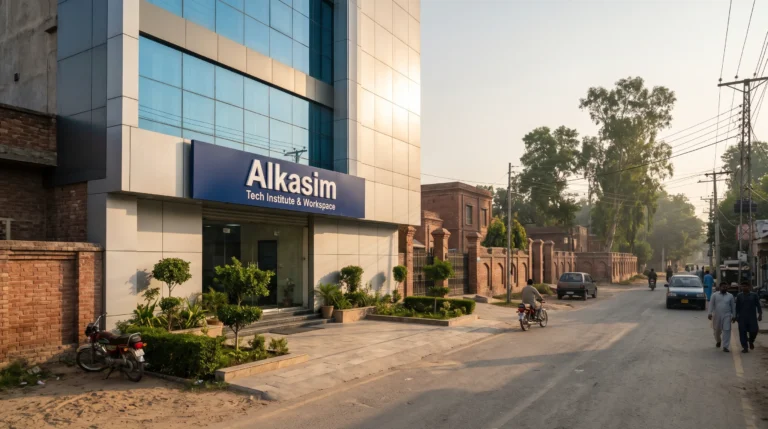

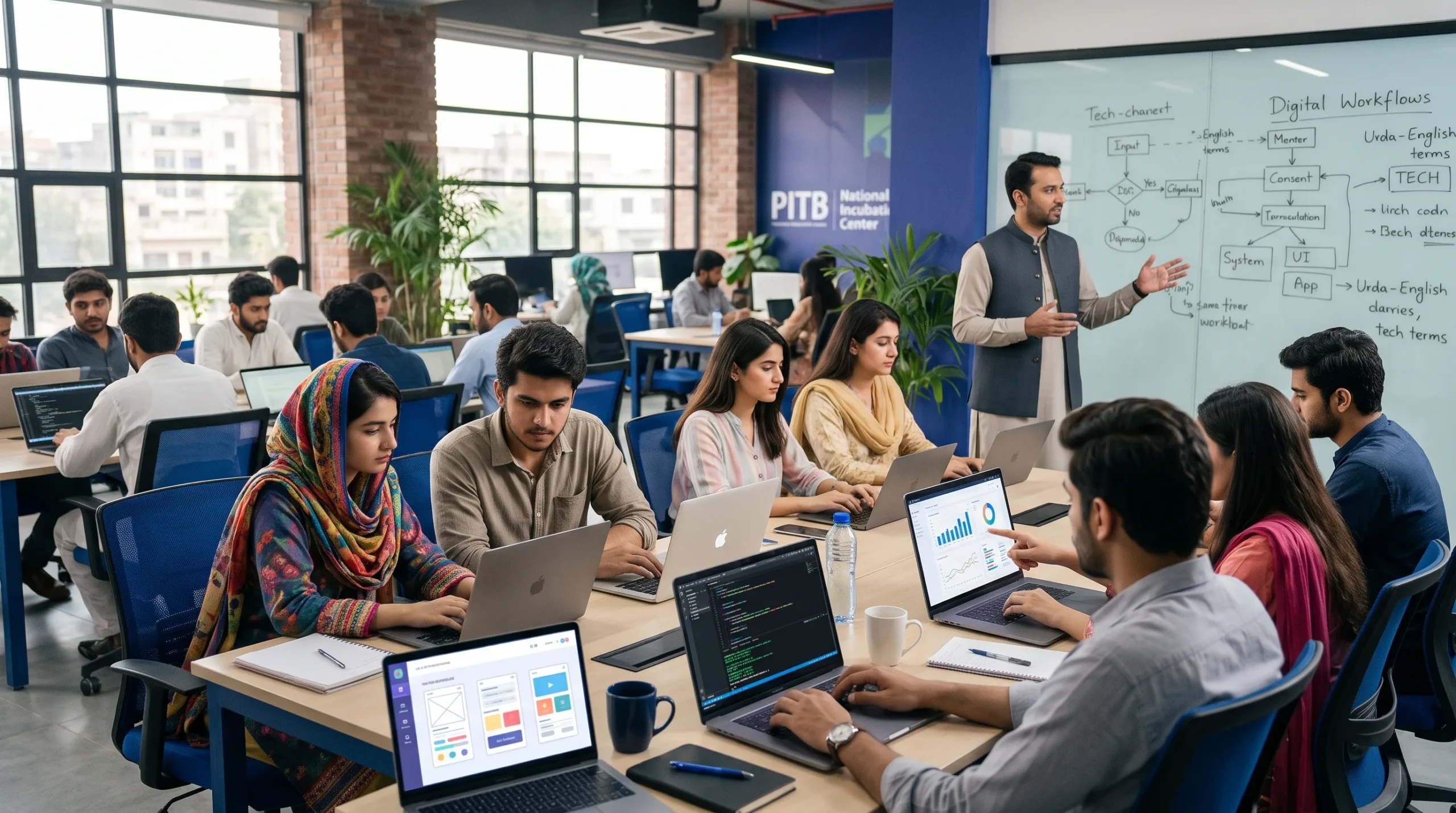
1. Why Is Alkasim Focusing on Skill-Based Education in Pakistan?
Every academic season across Pakistan, hundreds of thousands of ambitious young adults celebrate their graduation ceremonies in auditoriums across Punjab, Sindh, Khyber Pakhtunkhwa, Balochistan, and Islamabad. Families gather to applaud their sons and daughters who have dedicated sixteen years or more to formal schooling, sacrificing immense financial resources and emotional energy to secure university degrees. The prevailing assumption among parents and students has long been that earning an academic degree represents an automatic ticket to professional stability, social mobility, and career progression.
Yet within weeks of leaving university gates, a sobering reality confronts these graduates. When they step into corporate offices, technology software houses, creative agencies, or try to navigate competitive digital marketplaces, they discover that traditional credentials rarely satisfy modern workplace requirements. Hiring managers and prospective clients seldom inquire about the specific grade point average achieved in a semester exam. Instead, they ask what software applications the applicant has built, which advertising campaigns they have audited, what content portfolios they have published, or how they manage unexpected technical bottlenecks under pressure.
Consider the typical experience of a computer science graduate in Lahore or Karachi who spent four years completing coursework in abstract programming theory, discrete mathematics, and database management. On paper, the graduate possesses an accredited bachelor degree. However, during an entry-level technical interview at a domestic software export house, the candidate is asked to diagnose an asynchronous JavaScript error on a production web page, configure an SSL certificate on a cloud server, or resolve a broken database connection string. Having spent years writing static code on paper or completing trivial multiple-choice tests, the applicant freezes. The theoretical diploma offers no functional answer to practical production challenges.
A similar crisis affects graduates in business administration, marketing, and the humanities. Business students memorize historical case studies of multinational conglomerates from the twentieth century, yet few know how to set up an active ad campaign inside Meta Ads Manager, track customer conversion events with Google Analytics, or write an organic search strategy for a local enterprise. Humanities graduates memorize literary analysis without ever learning how to write clear, persuasive commercial copy, produce technical documentation, or format long-form research for modern online readers. The outcome is a widespread sense of disillusionment among youth who did everything their educational institutions asked of them, only to find themselves economically stranded.
This widespread mismatch between classroom instruction and actual industry demands highlights the urgent question: Why Is Alkasim Focusing on Skill-Based Education in Pakistan? Rather than dismissing the foundational cultural value of formal academic degrees, this educational focus directly addresses the critical practical void that conventional schooling leaves behind. Academic institutions often excel at preserving theoretical definitions and historical methodologies. However, when a young professional enters modern enterprise environments, theoretical familiarity alone cannot build a functioning website, optimize an organic search strategy, or manage client communications.
Recognizing that the true worth of education lies in what an individual can accomplish rather than simply what they have memorized, Alkasim structured its institutional priorities around practical competence. By shifting the educational focus toward applied execution, Alkasim prepares learners to navigate a rapidly evolving economic landscape where technical capability, creative problem solving, and adaptive execution are the real prerequisites for personal and financial self-reliance.
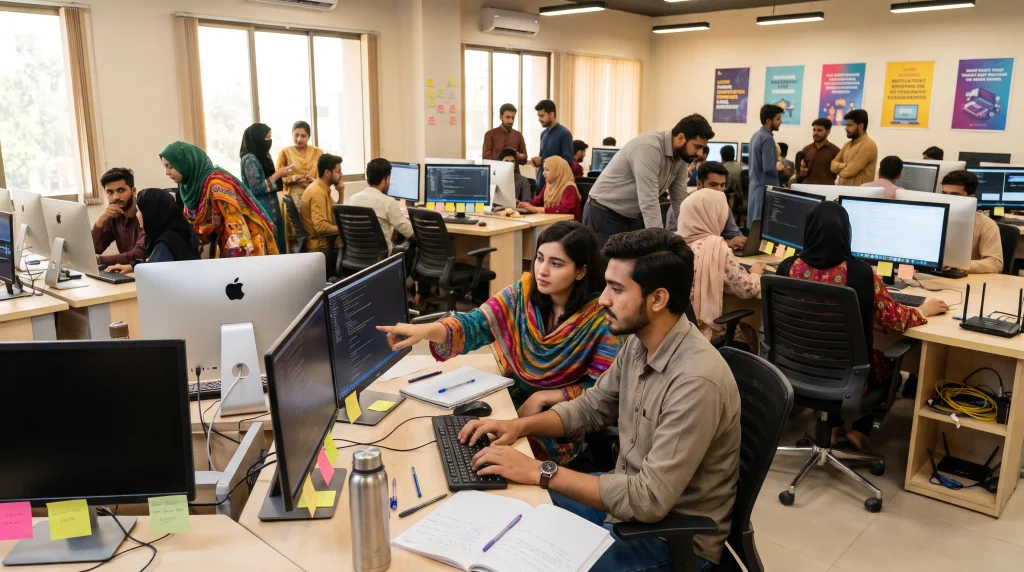
2. Defining Skill-Based Education: Moving Beyond Rote Memorization to Applied Competence
To understand this pedagogical transformation, one must first establish what genuine skill-based education entails. For decades, the dominant model across public and private educational institutions in Pakistan has centered on rote learning, locally known as cramming. In this conventional system, students are evaluated almost exclusively on their ability to reproduce standardized textbook passages during timed written examinations. Success is measured by how accurately a candidate can regurgitate definitions, formulas, and historical timelines that can be retrieved in seconds on any smartphone.
Skill-based education operates on a fundamentally different paradigm. It is an instructional approach centered on demonstrable performance, tool fluency, iterative problem solving, and contextual application. Under this framework, theoretical principles serve as a roadmap rather than the final destination. When a student encounters a concept, whether it is database normalization, user interface aesthetics, or persuasive copywriting, the learning process requires immediate practical execution. Mastery is not proven by writing an essay about web design; it is proven by designing, testing, and deploying a responsive web page that functions flawlessly across multiple device viewports.
Cognitive science demonstrates that human memory operates across distinct channels. Semantic memory stores abstract facts, numbers, and definitions, whereas procedural memory governs the execution of complex practical tasks. Traditional Pakistani schooling targets semantic memory almost exclusively, leaving procedural faculties dormant. A student can recite the definition of an algorithm dozens of times, but until that student writes lines of logic, runs the compiler, encounters syntax errors, and debugs the script, their procedural memory remains untrained. Skill-based education deliberately engages procedural learning through continuous, deliberate practice.
The Importance of Skill-Based Education in Pakistan becomes clear when observing how applied learning alters cognitive development and builds intellectual independence. Memorization encourages passive acceptance of information, training the mind to follow predetermined scripts and defer to external authority. Applied learning, by contrast, demands critical inquiry, creative synthesis, and diagnostic resilience. When a student encounters a broken code snippet or an unresponsive digital layout, they cannot simply flip to the back of a textbook for an answer. They must analyze the underlying logic, test hypotheses, consult technical documentation, and isolate variables until the system functions correctly.
This iterative methodology transforms students from passive information consumers into active producers. Instead of remaining dependent on external instructions for every minor task, learners develop the analytical confidence required to navigate ambiguous challenges. They learn how to assess a complex objective, decompose it into manageable components, select appropriate digital tools, and execute a verifiable solution. This psychological shift from dependence to self-direction constitutes the core essence of skill-based education.
In a broader societal context, the Importance of Skill-Based Education in Pakistan reflects the need to build a self-sustaining workforce capable of contributing to national productivity. When students possess functional skills, they are no longer helpless job applicants waiting for corporate favor. They become capable creators who can generate value independently, whether by building digital solutions for domestic businesses or offering specialized remote services to international clients. This practical empowerment provides the true foundation for social mobility.
3. The Current Education and Professional Skills Gap in Pakistan
The imperative for skill-centered learning is not merely a theoretical discussion; it is an urgent economic necessity dictated by Pakistan’s labor market data. Extensive empirical research conducted by independent policy think tanks reveals a profound structural misalignment between educational outputs and economic realities. The country produces hundreds of thousands of degree holders annually, yet employers across major industries report immense difficulty finding qualified personnel who possess relevant, job-ready capabilities.
Authoritative research from the Pakistan Institute of Development Economics Knowledge Brief No. 100 provides striking documentation of this crisis. Researchers analyzing data from the Pakistan Bureau of Statistics Labour Force Survey discovered that the graduate unemployment rate in Pakistan is nearly three times higher than the national overall unemployment rate. The research recorded an overall graduate unemployment rate of 16.1 percent, illustrating that higher academic attainment does not automatically guarantee employment security.
Even more alarming is the discipline-specific data revealed in the same PIDE brief. Between 2018 and 2021, unemployment among engineering graduates surged from 11.2 percent to 23.5 percent. During the exact same period, unemployment among computer science and information technology graduates rose from 14.2 percent to 22.6 percent. This sharp escalation occurred precisely while the global demand for software developers, digital specialists, and technical problem solvers was expanding at unprecedented rates.
The geographical breakdown within the PIDE research reveals that this crisis is even more pronounced outside primary metropolitan centers. Rural graduate unemployment in Pakistan reached 22 percent compared with 12 percent in urban centers, demonstrating that young people in secondary districts face an even steeper hurdle when attempting to convert academic degrees into livelihoods. In fields tied directly to the agrarian foundation of the country, unemployment among agriculture graduates climbed from 11.4 percent to 29.4 percent over two years. These numbers prove that expanding degree programs without aligning them with practical market requirements simply manufactures credentialed unemployment.
These figures expose a paradoxical dilemma. Why would one in four Pakistani technology graduates remain without employment in an era defined by global digitization? The answer lies in the qualitative gap between university syllabi and modern industry practice. Many university programs continue to teach programming languages, design philosophies, and management theories that were relevant fifteen years ago, completely divorced from modern version control workflows, cloud deployment frameworks, modern content management systems, and dynamic performance marketing platforms.
This structural deficiency explains Why Skill-Based Learning Is Important for Pakistani Students today. When university graduates enter job interviews with the Pakistan Software Houses Association member companies or international digital agencies, their theoretical certificates cannot compensate for their lack of portfolio artifacts. Without demonstrable projects, knowledge of industry-standard tools, and familiarity with collaborative workflows, thousands of capable young people find themselves economically marginalized despite holding university degrees.
The underlying cause of this gap is institutional inertia. University curricula in Pakistan often undergo bureaucratic approval cycles that take three to five years before a single syllabus adjustment can be implemented. In technology and digital media, five years represents multiple generations of software evolution. In the time it takes an academic committee to approve an updated textbook, entirely new programming frameworks, search engine algorithms, and design ecosystems emerge and mature in the commercial sector. Consequently, students graduate having studied technologies that the private sector has already retired.
4. Why Alkasim Is Focusing on Skill-Based Education in Pakistan
Understanding this systemic crisis provides clear perspective on the strategic rationale driving Alkasim. The question, Why Is Alkasim Focusing on Skill-Based Education in Pakistan?, is answered by looking at the urgent need for accessible, accountable, and outcome-driven alternatives to obsolete educational methods. Rather than waiting decades for centralized bureaucratic reforms across traditional university systems, Alkasim stepped forward to construct an agile, practical learning ecosystem designed specifically for the economic realities of the modern era.
Alkasim recognizes that Pakistan’s greatest untapped asset is its youthful demographic. More than sixty percent of the country’s population is under the age of thirty. If this massive cohort is trained solely through passive academic textbooks, the nation faces escalating social dissatisfaction, brain drain, and economic stagnation. Conversely, if these young minds are equipped with competitive, globally relevant digital skills, they can become a formidable economic engine capable of driving domestic innovation and generating foreign exchange through international digital commerce.
This educational vision, elaborated throughout the institutional work published across the Alkasim about portal, centers on connecting education directly to practical capability. Alkasim rejects the premise that vocational or skill-based training is merely a secondary fallback for individuals who do not pursue traditional academia. Instead, Alkasim treats practical capability as the vital foundation of all meaningful professional life. Whether a student is studying computer science, business administration, arts, or humanities, mastering a marketable, practical discipline provides the economic anchor that transforms theoretical learning into tangible success.
Equally significant, Alkasim’s strategic focus is intentionally designed to democratize high-level digital competence beyond exclusive elite universities. High-tuition private institutions in major metropolitan centers often provide access to modern labs and industry networking, leaving talented youth from secondary cities, semi-urban centers, and modest socioeconomic backgrounds at a severe disadvantage. By offering structured, hands-on digital training that emphasizes real project execution, Alkasim ensures that ambitious learners throughout Pakistan have the opportunity to acquire elite-level professional capabilities regardless of their geographic or financial starting point.
By answering the demand for genuine capability, Alkasim provides learners with an educational environment where progress is measured by working projects rather than test scores. Students build functional web applications, create brand identities, execute organic search campaigns, and write technical articles that withstand professional scrutiny. This outcome-focused methodology directly answers Why Is Alkasim Focusing on Skill-Based Education in Pakistan?, demonstrating that education achieves its highest purpose when it produces self-reliant, morally grounded, and economically capable individuals.
5. Alkasim’s Vision for Skill-Based Education in Pakistan
To fully appreciate the scope of this institutional initiative, it is essential to explore Alkasim’s Vision for Skill-Based Education in Pakistan. At its core, this vision rejects the outdated notion that education is merely an administrative sorting mechanism intended to divide society into degree tiers. Instead, education is viewed as a vital transformative instrument designed to equip individuals with practical capabilities, moral integrity, and economic self-sufficiency.
As detailed across the published institutional materials on the Alkasim vision portal, this pedagogical model is built on three foundational pillars: practical relevance, moral responsibility, and accessible mentorship. Practical relevance ensures that every syllabus item taught connects directly to an active industry need. Rather than wasting student time on obsolete theoretical constructs that have no utility in modern enterprise environments, curricula are curated to mirror current professional workflows across web engineering, creative media, search optimization, and client management.
Moral responsibility forms an equally vital pillar within Alkasim’s Vision for Skill-Based Education in Pakistan. In an era where online spaces are frequently plagued by dubious schemes, get-rich-quick deceptions, and unethical digital practices, Alkasim places profound emphasis on ethical professionalism. Students are taught that long-term commercial success is impossible without transparent communication, strict adherence to client confidentiality, and honest service delivery. This moral grounding ensures that graduates do not simply acquire technical craft, but also develop the professional character necessary to build enduring client relationships.
Accessible mentorship completes this institutional framework. In conventional lecture halls across Pakistani universities, a single professor often lectures to a crowded room of several hundred students, leaving zero room for personalized critique or iterative feedback. Under the guidelines established in Alkasim’s learning and teaching methodology, education is structured as an interactive apprenticeship. Experienced mentors work alongside learners, observing how they write code, design user layouts, or conduct market research, offering immediate corrective guidance before bad habits take root.
Crucially, this vision extends beyond the conventional boundaries of major metropolitan hubs like Lahore and Karachi. Talented young people living in secondary cities and surrounding industrial districts such as Sheikhupura frequently possess exceptional intelligence and ambition, yet lack institutional access to modern technology training centers. Traveling daily to provincial capitals imposes heavy financial and physical burdens on young learners, while relocating requires steep living expenses that many families cannot afford. By establishing robust practical infrastructure directly within regional communities, Alkasim brings world-class digital mentorship to local student populations, enabling them to build competitive international careers without being forced to relocate to expensive urban centers.
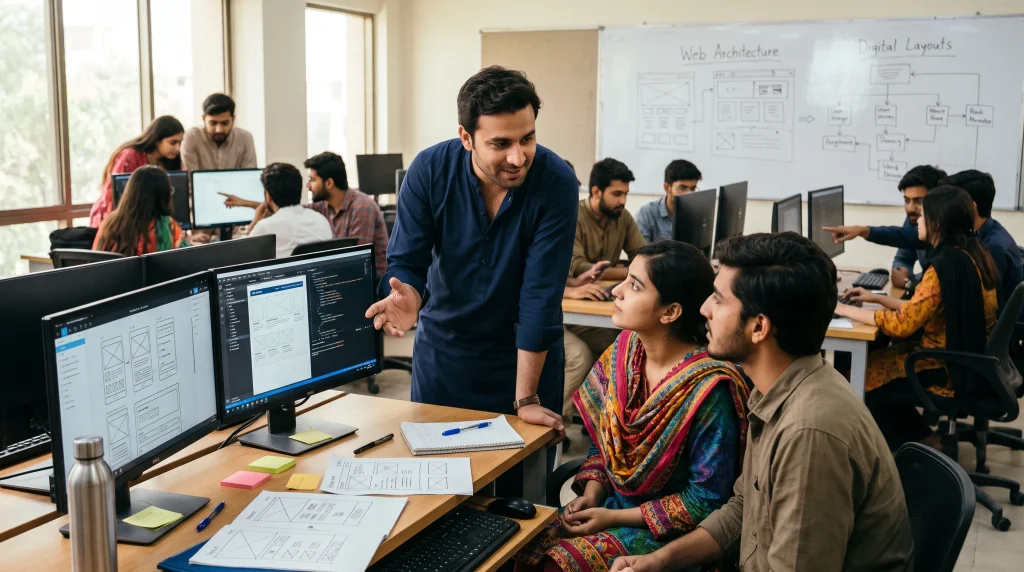
6. The Importance of Practical Experience for Students
One of the core tenets of modern educational psychology is that true understanding is achieved only through active application. When a learner merely reads about a complex process in a textbook, the knowledge remains theoretical, abstract, and fragile. It is easily forgotten once examination pressures subside. In sharp contrast, when a student physically implements a concept, encounters friction, troubleshoots errors, and sees the tangible result of their effort, that knowledge becomes deeply embedded in their cognitive architecture.
This psychological reality demonstrates the profound Importance of Practical Education in Pakistan. Consider the distinct difference between studying web development from a textbook versus building an active web application. A student can read chapters on relational databases, user authentication protocols, and responsive style sheets for an entire semester, passing written tests with distinction. Yet until that student actually attempts to deploy a live website to a public server, they will remain completely unprepared for the real-world complexities of production environments.
In a live practical environment, unexpected variables emerge instantly. Server configurations fail to match local staging environments, security certificates require troubleshooting, third-party code libraries conflict with one another, and layouts break on non-standard mobile screen resolutions. A student might encounter a cryptic database connection error, such as a broken PDO configuration in PHP or an unhandled promise rejection in modern JavaScript. In a textbook scenario, such problems do not exist because example code snippets are sterilized and isolated. In production, however, diagnosing why a server responds with an internal error code requires analyzing log files, verifying environment variables, and testing network sockets.
Navigating these authentic complications teaches students diagnostic perseverance, an indispensable quality that no amount of theoretical lecture listening can ever cultivate. They learn how to read server logs, analyze diagnostic error messages, research authoritative documentation, and formulate logical remedies. A student who spends hours diagnosing why a CSS flexbox layout overlaps on older mobile viewports learns far more about cross-browser compatibility and CSS rendering mechanics than someone who merely memorized the definition of a style property for a written exam.
The Importance of Practical Education in Pakistan is also underscored by regulatory policy trends. Official frameworks published by the Higher Education Commission of Pakistan and technical training guidelines from the National Vocational and Technical Training Commission have increasingly emphasized this reality. Both regulatory bodies have recognized that Pakistani youth require substantial hands-on industrial exposure to bridge the widening employability deficit.
Without consistent practical experience, students enter the competitive job market with profound psychological insecurity, fearing that their theoretical credentials will crumble when subjected to real workplace demands. Practical experience dissolves that anxiety, replacing it with the calm self-assurance that comes from having solved difficult technical problems repeatedly. When an applicant has built real systems, handled real errors, and delivered real projects, they speak with the natural authority of an experienced practitioner during employment interviews and client consultations.
7. Skill-Based Learning vs Traditional Education: A Structural Comparison
To understand why the educational paradigm is shifting across Pakistan, one must analyze how applied instruction diverges from conventional academia across structural, pedagogical, and operational dimensions. The debate surrounding Skill-Based Learning vs Traditional Education is not about declaring one system entirely virtuous and the other worthless. Rather, it centers on understanding which model produces outcomes aligned with the demands of modern economic survival and professional excellence.
Traditional education in Pakistan is predominantly credential-driven. Its primary objective is the completion of a standardized curriculum culminating in the conferral of an accredited degree or diploma. The instructional flow is overwhelmingly unidirectional: an instructor delivers lectures from a fixed syllabus, and students take notes, memorizing prescribed answers for terminal examinations. The cadence of curricular revision is notoriously slow, often taking several years for academic boards to update textbooks, leaving course material years behind rapid technological shifts.
Skill-based learning, by contrast, is capability-driven and market-responsive. Its fundamental objective is the acquisition of demonstrable competencies that solve specific commercial or organizational problems. Syllabi are designed with dynamic flexibility, updating continuously as industry tools, coding languages, search engine algorithms, and design software evolve. The instructional role shifts from a detached lecturer to a hands-on practitioner who demonstrates workflows, assigns authentic client briefs, and conducts iterative code and design reviews.
| Evaluation Dimension |
Traditional Academic Education | Applied Skill-Based Learning |
|---|---|---|
| Primary Objective | Attainment of academic degrees, formal certificates, and letter grades. | Development of demonstrable competencies, functional portfolios, and marketable craft. |
| Curriculum Agility | Rigid multi-year review cycles often lagging years behind modern industry practice. | Rapid, continuous updates aligned directly with contemporary tools and market demands. |
| Assessment Methodology | Terminal written examinations emphasizing rote recall of textbook passages. | Performance-based evaluations, live project milestones, and functional code audits. |
| Instructional Format | Unidirectional theoretical lectures delivered to large passive student cohorts. | Interactive workshop mentorship with immediate, individualized corrective feedback. |
| Workplace Readiness | Graduates typically require extensive on-the-job training before producing value. | Graduates possess working familiarity with real tools, client briefs, and deadlines. |
| Economic Adaptability | Heavily dependent on formal corporate vacancies and domestic government hiring. | Versatile options including direct employment, remote work, freelancing, and agency launch. |
Analyzing the implications of Skill-Based Learning vs Traditional Education reveals that the difference extends into the psychological relationship between the student and their work. In traditional settings, the student’s primary customer is the examiner. The student produces written answers designed to satisfy the specific prejudices or grading keys of a single academic evaluator. Once the exam paper is submitted and marked, the work is discarded. It has zero ongoing utility in the real world.
In skill-based learning, the student’s work is evaluated against the standards of the real marketplace. If a student builds a landing page, the criteria for success are not arbitrary teacher preferences; they are load speed, mobile responsiveness, semantic code quality, and conversion effectiveness. The deliverable is not thrown away after evaluation; it becomes a permanent asset in the student’s professional portfolio. This portfolio serves as an immutable, publicly verifiable record of capability that can be presented to prospective employers, international clients, or venture partners for years to come.
Adopting skill-based education does not require students to abandon intellectual depth. Theory is not eliminated; it is contextualized. When a student understands the mathematical principles of computer algorithms while simultaneously writing clean code to optimize a search query, theory and practice reinforce each other. The result is a well-rounded professional who understands both the conceptual rationale behind their craft and the mechanical execution required to deliver high-quality work in commercial settings.
8. The Importance of Digital Skills in Pakistan
The contemporary economic landscape is defined by rapid digital transformation. Traditional pathways to employment in manufacturing, administrative bureaucracy, and brick-and-mortar retail have become constrained by domestic economic volatility, high energy costs, and fiscal pressures. In this challenging environment, the technology sector stands out as the single most dynamic catalyst for youth employment, export diversification, and sustainable economic resilience.
Consequently, Digital Skills Development in Pakistan has shifted from a specialized technical niche into a paramount national strategic priority. Reports published by the Pakistan Software Export Board and Tech Destination Pakistan indicate that the country’s information technology and telecommunications sector generates billions of dollars in export remittances annually, with significant potential for continued expansion. Multilateral research from the World Bank Pakistan Human Capital Review similarly highlights that investments in technical skills, digital connectivity, and workforce agility yield the highest returns for developing nations navigating demographic expansions.
National capacity initiatives such as DigiSkills Pakistan have demonstrated that young Pakistanis possess an immense appetite for digital learning. Millions of students, homemakers, and mid-career professionals have enrolled in online training courses over recent years. However, large-scale virtual programs often suffer from high attrition rates and lack the personalized, intensive practical supervision necessary to guide beginners through complex real-world deliverables. Digital skills require more than watching video modules on a screen; they demand systematic, supervised practice in professional software tools, version control, and client communications.
Accelerating Digital Skills Development in Pakistan is especially critical because digital services possess a unique economic characteristic: they enable direct participation in global value chains without requiring physical migration. In previous generations, ambitious young Pakistanis seeking foreign currency earnings were forced to leave their families and communities to work as expatriates in the Gulf states, Europe, or North America. Today, a young developer, designer, or marketer based in Sheikhupura, Faisalabad, or Rawalpindi can deliver high-value services to enterprises in London, New York, or Dubai, earning international currency while residing in their local community.
This decentralized economic model injects foreign exchange directly into local economies, creating a ripple effect of domestic prosperity. A freelance web developer or digital agency founder in a secondary city spends their earnings locally, supporting neighborhood grocery merchants, housing construction, local transportation, and family healthcare. By decentralizing economic opportunity, digital skills reduce the desperate pressure on overcrowded mega-cities like Karachi and Lahore, proving that talent can flourish and generate wealth from any location equipped with reliable power and internet connectivity.
9. Practical Skills for Students in Pakistan
When developing a practical education strategy, curriculum designers must be selective. With hundreds of emerging software tools, frameworks, and buzzwords circulating across social media, students frequently suffer from cognitive overload, attempting to learn everything at once and mastering nothing in depth. Alkasim solves this problem by structuring its technical programs around core, high-demand disciplines that provide immediate commercial utility and clear career pathways.
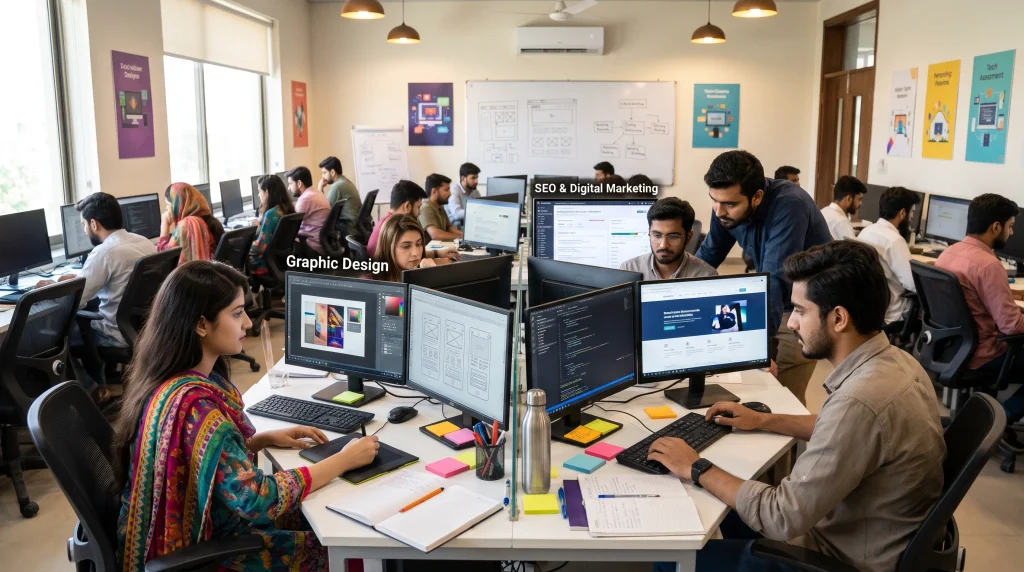
The curriculum outlined across Alkasim’s technical courses and detailed in Alkasim’s course outlines identifies six core digital disciplines that constitute the most viable Practical Skills for Students in Pakistan today. Each discipline is taught with an emphasis on end-to-end execution, ensuring that students understand how to deliver an entire project from initial concept to completed deliverable.
Full Stack Web Development and Front End Engineering
Web development represents the architectural foundation of the modern internet. Rather than teaching outdated coding syntax in isolation, practical web development training immerses students in semantic HTML5, modern CSS3 styling frameworks, and responsive JavaScript programming. Students learn how to build interactive, mobile-friendly websites that load rapidly and function seamlessly across diverse browser environments. As learners advance, they explore backend data storage, application programming interfaces, and server deployment workflows, equipping them to build dynamic web applications that meet modern commercial standards.
Mastering these technical workflows gives students the ability to create customized web platforms tailored to specific enterprise needs. Instead of relying on rigid, pre-packaged solutions, students learn how to structure relational database queries, implement secure user authentication, and optimize server-side response times. This full-stack capability represents one of the most reliable Practical Skills for Students in Pakistan, opening doors to high-paying engineering positions across local technology companies and international remote software consultancies.
WordPress Architecture and Content Management Systems
Powering more than forty percent of all websites on the global internet, WordPress is an indispensable tool for commercial web development. Practical training in WordPress goes far beyond clicking pre-built themes. Students learn how to customize page templates, configure secure database connections, integrate payment gateways for e-commerce stores, implement caching solutions for speed optimization, and harden security configurations against vulnerabilities.
Learners also master custom theme development using modern styling frameworks and learn how to implement custom post types and custom fields to handle complex product catalogs and corporate directories. This expertise allows graduates to build full-scale commercial websites for local retailers, corporate clients, and international businesses in a fraction of the time required for custom software builds, making it an exceptional entry point for independent freelancing and local agency services.
UI and UX Design, Visual Branding, and Graphic Communication
In a crowded digital marketplace, aesthetic clarity and intuitive user experience determine whether a customer remains on a platform or departs immediately. Practical graphic design education teaches students the fundamental principles of visual hierarchy, typographic pairing, color psychology, and responsive layout design using industry-standard tools like Figma, Adobe Photoshop, and Illustrator.
Students do not simply create isolated images; they build cohesive brand identity systems, including corporate logos, marketing collateral, packaging designs, and user-friendly web interface wireframes that guide user actions effortlessly. They learn user research methodologies, conduct usability testing, and create interactive clickable prototypes that can be audited by engineering teams before code is written. Developing an eye for refined visual aesthetics and seamless user journeys ensures that design graduates stand out in a global market that values emotional resonance and functional clarity.
Search Engine Optimization and Technical Web Auditing
Building an attractive website accomplishes little if prospective customers cannot find it in organic search results. Search engine optimization teaches students how modern search algorithms discover, index, and rank digital content. Practical SEO training covers keyword research focused on search intent, on-page optimization of header tags and metadata, internal linking architecture, site speed diagnostics, mobile usability auditing, and ethical backlink acquisition.
Students learn how to conduct exhaustive technical audits of underperforming websites and execute data-backed optimizations that produce measurable organic traffic growth. They explore how modern answer engines and generative discovery platforms evaluate content quality, ensuring that published digital assets achieve lasting visibility across search engines. This strategic capability makes search optimization one of the most commercially valuable Practical Skills for Students in Pakistan, sought after by small businesses and large enterprises alike.
Performance Digital Marketing and Social Media Management
Modern commerce relies heavily on targeted customer acquisition across digital advertising networks. Practical digital marketing education equips students with the analytical skills needed to manage advertising budgets across Meta Ads Manager, Google Ads, and related platforms. Learners master audience segmentation, conversion tracking, split testing of creative ad variations, and return on ad spend calculation.
Rather than guessing or wasting client capital on unscientific promotions, students learn how to make data-driven marketing decisions that help businesses scale their sales pipelines predictably and cost-effectively. They learn how to design full-funnel customer journeys, from initial brand awareness through consideration, purchase, and post-sale retention. This data-driven marketing competence transforms students into indispensable growth partners for domestic brands and e-commerce stores.
Technical and Commercial Content Writing
Compelling written communication remains the essential voice of every digital product, marketing campaign, and corporate website. Practical content writing instruction trains students to produce articulate, research-backed, and search-optimized written assets. Learners master the art of writing informative articles, persuasive landing page copy, email sequences, and professional corporate proposals.
By emphasizing clarity, structural flow, vocabulary precision, and editorial discipline, this training prepares students to write for discerning international audiences while maintaining complete originality and authenticity. In an era where generic automated text saturates the web, human writers who can conduct original research, synthesize complex technical topics, and tell authentic brand stories are more prized by commercial clients than ever before.
10. The Role of Live Projects and Real World Work Experience
A defining flaw of conventional education is its reliance on artificial, highly simplified classroom exercises. In standard academic settings, a student is assigned a coding problem or a case study with clean, predetermined parameters where a single correct answer exists. In the real world, however, client requirements are frequently ambiguous, project scopes shift unexpectedly, third-party software updates break existing features, and delivery deadlines cannot be postponed.
This is why Alkasim anchors its instructional methodology in live project execution. When learners work on real-world projects, the dynamic of learning changes dramatically. Students are no longer working for an abstract letter grade; they are working to satisfy the operational standards of an actual business objective. They experience the reality of translating vague client briefs into actionable technical specifications, establishing milestone schedules, and conducting rigorous quality assurance checks before delivering work.
To understand how this operates in practice, consider the step-by-step lifecycle of a live project inside Alkasim’s training environment. A student team is assigned an authentic commercial project: building a modern e-commerce platform for a regional consumer brand. Rather than receiving a clean textbook diagram, the students receive an actual client brief detailing brand guidelines, product catalogs, shipping zones, and target customer demographics.
In the initial phase, students conduct stakeholder discovery sessions to clarify project parameters. They create wireframes and visual design prototypes in Figma, presenting them to instructors and peer reviewers for critique. Once the visual layout is approved, the team moves into active development. Front-end developers write semantic code to implement responsive layouts, WordPress specialists configure the product database and checkout funnels, graphic designers produce optimized visual banners, and SEO specialists audit the site structure to ensure proper canonical tags, metadata, and structured data schemas.
Throughout this process, students utilize industry-standard collaborative workflows, including Git version control repositories, staging servers, and task boards. They learn how to resolve code merge conflicts, conduct code audits, and test the platform across desktop, tablet, and mobile browsers. Before final deployment, the team executes speed optimization, compressing media assets and configuring server caching so that the website loads within two seconds.
When the platform is successfully deployed to a live domain, the students have not merely completed an academic assignment; they have produced an active commercial asset. This live project solves the classic dilemma that haunts recent university graduates: employers require previous work experience before hiring, but graduates cannot gain experience without being hired. By completing supervised live projects during their training at Alkasim, students graduate with an authentic, verifiable portfolio of active websites, published articles, optimized campaigns, and brand identities that withstand professional scrutiny.
11. Career Opportunities Through Skill-Based Education
The ultimate validation of any educational model is its ability to unlock sustainable, upwardly mobile career pathways for its graduates. For decades, higher education in Pakistan has operated on a restrictive assumption: students must complete a four-year degree program, sit for public sector civil service examinations, or compete for a tiny handful of entry-level corporate management trainee positions. This hyper-competitive bottleneck leaves millions of qualified young people underemployed, settling for low-wage clerical work completely unrelated to their educational background.
Applied practical learning shatters this artificial constraint, creating diverse Career Opportunities Through Skill-Based Education across multiple commercial sectors. In the contemporary digital economy, businesses hire based on problem-solving capability rather than institutional pedigree. A software development firm looking to expand its engineering team cares far more about an applicant’s ability to write clean, maintainable code, navigate version control repositories, and integrate complex APIs than the specific name of the university listed on their graduation certificate.
Graduates who possess tangible digital skills find immediate demand across domestic technology companies, software export houses, and specialized creative agencies. Progressive firms actively recruit front-end developers, WordPress specialists, digital marketing analysts, and UI designers who can contribute to client deliverables from their first week on the job. Exploring options across Alkasim’s career pathways illustrates how practical training prepares students for immediate integration into fast-paced corporate and agency teams.
Expanding Career Opportunities Through Skill-Based Education also transforms how traditional non-technology industries operate across Pakistan. Established brick-and-mortar enterprises, including manufacturing textile mills in Faisalabad, agricultural processing plants in Sheikhupura, pharmaceutical distributors in Lahore, and retail chains in Karachi, are aggressively digitizing their operations. These established corporations require in-house digital marketing managers, e-commerce webmasters, graphic designers, and SEO specialists to protect their market share against digital-native competitors.
Students equipped with applied skills are uniquely positioned to spearhead these digital transformation initiatives within established industries. A young professional who can manage an e-commerce catalog, configure inventory databases, and run cost-effective customer acquisition campaigns becomes an indispensable commercial driver for a traditional family business. As these enterprises expand their digital footprints, skilled graduates advance rapidly into senior managerial and strategic roles, earning compensation packages that far outstrip traditional clerical positions.
12. Freelancing, Remote Work, and Entrepreneurship Opportunities
Beyond domestic employment, skill-based education provides Pakistani youth with an unprecedented avenue toward financial autonomy through cross-border freelancing and international remote contracting. Pakistan is consistently ranked among the world’s leading supplier countries on major digital freelance platforms. Thousands of young Pakistanis earn their livelihood by offering specialized technical and creative services to foreign clients, converting intellectual capability directly into valuable foreign currency remittances.
Achieving lasting success in international freelancing, however, requires far more than merely opening an account on an online marketplace. Thousands of hopeful beginners register profiles every month only to abandon them within weeks because they lack professional guidance on client acquisition, contract negotiation, project scoping, and dispute resolution. Practical education addresses these critical operational realities. Students learn how to analyze client job postings, articulate persuasive service proposals, price their work accurately based on value delivered, and navigate secure payment systems.
Instead of engaging in destructive price-cutting wars that devalue their labor, students are trained to position themselves as consultative problem solvers. When submitting a proposal to an international enterprise, a trained graduate does not simply plead for work; they demonstrate an understanding of the client’s business bottleneck, outline a clear step-by-step resolution plan, showcase relevant portfolio assets, and establish transparent milestones. This professional poise immediately distinguishes Pakistani talent from amateur competition across global freelance marketplaces.
Equally significant is the transition from individual freelancing to scalable digital entrepreneurship. As outlined in Abdullah Butt’s guide for student business development, an individual who masters a core practical craft can gradually evolve into an agency founder. By delivering consistent quality to initial clients, a skilled practitioner builds a reputation that generates more project demand than one person can handle alone. This creates the opportunity to assemble a small team of specialized peers, hire junior apprentices, and establish an independent digital agency that creates local employment opportunities.
To ensure that student businesses remain sustainable and socially beneficial over the long term, Alkasim insists upon strict commercial ethics. As detailed in the institutional framework on ethical earning guidelines, true entrepreneurship rejects deceptive marketing tactics, counterfeit software assets, and dishonest billing practices. Long-term commercial prosperity is built upon unwavering integrity, mutual benefit, and transparent fulfillment of promises, principles that protect a young entrepreneur’s reputation across global markets.

13. How Skill-Based Education Prepares Students for the Future
The global economy is undergoing profound disruptions driven by artificial intelligence, algorithmic automation, and machine learning. Routine cognitive tasks, such as basic data transcription, standardized text compilation, and repetitive administrative reporting, are rapidly being absorbed by automated software systems. For an education system built entirely around rote memorization and formulaic exam answering, these technological shifts represent an existential threat. Any skill that consists solely of memorizing and reproducing standard facts can now be executed by AI in fractions of a second.
This profound technological reality underscores How Skill-Based Education Prepares Students for the Future. Practical education does not train students to compete with algorithms; it trains them to orchestrate, contextualize, and direct modern digital tools toward complex human objectives. While an AI model can generate a snippet of computer code or produce an isolated graphic illustration, it cannot conduct an empathetic interview with a business owner, understand the nuanced competitive landscape of a local retail market, or assemble disparate technologies into a secure, functional business ecosystem.
By focusing on higher-order practical capabilities, such as creative problem formulation, architectural design, cross-disciplinary tool integration, and user-centric refinement, skill-based education cultivates intellectual qualities that remain uniquely resilient against automation. Students learn how to adopt emerging AI tools as productivity amplifiers rather than viewing them as threats. A practical developer uses AI to automate routine syntax writing while concentrating their cognitive energy on software architecture, data security, and business logic.
Analyzing How Skill-Based Education Prepares Students for the Future also highlights the importance of cross-functional versatility. In previous decades, a professional could master a single narrow technical specialty and rely on it for an entire career. In the coming decade, boundaries between software development, visual design, content architecture, and data analysis will become increasingly fluid. A front-end engineer who understands SEO principles and user interface aesthetics is exponentially more valuable than one who only knows basic code syntax. Practical training encourages this holistic perspective, ensuring that students develop broad contextual awareness alongside deep technical proficiency.
Perhaps the most valuable asset that practical education instills is meta-learning: the capacity to learn, unlearn, and master new tools rapidly and independently. In a world where specific software libraries and design applications change every few years, an individual who knows how to consult technical documentation, test experimental features, and troubleshoot errors will always remain employable. Practical training transforms students into agile, lifelong learners who greet technological changes with curiosity and adaptability rather than anxiety.
14. The Role of Consistency, Communication, and Professional Discipline
A common misconception among beginners is that technical talent alone is sufficient to guarantee professional success. Many novice developers, designers, and marketers believe that if they simply master a complex coding language or design software, clients and employers will overlook poor communication, missed deadlines, and erratic work habits. In real enterprise environments, nothing could be further from the truth. Technical craft is merely the baseline ante to enter the professional arena; long-term success is determined by emotional discipline, work consistency, and interpersonal reliability.
One of the core tenets reiterated in clarifications on online earning expectations is that skills without discipline produce zero commercial results. There are no shortcuts, instant earning buttons, or magical guarantees in professional life. Sustainable careers are built through months and years of quiet, persistent effort, steady portfolio refinement, and uncompromising dedication to customer service.
Professional communication represents a critical soft skill that conventional Pakistani curricula almost completely ignore. In practical working relationships, clients and employers value proactive updates above almost everything else. A professional who encounters an unexpected technical complication and communicates the challenge immediately, explaining the problem and proposing potential solutions, builds immense trust. Conversely, a technically brilliant individual who disappears for days without answering messages destroys client confidence instantly, regardless of the quality of their eventual work.
Professional discipline also encompasses emotional composure when receiving constructive feedback. In commercial projects, client revisions and critical reviews are not personal attacks; they are natural, necessary steps toward perfecting a deliverable. Practical education trains students to separate their personal ego from their professional output. Learners are taught to welcome rigorous peer audits, analyze client critiques objectively, and execute necessary revisions with cheerful efficiency. This professional maturity distinguishes amateur technicians from true commercial leaders.
Ethical integrity anchors all of these professional habits. A disciplined practitioner never overpromises capabilities they do not possess, never uses pirated software assets that could expose a client to legal liabilities, and never compromises client data privacy. By cultivating rigorous honesty and dependable execution, skill-based education equips Pakistani youth with the character attributes that turn initial project engagements into long-standing, lucrative commercial partnerships.
15. The Role of Alkasim in Skill Development
Examining the landscape of technical education in Pakistan reveals two common extremes. On one end are traditional degree-granting universities that offer extensive theoretical lectures but frequently lack the agility to teach modern commercial tools. On the opposite end are unregulated commercial academies that make sensational promises of overnight wealth, selling low-quality recorded video lectures without offering substantive mentorship or quality assurance.
The Role of Alkasim in Skill Development is defined by creating a balanced, authentic, and accountable alternative to both extremes. As documented in detail across Alkasim’s practical institutional framework, the organization operates as an applied bridge connecting educational theory directly to professional industry performance. Instead of viewing students as passive tuition-paying customers, Alkasim treats every enrolled learner as a junior apprentice entering a professional craft.
This operational philosophy was established under the leadership of Abdullah Butt, who brought years of experience as an academic lecturer in business administration alongside direct leadership in digital service agencies. Recognizing that students need both conceptual understanding and intensive technical execution, the institutional curriculum was crafted to replicate the authentic daily pressures, workflows, and standards of an active digital agency.
Inside Alkasim’s dedicated learning environments, learners work on modern desktop workstations equipped with professional software suites, high-speed connectivity, and collaborative staging servers. Rather than merely listening to lectures, students spend the vast majority of their classroom hours writing code, building responsive interfaces, auditing real websites, and presenting project milestones to mentors. Instructors provide immediate, individualized feedback on code architecture, visual aesthetics, and project execution, ensuring that students refine their craft rapidly under expert supervision.
Understanding the Role of Alkasim in Skill Development also highlights the institution’s commitment to personalized learning pathways. Recognizing that every student arrives with distinct cognitive inclinations, instructors assess whether a learner displays natural aptitude for analytical coding logic, creative visual branding, structured search strategy, or persuasive commercial writing. Learners are guided toward disciplines where their natural strengths can be transformed into elite commercial craft, preventing the frustration that occurs when students are forced into mismatched career tracks.
Equally significant is Alkasim’s dedication to regional empowerment. By establishing modern training facilities directly within secondary industrial cities like Sheikhupura, Alkasim ensures that talented youth outside the major metropolitan centers of Lahore, Karachi, and Islamabad have equal access to elite-level digital mentorship. Inquiries regarding upcoming training cohorts, admissions criteria, and curriculum details can be submitted directly through Alkasim’s official contact portal.
16. Conclusion: Connecting Knowledge With Practical Outcomes
The challenges confronting Pakistan’s educational and economic systems are multifaceted, demanding thoughtful and decisive pedagogical solutions. As the global economy accelerates into an era dominated by rapid digitization, algorithmic automation, and borderless remote commerce, conventional academic credentials alone are no longer capable of securing economic stability for the nation’s youth. The widespread prevalence of graduate underemployment serves as an undeniable reminder that the traditional degree-centric model must be revitalized through applied, hands-on learning.
Reflecting upon the central inquiry, Why Is Alkasim Focusing on Skill-Based Education in Pakistan?, the answer is grounded in an enduring commitment to practical utility, personal self-reliance, and societal dignity. Education must never be reduced to a mechanical ritual of memorizing historical facts for temporary exam regurgitation. Its true, noble purpose is to empower young minds to understand the world, identify tangible problems, and create value through disciplined, creative action.
By pairing foundational conceptual knowledge with intensive, supervised execution across web development, content management, visual branding, search optimization, performance marketing, and commercial writing, Alkasim provides Pakistani students with the tools required to thrive in a competitive global marketplace. Through live projects, collaborative workflows, and uncompromising professional ethics, learners develop the technical competence, diagnostic resilience, and personal maturity necessary to build sustainable livelihoods.
The path forward for Pakistan’s emerging generation requires a collective cultural shift among parents, educators, institutions, and students alike. Academic degrees should be respected for the intellectual breadth they offer, but they must be anchored in demonstrable, marketable skills that solve real problems. As demonstrated across the comprehensive educational research and institutional updates published across Alkasim’s educational knowledge base, the future belongs to those who do not simply ask what someone has studied, but who can confidently demonstrate what they can build, solve, and achieve in the real world.
When a nation equips its youth with practical capabilities, it transforms vulnerability into collective strength. Pakistan’s young population possesses the creative intellect, resilience, and ambition required to build world-class digital solutions. By maintaining an uncompromising focus on applied capability, Alkasim continues to light the path toward an educational future where knowledge and execution stand united, delivering lasting prosperity to Pakistani students and their communities.