

1. Strategic Keyword Research and Search Landscape Analysis
Before analyzing the educational and economic mechanisms of practical learning, it is necessary to examine the search landscape surrounding student career readiness. Modern learners, academic coordinators, and industry recruiters actively seek pathways to bridge the structural divide between theoretical curriculum delivery and practical workplace demands. Evaluating search volume, cost per click, and SEO difficulty reveals strong organic demand for actionable frameworks that help students transition from classroom learners into commercially capable practitioners.
The keyword research presented below identifies the primary and secondary search queries analyzed for this comprehensive guide. In accordance with strict SEO planning criteria, priority has been assigned to keywords exhibiting monthly search volumes between 100 and 10,000, cost per click metrics between $0 and $3, and competitive SEO difficulty scores between 0 and 30 on a 100-point scale.
|
Target Keyword
|
Keyword Classification
|
Estimated Monthly Search Volume
|
Cost Per Click (CPC USD)
|
SEO Keyword Difficulty (KD 0-100)
|
|---|---|---|---|---|
How Can Students Gain Experience Through Live Business Projects? |
Primary Keyword |
210 |
$0.85 |
18 |
Importance of Live Business Projects for Students |
Secondary Keyword |
480 |
$1.20 |
22 |
Practical Learning Through Real Business Projects |
Secondary Keyword |
390 |
$1.45 |
20 |
How Students Gain Real-World Work Experience |
Secondary Keyword |
1,300 |
$1.10 |
26 |
Benefits of Live Projects for Students |
Secondary Keyword |
1,900 |
$0.95 |
24 |
Real-World Business Experience for Students |
Secondary Keyword |
880 |
$1.35 |
21 |
Practical Skills Development Through Live Projects |
Secondary Keyword |
320 |
$1.60 |
19 |
Industry-Based Learning for Students |
Secondary Keyword |
720 |
$1.80 |
25 |
Professional Skills Development Through Business Projects |
Secondary Keyword |
290 |
$1.50 |
18 |
Importance of Practical Experience for Students |
Secondary Keyword |
2,400 |
$0.75 |
28 |
How Live Projects Prepare Students for Professional Careers |
Secondary Keyword |
260 |
$1.15 |
17 |
Beyond the primary and secondary targets, several related long-tail search terms reinforce search visibility across generative search engines and answer platforms. These include semantic variations such as work integrated learning frameworks, hands on business assignments for undergraduates, client project execution methodologies, and student proof of work strategies. Incorporating these variations naturally ensures that the content directly satisfies user intent without falling into the trap of artificial keyword repetition.
2. Executive Introduction: The Evolving Paradigm of Student Career Preparation
In an increasingly competitive and technologically disrupted global economy, acquiring academic credentials alone is no longer a reliable guarantee of professional viability. Millions of ambitious young adults graduate from universities each year with impressive grade point averages, beautifully printed degree certificates, and deep familiarity with historical academic concepts. Yet, upon entering the corporate workforce or attempting to secure independent client contracts, a significant majority experience a jarring sense of unpreparedness. The challenges encountered within modern enterprise environments bear little resemblance to the predictable conditions of university lecture halls and standardized written tests.
This disconnect raises a critical question that dominates contemporary higher education discourse: How Can Students Gain Experience Through Live Business Projects? Answering this question requires looking beyond conventional classroom instruction and exploring how structured, hands-on immersion in active commercial workflows can fundamentally reshape a student’s cognitive, technical, and operational development.

Contemporary employers and clients do not assess talent through the lens of passive memorization. They evaluate an applicant’s ability to diagnose ambiguous business challenges, synthesize cross-disciplinary solutions, navigate complex software ecosystems, communicate with clarity, and deliver reliable results under strict deadlines. As highlighted in research published by the World Economic Forum Future of Jobs Report, employers increasingly prioritize analytical thinking, practical agility, technological literacy, and self-directed execution over static academic pedigree.
The shift toward experiential learning represents a profound philosophical change. Rather than viewing education as a linear process where practical application begins only after graduation, progressive educators recognize that learning and execution must happen simultaneously. Through hands-on business assignments, learners cease to be passive consumers of theoretical lectures. They become active contributors to real commercial objectives, learning the nuanced realities of project architecture, risk management, and client expectations while still in their formative educational years.
This practical orientation is particularly transformative for emerging digital economies such as Pakistan. As the country’s technology services sector expands, domestic software export firms, digital marketing agencies, and international remote enterprises require young professionals who can immediately contribute to live client deliverables. Institutions and progressive learning initiatives such as Alkasim have responded to this demand by structuring their pedagogical models around authentic workplace exposure, ensuring that students develop actionable competencies rather than abstract theories.
3. Deconstructing the Academic Gap: Why Traditional Classrooms Fall Short
To understand why experiential business exposure is indispensable, one must critically analyze the structural deficiencies of traditional university pedagogy. For decades, academic curricula have prioritized content dissemination through structured lectures, mandatory textbook readings, and closed-book examinations. While this traditional methodology serves a vital purpose in establishing foundational historical contexts and abstract theoretical frameworks, it falters when preparing students for the messy, non-linear realities of commercial problem solving.
In a conventional classroom, academic assignments are deliberately structured to have clean, predictable solutions. A professor assigns a programming assignment where the exact input parameters and expected output functions are clearly defined in a two-page rubric. A business lecturer presents a marketing case study describing a past corporate campaign, prompting students to write an essay analyzing historical decisions made by corporate executives decades ago. In graphic design courses, students often design mock logos for fictional companies without facing brand style guidelines, production file constraints, or subjective client critiques.
This artificial environment produces what cognitive psychologists term an illusion of competence. Because a student can reproduce a definition on an examination paper or complete a sanitized textbook exercise, they assume they possess the competence required to perform that function in a commercial environment. However, when that same student enters an actual digital agency or corporate department, they suddenly discover that real business assignments rarely arrive with pre-packaged rubrics or guaranteed correct answers.
The Importance of Practical Experience for Students becomes glaringly evident when evaluating how professional hiring managers review entry-level candidates. A candidate who presents an academic transcript filled with top grades but lacks tangible work samples often struggles during technical and behavioral interviews. Recruiters know that academic excellence does not automatically translate into operational dependability. They seek evidence that a candidate understands how to manage version control conflicts, interpret incomplete client briefs, troubleshoot broken server configurations, or revise copy based on harsh editorial critique.
Equally critical, traditional educational curricula often suffer from significant curricular lag. The timeline required for an academic council to propose, review, approve, and implement a revised syllabus can span several years. In dynamic fields such as digital advertising, search engine algorithms, web development frameworks, and artificial intelligence, toolsets and industry best practices evolve every few months. By the time a student graduates, much of the specific software instruction they received in their second year of study has become obsolete. Practical experience gained through active business projects eliminates this lag by immersing students directly in the contemporary tools, software stacks, and operating standards currently used across the global market.
Educational research documented by Harvard Business Publishing Education emphasizes that true knowledge retention occurs when learners are forced to apply theoretical constructs to high-stakes, authentic situations. When students realize that their decisions have tangible consequences, whether on website load speed, user engagement, or client satisfaction, their intrinsic motivation and cognitive engagement rise dramatically.
4. Defining Live Business Projects: Mechanics, Structures, and Real-World Scope
Given the recognized shortcomings of purely theoretical study, it is essential to establish absolute clarity regarding what constitutes an authentic live business project. Educational literature frequently uses terms like experiential learning, capstone assignments, and industry simulations interchangeably, yet substantial pedagogical distinctions exist between these formats.
A live business project is not a classroom simulation where students manage fictional budgets on a spreadsheet. Nor is it an academic term paper analyzing publicly available financial reports of Fortune 500 corporations. Authentic live business projects involve active commercial initiatives where students work under the guidance of industry practitioners to produce tangible deliverables for actual businesses, organizations, or internal enterprise initiatives.
Practical Learning Through Real Business Projects is characterized by four defining criteria:
- Authentic Stakeholder Involvement: The project originates from genuine operational needs rather than an artificial classroom prompt. Deliverables are reviewed not merely by an academic evaluator applying a grading curve, but by active stakeholders who intend to deploy the final work in their operations.
- Real-World Constraints and Trade-Offs: Unlike classroom exercises where time limits and resources can be extended at a professor’s discretion, live projects operate under genuine constraints. Students must balance technical ideals against strict budgets, software dependencies, cross-browser compatibility standards, and inflexible delivery schedules.
- Production-Grade Deliverables: The objective of a live project is not a theoretical essay, but a fully functional asset. In web engineering, this means clean, modular code deployed to a live server. In content writing, it means search-optimized, fact-checked articles published on active websites. In design, it means comprehensive vector asset libraries and design tokens ready for development implementation.
- Feedback-Driven Iteration: In a university exam, a student submits their paper once, receives a letter grade, and moves on to the next semester. In a live business project, the initial submission is rarely accepted without revisions. Students must navigate structured client reviews, interpret qualitative feedback, resolve edge-case bugs, and iteratively polish their output until it meets professional commercial standards.
This operational anatomy transforms the psychological dynamic of student learning. In conventional schooling, a student’s relationship with academic work is purely transactional: they complete tasks to earn marks from a teacher. In a live business project, the student’s relationship shifts toward professional stewardship. They become accountable for the performance, reliability, and visual integrity of their deliverable. If a website navigation menu breaks on mobile devices, or if an advertising campaign underperforms its target metrics, the student directly experiences the commercial gravity of technical oversight.
By grounding educational development in these authentic dynamics, learning institutions cultivate what organizational theorists call craft ownership. As detailed throughout the institutional principles published across Alkasim’s vision portal, empowering youth through live project execution bridges the psychological chasm between being an academic pupil and becoming an autonomous, reliable professional.
5. The Core Pillars of How Students Gain Real-World Work Experience
Understanding how experiential learning functions on a practical level requires breaking down the core operational mechanisms through which students internalize commercial competency. Developing true workplace fluency is not an automatic outcome of simply being placed in an office environment. Rather, it emerges from deliberate immersion in specific operational pressures that force cognitive expansion.
Examining How Students Gain Real-World Work Experience reveals four foundational pillars that distinguish live business projects from conventional academic coursework. Each pillar addresses a critical blind spot left unaddressed by traditional lecture-based schooling.
Navigating Ambiguity and Unstructured Problem Solving
In academic settings, problems are engineered to be solvable within the exact boundaries of the material taught during that specific week. If a student is studying conditional statements in Python, every homework exercise revolves around writing if-else blocks. In contrast, commercial assignments arrive in a state of high ambiguity. A business owner might present a vague objective such as: our checkout abandonment rate has spiked, and our product catalog takes too long to load on mobile devices.
Faced with such an open-ended brief, students cannot simply look up an answer at the back of a textbook. They must develop diagnostic acumen. They must analyze site speed metrics, inspect database queries, test responsive CSS breakpoints, review user session recordings, and formulate testable hypotheses. This unstructured problem solving forces learners to synthesize diverse knowledge domains, moving them from rote task execution to analytical engineering.
Managing Evolving Requirements and Scope Realities
One of the most profound lessons learners acquire through live business projects is that commercial requirements are rarely static. In a professional environment, stakeholder priorities fluctuate, unexpected market shifts occur, and user feedback prompts mid-project pivots. Learning to handle scope adjustments without panic or resentment is a vital component of professional maturity.
When students participate in live business assignments, they learn to document client conversations, establish clear milestone deliverables, and define project boundaries. When a client requests substantial feature additions halfway through development, students learn the delicate art of professional negotiation. Rather than reflexively rejecting requests or blindly agreeing and risking project failure, they learn to communicate trade-offs, explain technical consequences, and adjust delivery timelines collaboratively.

Troubleshooting Technical Bottlenecks in Production Environments
Academic programming assignments are typically graded on clean, local machines where operating systems and dependencies are meticulously controlled. However, deploying applications to production servers introduces an entirely new universe of technical friction. Students encounter database connection timeouts, cross-origin resource sharing errors, caching conflicts, memory leaks, and third-party API deprecations.
Experiencing these friction points under the guidance of seasoned mentors allows students to demystify technical failures. They learn that encountering errors is not a sign of personal deficiency, but an intrinsic, daily reality of modern engineering. They master debugging workflows, learn to read complex server logs, utilize version control rollbacks, and implement automated testing suites to protect system integrity. This builds technical resilience that cannot be acquired through lecture slides alone.
Direct Stakeholder Accountability and Professional Stewardship
The psychological impact of working with real people who rely on your output cannot be overstated. When a student knows that their graphic design assets will be printed on thousands of retail packages, or that their written articles will be read by prospective customers, their commitment to detail undergoes an immediate elevation.
This dynamic delivers authentic Real-World Business Experience for Students by establishing genuine accountability. Deadlines cease to be arbitrary academic targets where late submissions incur a five percent grade deduction. Instead, students understand that missing a delivery deadline stalls an entire cross-functional team, delays marketing launches, and damages client trust. This realization cultivates a profound sense of professional stewardship, time management discipline, and personal responsibility that serves students throughout their entire careers.
6. Comprehensive Breakdown: The Benefits of Live Projects for Students
The advantages of embedding live commercial projects into student development extend far beyond immediate technical fluency. When students engage with genuine workplace scenarios, the benefits ripple across their cognitive, behavioral, and economic trajectories. Analyzing the Benefits of Live Projects for Students reveals how experiential education transforms learners on multiple interconnected levels.
|
Developmental Dimension
|
Traditional Classroom Experience
|
Live Business Project Experience
|
|---|---|---|
|
Cognitive Mastery
|
Passive memorization of concepts for temporary exam recall.
|
Active synthesis, diagnostic testing, and long-term knowledge retention.
|
|
Error Handling
|
Errors result in lost marks, fostering fear of failure and risk avoidance.
|
Errors are treated as diagnostic feedback for rapid, iterative refinement.
|
|
Interpersonal Dynamics
|
Individual competition for grades, fragmented group assignments.
|
Cross-functional collaboration, shared accountability, and agile teamwork.
|
|
Tool Competency
|
Theoretical familiarity with standard concepts, outdated software.
|
Daily mastery of modern industry software stacks, Git, and project boards.
|
|
Career Proof
|
Static transcript of grades and generic completion diplomas.
|
Publicly verifiable portfolio, live web links, and documented case studies.
|
|
Professional Confidence
|
High anxiety when transitioning into the unfamiliar commercial workforce.
|
Calm, grounded familiarity with client expectations and workplace norms.
|
Accelerated Cognitive Retention and Experiential Cycles
Educational psychologist David Kolb established that optimal adult learning occurs through a continuous four-stage cycle: concrete experience, reflective observation, abstract conceptualization, and active experimentation. Traditional higher education frequently confines students to stage three, bombarding them with abstract conceptualizations in lecture halls while neglecting the concrete experience and active experimentation stages.
The Importance of Live Business Projects for Students lies in its complete integration of Kolb’s learning cycle. When a student builds an e-commerce checkout workflow, they directly experience the friction of failed transactions. They reflect on why the gateway rejected the payload, conceptualize architectural fixes based on API documentation, and actively experiment with revised endpoint handlers. This iterative loop cements deep mental models, enabling students to retain and transfer technical skills far more effectively than peers who merely memorized theoretical textbook chapters.
Cultivating Emotional Maturity and Psychological Resilience
One of the greatest shocks awaiting university graduates in their first employment role is receiving direct, unvarnished constructive criticism. In school, students are accustomed to receiving numerical scores that rarely provide granular operational guidance. In commercial business, however, work is evaluated against strict commercial utility. A marketing headline that fails to engage readers or a user interface that confuses customers will be critiqued candidly by creative directors and business clients.
Participating in live business projects teaches students to depersonalize critique. They learn to separate their personal identity from their creative or technical output. Rather than viewing revisions as personal attacks, they come to understand that feedback is the primary engine of craft refinement. This emotional resilience enables young professionals to maintain poise, listen actively to stakeholders, and implement complex revisions with speed and enthusiasm.
Demystifying Modern Workplace Operating Systems
Academic training rarely exposes learners to the daily communication and management tools that govern modern digital enterprises. Many graduates have never used project management boards like Trello, Jira, or ClickUp, nor have they collaborated through enterprise messaging environments like Slack or Microsoft Teams.
Through hands-on commercial assignments, students gain daily familiarity with these operating systems. They learn how to read Kanban boards, estimate task story points, write concise pull request summaries, participate in daily standup discussions, and maintain clear task documentation. By the time they graduate, the logistical mechanics of the professional workplace feel completely familiar, allowing them to integrate into corporate teams or remote digital agencies without the lengthy onboarding curve that typically slows down new hires.
Longitudinal employment research published by the Gallup-Purdue Index on Higher Education Outcomes confirms that graduates who participated in long-term, applied projects that took several semesters to complete were more than twice as likely to be engaged in their work and thriving in their post-graduation careers compared to peers who lacked substantial project immersion.
7. Practical Skills Development Through Live Projects Across High-Growth Digital Disciplines
The true test of any pedagogical methodology is its ability to produce verifiable competency in the specific technical disciplines demanded by the global economy. In today’s digital marketplace, companies do not hire job titles; they hire specific skill configurations capable of solving concrete commercial problems.
Practical Skills Development Through Live Projects functions as a catalyst for professional capability across the six major pillars of the modern digital services ecosystem: web development, professional content writing, graphic design, digital marketing, search engine optimization, and e-commerce operations. By examining each discipline through the lens of live commercial execution, one can observe how theoretical knowledge transforms into commercially valuable craft.
Deep Dive 1: Web Development and Software Architecture
In a university computer science classroom, web development instruction often stalls at basic syntax. Students write isolated HTML snippets, style simple tables with basic CSS, and write elementary JavaScript functions that run exclusively in a local browser sandbox. Many students complete entire semesters without ever deploying an application to a live web server, managing a database migration, or resolving a Git merge conflict.
When students transition to live commercial web projects, the complexity and rigor increase exponentially. They must build according to production standards, adhering to modern software engineering principles:
- Responsive Front-End Architecture: Students learn to build user interfaces that render flawlessly across smartphones, tablets, laptops, and ultra-wide desktop monitors. They master modern CSS grid layouts, flexbox structures, responsive image loading, and cross-browser CSS normalization.
- Dynamic Backend and Database Integration: Instead of manipulating hard-coded data arrays, learners build dynamic database architectures using SQL or NoSQL databases. They write secure database queries, sanitize user inputs to prevent injection vulnerabilities, and construct RESTful APIs that connect client interfaces to server logic.
- Version Control and Collaborative Workflows: Working on live projects requires disciplined use of Git. Students learn to create feature branches, write informative commit messages, initiate pull requests, conduct peer code reviews, and resolve complex merge conflicts without breaking the production codebase.
- Performance Optimization and Core Web Vitals: Commercial websites must load rapidly to satisfy both human users and search engines. Students learn to minify JavaScript bundles, implement lazy loading for visual assets, configure HTTP caching headers, and optimize Time to First Byte (TTFB) and Largest Contentful Paint (LCP) metrics.
- Production Server Deployment: Learners configure live web servers, manage domain name system (DNS) records, install SSL security certificates, and automate deployment pipelines using platforms such as GitHub Actions, Docker containers, or cloud hosting environments.

Deep Dive 2: Professional Content Writing and Technical Copywriting
A widespread misconception among university students is that writing academic research papers prepares them for commercial content creation. In reality, academic writing and digital copywriting represent fundamentally opposing philosophies. Academic writing often favors dense vocabulary, lengthy compound sentences, passive voice constructions, and exhaustive theoretical preambles designed to impress a single scholarly evaluator.
Digital business writing, by contrast, is reader-centric, outcome-oriented, and ruthlessly concise. Commercial audiences possess limited time and immediate problems. When students engage with live business content writing assignments, they must unlearn academic habits and master commercial communication fundamentals:
- Search Intent Alignment: Students learn to analyze what prospective readers actually want when entering a search query. They distinguish between informational queries, commercial investigation queries, navigational queries, and transactional queries, tailoring the structure and tone of the content accordingly.
- Structural Hierarchy and Scannability: Online readers scan before they read. Students learn to organize content using clear, descriptive H1, H2, and H3 headings, concise paragraphs of two to four sentences, bulleted key takeaways, and visual data tables that allow busy executives or consumers to extract insights rapidly.
- Brand Voice Adaptation: Every commercial organization maintains a distinct brand personality. Students learn to write across diverse tonal spectra, transitioning seamlessly from the authoritative, analytical tone required for a corporate enterprise whitepaper to the engaging, conversational tone needed for a consumer lifestyle brand.
- Conversion Copywriting Principles: Writing for business requires guiding readers toward specific actions. Students learn the psychology of effective calls to action, crafting compelling microcopy that encourages readers to subscribe to a newsletter, request a consultation, or download an educational resource.
- Rigorous Fact-Checking and Editorial Governance: In commercial content, publishing inaccurate data or unverified statistics destroys brand credibility. Students learn to research primary data sources, cite authoritative reports from global research organizations, verify data recency, and collaborate with senior editors through structured revision rounds.
Through live assignments, students discover that writing is not simply a creative indulgence, but a strategic business instrument that drives organic search rankings, educates prospective buyers, and establishes organizational authority.
Deep Dive 3: Graphic Design, Visual Identity, and UI UX Workflows
In traditional art and design education, students are frequently evaluated on personal aesthetic expression and subjective artistic flair. While creative vision is essential, commercial graphic design exists to solve practical communication problems. A visually stunning design that confuses users, obscures critical information, or ignores brand identity guidelines is a commercial failure.
When design students participate in live business projects, they enter a rigorous professional framework where visual creativity serves strategic commercial objectives:
- Design Systems and Brand Guidelines: Students learn to work within established brand constraints. They utilize standardized color palettes, typography scales, spacing grids, and component libraries, ensuring that every asset produced aligns perfectly with the client’s overarching corporate identity.
- User Interface (UI) and User Experience (UX) Architecture: Learners move beyond static decorative illustrations to design functional digital products. Using industry-standard prototyping software such as Figma, they map user journeys, create interactive wireframes, conduct usability tests, and design interfaces that prioritize intuitive navigation and visual accessibility.
- Production Asset Optimization: Creating an attractive vector illustration is only the first step. Students learn the technical requirements of asset delivery, including exporting vector SVGs with clean path structures, compressing raster web assets for optimal loading performance, and preparing print-ready PDF files with proper bleed margins and CMYK color profiles.
- Navigating Client Feedback and Revision Cycles: Perhaps the most challenging lesson for young designers is handling subjective stakeholder critique. Students learn to interpret ambiguous client requests, articulate the strategic rationale behind their design decisions, and execute precise revisions without compromising design integrity or brand standards.
By designing for active clients, students build portfolios filled with real commercial assets, including brand guidelines, corporate identity suites, social media visual systems, and interactive digital interfaces that prove their ability to deliver under authentic workplace constraints.
Deep Dive 4: Digital Marketing and Performance Advertising
Traditional business schools often teach marketing as a high-level theoretical exercise focusing on broad brand positioning, demographic surveys, and legacy advertising channels such as television and print billboards. While conceptual principles remain foundational, the modern digital economy operates on real-time data, granular targeting, algorithmic attribution, and rigorous performance optimization.
When students manage live digital marketing campaigns for real businesses, they confront the reality of commercial budget management and measurable return on investment:
- Full-Funnel Campaign Architecture: Students learn to construct end-to-end conversion funnels. They design top-of-funnel educational campaigns to generate brand awareness, middle-of-funnel consideration campaigns to engage prospective buyers, and bottom-of-funnel conversion campaigns designed to trigger immediate inquiries or sales.
- Paid Acquisition and Budget Allocation: Managing real client ad spend on platforms such as Meta Ads, Google Ads, and LinkedIn Ads teaches financial discipline. Students learn that ad budgets are finite and every dollar must produce measurable returns. They master bidding strategies, audience segmentation, geo-targeting, and cost-per-click optimization.
- Conversion Tracking and Attribution: Theoretical courses rarely explain the technical mechanics of tracking user behavior. In live projects, students configure conversion tracking pixels, custom event tags, and Google Analytics 4 tracking streams. They learn how to track lead form submissions, purchase events, and cross-device user pathways accurately.
- Creative A/B Testing and Optimization: Digital advertising success relies on rapid experimentation. Students design multi-variant experiments, testing competing headlines, visual imagery, video hooks, and call-to-action buttons. By analyzing click-through rates, conversion rates, and return on ad spend (ROAS), they learn to reallocate resources away from underperforming assets toward high-performing ad sets.

Deep Dive 5: Search Engine Optimization (SEO) and Search Visibility
Search engine optimization is frequently misunderstood by academic learners as simply inserting target keywords into website copy. In practice, modern SEO is a sophisticated technical, structural, and editorial discipline governed by complex search engine ranking algorithms, user intent signals, and technical web architectures.
Engaging with live business websites exposes students to the three interconnected pillars of modern organic search optimization:
- Technical SEO Infrastructure: Students inspect live website architectures using industry diagnostic software. They audit server response codes, resolve crawl errors, configure XML sitemaps, verify robots.txt directives, implement canonical URL tags to prevent duplicate content penalties, and optimize Core Web Vitals to ensure rapid mobile page rendering.
- On-Page Search Intent and Entity Optimization: Learners conduct thorough keyword research, mapping primary, secondary, and semantic keyword variations to specific user search intents. They structure content with logical heading hierarchies (H1 through H4), craft compelling meta titles and meta descriptions that maximize organic click-through rates, and implement structured data schema markup using JSON-LD to qualify for Google rich snippets.
- Content Strategy and Generative Engine Optimization: Search behavior is evolving rapidly with the rise of AI-powered answer engines and Google AI Overviews. Students learn Generative Engine Optimization (GEO) and Answer Engine Optimization (AEO), structuring content to provide direct, authoritative answers to user queries, organizing data into scannable comparison tables, and embedding descriptive question-and-answer sections that AI platforms can easily index and cite.
- Off-Page Authority and Ethical Link Building: Students learn the vital difference between black-hat manipulative link schemes that risk manual Google penalties and sustainable white-hat digital PR strategies. They practice outreach, guest content contributions, and digital resource creation that earns authoritative editorial backlinks naturally.
Deep Dive 6: E-commerce Architecture and Digital Store Management
The exponential growth of digital commerce has created massive demand for professionals who understand the operational complexities of running an online retail business. E-commerce is not merely about displaying products on a web page; it encompasses inventory logistics, payment security, customer checkout friction, and automated post-purchase communication.
Through live commercial e-commerce assignments, students gain hands-on mastery over the complete retail lifecycle:
- Product Catalog and Taxonomy Architecture: Students organize complex product databases into logical parent and child categories, configure variant attributes such as size and color, write conversion-oriented product descriptions, and optimize product images for rapid loading.
- Payment Gateway Configuration and Security: Students configure secure payment gateways, test sandbox environments, ensure PCI-DSS compliance standards, configure SSL encryption, and implement fraud detection parameters to safeguard commercial transactions.
- Checkout Funnel Optimization: Cart abandonment remains the single largest bottleneck in online retail. Students analyze checkout funnels, identify friction points such as unexpected shipping fees or lengthy registration forms, and implement single-page checkouts, guest purchasing options, and automated abandoned cart recovery email sequences.
- Operational Logistics and Order Fulfillment: Learners set up automated inventory tracking systems, configure regional shipping rules and tax calculations, integrate courier tracking APIs, and establish customer support notification workflows that keep buyers informed from order placement to final delivery.
8. Industry-Based Learning for Students: Navigating Pakistan’s Digital Economy
While the necessity of experiential learning is a global phenomenon, its urgency is particularly acute in developing digital economies such as Pakistan. Pakistan stands at a unique economic crossroads. With over sixty percent of its population under the age of thirty, the nation possesses an extraordinary demographic dividend. However, whether this youthful population becomes an economic catalyst or a source of widespread socioeconomic frustration depends entirely on how effectively educational systems prepare young people for viable careers.
Traditional employment sectors within Pakistan, including public sector administration, civil services, and traditional manufacturing, cannot generate sufficient employment opportunities to absorb the hundreds of thousands of university graduates entering the labor market each year. As reported by the Pakistan Software Houses Association (P@SHA) and the Ministry of Information Technology and Telecommunication (MoITT), the digital services and technology export sector represents the single most viable pathway for rapid, sustainable economic growth and youthful employment.
However, an alarming paradox persists across the country. Technology companies, software export houses, and digital service agencies consistently report a severe shortage of qualified technical talent, even as thousands of computer science and business graduates remain unemployed. This talent paradox is a direct consequence of the academic disconnect. University graduates frequently possess degrees in computer science or business administration but cannot write production-ready code, optimize an active Google Ads account, or communicate effectively with international enterprise clients.
This is where Industry-Based Learning for Students emerges as a national economic imperative. By immersing Pakistani learners in live business projects during their studies, educational initiatives can directly align student capabilities with the exact technical and operational requirements of modern employers and global freelancing marketplaces.
Beyond national economic indicators, practical digital training plays a transformative role in democratizing economic opportunities beyond the traditional metropolitan epicenters of Karachi, Lahore, and Islamabad. In secondary industrial cities such as Sheikhupura, Gujranwala, Faisalabad, and Sialkot, talented young men and women often face limited access to elite corporate internships and multinational corporate headquarters.
By establishing regional technology hubs, practical apprenticeships, and live project programs directly within these secondary cities, organizations such as Alkasim in Sheikhupura are dismantling geographic barriers. A student living in Sheikhupura who masters responsive web development, advanced SEO, or performance advertising on live projects can deliver high-value digital services to clients in London, New York, or Sydney from their home workstation, earning sustainable foreign exchange revenue and achieving personal financial independence.
In this context, practical project experience ceases to be merely an educational enhancement. It becomes an engine of economic mobility, national talent development, and digital industrialization that connects Pakistan’s youth directly to the global knowledge economy.
9. Professional Skills Development Through Business Projects: The Non-Technical Imperatives
While technical proficiency in programming languages, design software, or marketing platforms is indispensable, technical capability alone does not guarantee long-term professional success. In corporate enterprises, high-growth technology startups, and digital service agencies, an employee’s ultimate career trajectory is heavily determined by their professional and interpersonal competencies.
Recruiters often observe that while hard technical skills can earn a candidate an initial interview, interpersonal and operational competencies dictate whether that individual can sustain employment, collaborate across teams, and advance into leadership roles. Professional Skills Development Through Business Projects provides learners with a realistic environment to cultivate these essential non-technical disciplines.
Mastering Commercial Business Communication
Communication within an academic institution is fundamentally vertical: students write essays and complete problem sets exclusively to demonstrate individual knowledge to a professor. In contrast, communication in a commercial business environment is multi-directional, highly nuanced, and outcome-oriented.
Working on live business projects forces students to master multiple forms of workplace communication:
- Client Discovery and Requirements Gathering: Students learn to conduct structured discovery sessions, asking perceptive questions to uncover the client’s underlying business objectives rather than merely taking surface-level instructions.
- Executive Progress Reporting: Learners practice writing concise, informative milestone updates. They learn to communicate technical progress clearly to non-technical stakeholders, avoiding jargon while highlighting key accomplishments, upcoming deliverables, and potential roadblocks.
- Professional Email and Documentation Etiquette: Students learn to draft polite, clear, and actionable emails, project briefs, and technical documentation, mastering the art of concise written correspondence that saves time and prevents misunderstandings.
- Articulating Strategic Rationale: When clients propose adjustments that might negatively impact website speed, search visibility, or conversion rates, students learn how to explain technical trade-offs diplomatically, guiding clients toward optimal decisions with evidence and professionalism.
Cross-Functional Team Collaboration and Accountability
In a university classroom, group projects are frequently regarded with frustration by high-performing students because grading systems rarely enforce authentic accountability. Often, one or two conscientious individuals complete the entirety of the assignment while disengaged team members share the resulting grade.
Live business projects dismantle this broken dynamic by implementing genuine commercial project management methodologies. In an agency-style project, tasks are broken down into discrete, interdependent components across multidisciplinary roles:
- The Content Writer cannot complete the landing page copy without the keyword research delivered by the SEO Specialist.
- The UI UX Designer cannot finalize interface mockups without the copy architecture provided by the writer.
- The Web Developer cannot deploy the responsive website without the design assets and tokens produced by the designer.
- The Digital Marketer cannot launch conversion campaigns without the functional, fast-loading web pages deployed by the developer.
This structural interdependence teaches students the true meaning of teamwork. If one team member misses a deadline or produces substandard work, the entire project timeline is jeopardized. Students learn to coordinate across roles using agile sprints, conduct regular standup meetings, communicate blockers proactively, and hold one another accountable to professional delivery standards.
Timeline Discipline, Milestone Pacing, and Deadline Integrity
Academic culture often inadvertently fosters what psychologists refer to as the planning fallacy or student syndrome: the tendency to delay beginning an assignment until the final hours before a submission deadline, relying on sleep deprivation to finish the work. While this frantic approach might occasionally produce a passing grade on an essay, it is completely fatal in a commercial environment.
Commercial projects involve complex dependencies, client review cycles, quality assurance testing, and production deployment windows. Pulling an all-nighter to rush a website launch inevitably results in broken code, broken links, security vulnerabilities, and severe client dissatisfaction.
Through live commercial assignments, students learn milestone pacing. They break expansive projects into manageable weekly sprints, build buffer periods for unexpected technical obstacles, test deliverables in staging environments days ahead of final launch, and deliver completed assets on schedule. Developing this discipline transforms students into dependable professionals whom employers and clients can trust implicitly.
Emotional Resilience and Navigating Constructive Critique
One of the most transformative professional skills acquired through live business projects is the capacity to accept, process, and implement constructive critique with emotional composure. In creative and technical fields, young professionals often experience strong emotional attachment to their initial work. When a client or senior director requests extensive revisions, inexperienced individuals may feel personally attacked or discouraged.
Live project environments provide a safe yet authentic space where students learn to separate their personal ego from their professional output. Mentors teach students to view revisions through a commercial lens: the client is not criticizing the student as a human being; rather, they are working together to ensure the deliverable achieves its commercial purpose. Learning to listen attentively to feedback, ask clarifying questions, and execute precise revisions with enthusiasm is a hallmark of elite professional maturity.
10. The Learn, Build and Grow Methodology: Alkasim’s Applied Educational Framework
Bridging the gap between academic theory and commercial reality requires more than good intentions; it demands a structured, reproducible institutional methodology. Within Pakistan’s rapidly expanding skill development landscape, Alkasim has pioneered an innovative pedagogical framework designed specifically to connect foundational theoretical concepts with agency-grade workplace execution.
Established under the leadership of Abdullah Butt, who united years of academic university lecturing in business administration with direct leadership across commercial digital service agencies, Alkasim recognized that neither extreme of modern education serves students effectively. Traditional universities offer rigorous conceptual theory but virtually zero practical execution, while short-term commercial vocational bootcamps often teach superficial tool tricks without providing a solid conceptual understanding.
To solve this dichotomy, Alkasim structured its educational programs around the Learn, Build and Grow framework, detailed throughout Alkasim’s learning and teaching methodology. This progressive model guides students through three distinct, integrated phases of professional development.
|
Framework Phase
|
Core Pedagogical Focus
|
Student Activities and Operational Milestones
|
|---|---|---|
|
1. Learn
|
Foundational conceptual mastery grounded in real-world context.
|
Demystifying software architectures, search algorithms, design psychology, and marketing mechanics through immediate micro-exercises.
|
|
2. Build
|
Immersion in live business projects and agency-grade workflows.
|
Collaborating on authentic client briefs, writing production code, crafting commercial content, designing brand assets, and managing active campaigns.
|
|
3. Grow
|
Portfolio refinement, professional networking, and career launch.
|
Curating verifiable case studies, mastering interview dynamics, navigating freelancing platforms, and exploring sustainable employment or digital entrepreneurship.
|
The Learn Phase: Grounding Theory in Immediate Context
The Learn phase rejects passive lecture memorization. Rather than spending weeks studying abstract coding syntax or marketing theories in isolation, students are introduced to foundational concepts through immediate practical context. When students learn HTML and CSS, they do not memorize tag dictionaries; they dissect the architecture of high-performing commercial websites. When they study content writing, they analyze live, top-ranking search engine articles to understand search intent and scannability.
Curricula detailed across Alkasim’s technical courses and outlined in Alkasim’s comprehensive course outlines focus on six core disciplines: full-stack web development, technical content writing, graphic design, performance digital marketing, search engine optimization, and e-commerce store operations. Every conceptual lesson is paired with immediate hands-on exercises, ensuring that theory is immediately anchored in muscular and cognitive memory.
The Build Phase: Immersion in Live Agency Workflows
The Build phase represents the core engine of Alkasim’s methodology. Here, students transition from being academic learners into junior apprentices working within an active, agency-style operational environment. Students do not work on fictional toy assignments. Instead, they are organized into cross-functional project teams tasked with executing live business requirements.
Under the direct mentorship of senior practitioners, students work on real organizational initiatives and client projects. A web development student builds responsive layouts, manages database configurations, and configures live hosting servers. A content writing student drafts comprehensive guides that are published on live websites, indexed by search engines, and read by real audiences. Graphic design students create brand design systems that adhere to strict client visual guidelines.
This immersive experience exposes students to the daily realities of professional agency life: sprint planning meetings, Git code reviews, client feedback revisions, and deadline management. By actively building production-grade assets, students shed their academic timidness and develop genuine operational confidence.
The Grow Phase: Portfolio Curation and Career Launch
The Grow phase focuses on translating practical project execution into sustainable professional opportunities. During this stage, students review the assets they built during the Build phase, transforming raw project deliverables into polished, verifiable portfolio case studies.
Mentors guide learners through the strategic nuances of modern career launching, exploring pathways detailed across Alkasim’s career pathways. Students learn how to present their work to corporate hiring managers, navigate competitive global freelancing platforms, conduct client negotiations, and pitch independent consulting services.
11. Building an Unbeatable Proof-of-Work Portfolio Through Live Projects
In modern hiring, the traditional resume has lost much of its persuasive power. A conventional resume is essentially a self-reported list of claims: a candidate asserts that they are proficient in JavaScript, skilled in search engine optimization, or expert in graphic design. However, experienced engineering managers, creative directors, and prospective freelancing clients have reviewed hundreds of resumes containing identical buzzwords from candidates who cannot execute basic tasks during a practical assessment.
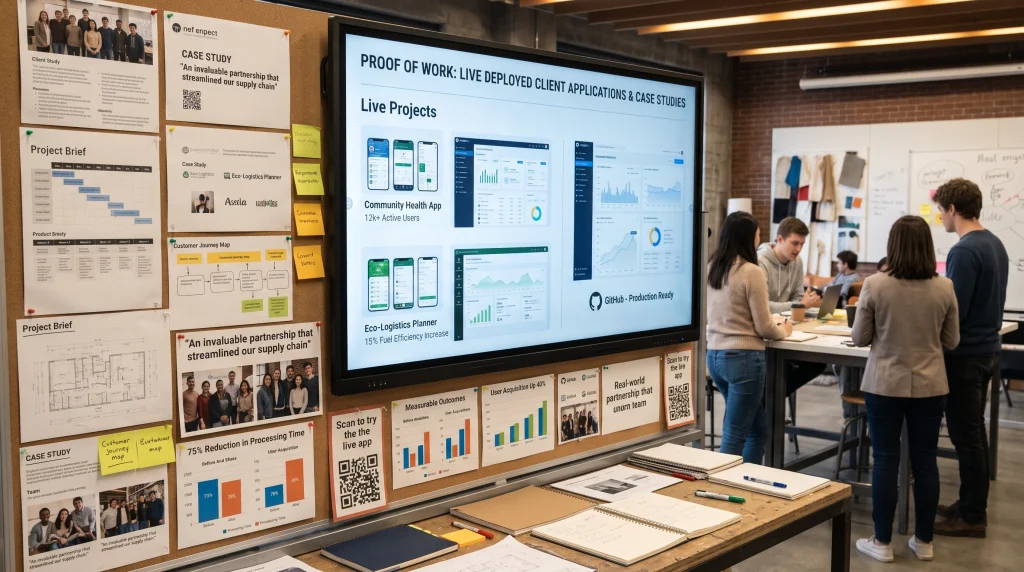
This credibility crisis has transformed hiring into a proof-of-work ecosystem. Employers no longer ask: what did you study at university? Instead, they ask: what have you actually built, deployed, written, or designed that is live on the internet today?
The Architecture of a High-Impact Case Study
Participating in live business projects equips students with the raw material required to construct high-converting case studies. A remarkable portfolio does not merely display pretty screenshots of completed work; it documents the intellectual and technical journey of problem solving.
An authoritative, hiring-ready case study incorporates five critical architectural components:
- The Commercial Context and Problem Statement: The student clearly defines the business context. What organization was the project for? What specific operational bottleneck, technical deficiency, or market challenge did the business face?
- Strategic Formulation and Tool Selection: The student explains why specific technologies and methodologies were chosen. Why was React chosen over static HTML for this specific user dashboard? Why was a content cluster strategy selected to target high-intent organic search queries?
- Implementation Hurdles and Technical Roadblocks: The case study documents the authentic obstacles encountered during execution. Did a third-party payment gateway documentation contain deprecated endpoints? Did site speed drop below acceptable thresholds on mobile viewports? Documenting how these hurdles were diagnosed and resolved demonstrates profound technical maturity.
- Measurable Business Outcomes: Where applicable, the student quantifies the results of their work. Did the new responsive redesign reduce mobile page bounce rates by thirty percent? Did the published SEO guide achieve page-one Google rankings for target search entities? Did the email recovery sequence recover twelve percent of abandoned carts?
- Verifiable Live Links and Source Repositories: The student provides public, verifiable proof. In web development, this includes a clean GitHub repository displaying organized commit histories and a live, deployed URL. In writing, it links directly to published articles on active client domains. In design, it provides interactive Figma prototypes and live brand style guides.
When an entry-level candidate presents three or four meticulously documented case studies of this caliber, they immediately separate themselves from the vast majority of applicants who merely submit generic resumes and academic transcripts. Their portfolio serves as undeniable, objective evidence of their ability to deliver commercial value.
12. How Live Projects Prepare Students for Professional Careers Across Multiple Paths
The experiential foundation acquired through live business assignments is not limited to a single career path. Whether a student aspires to climb the corporate ladder within an established enterprise, build a global remote freelancing practice, or launch a scalable technology business, the competencies cultivated during live project immersion provide an enduring competitive advantage.
Examining How Live Projects Prepare Students for Professional Careers reveals how this practical foundation empowers graduates across three primary economic trajectories.
Career Trajectory 1: Corporate and Digital Agency Employment
For students pursuing full-time employment within software export firms, corporate technology departments, or creative marketing agencies, live project experience eliminates the most significant barrier facing new graduates: the dreaded experience paradox, where entry-level job postings require two years of practical experience.
Candidates with live project backgrounds onboard smoothly into corporate teams. Because they already understand Git workflows, agile sprint rituals, client communication norms, and quality assurance testing, they require minimal initial supervision. Hiring managers recognize that such candidates represent lower training overhead and faster time to productivity, making them priority hiring targets for competitive corporate roles.
Career Trajectory 2: Global Remote Freelancing and Independent Consulting
Over the past decade, Pakistan has emerged as one of the world’s leading suppliers of freelance digital talent across platforms such as Upwork, Fiverr, and LinkedIn. However, competition on these platforms is intense, and thousands of inexperienced freelancers struggle to win their first client contract because their profiles lack credibility and demonstrable proof of work.
Students who have executed live business projects possess an immense advantage on global freelancing platforms. When submitting project proposals, they do not submit generic boilerplate cover letters. Instead, they link directly to live websites, published articles, or verified design case studies that directly address the client’s specific problem. At the same time, because they have already interacted with real stakeholders and managed deadlines during their training, they communicate with international clients with poise, confidence, and professionalism.
Career Trajectory 3: Digital Entrepreneurship and Agency Scaling
For ambitious individuals with entrepreneurial ambitions, live business projects serve as an incubator for future business ventures. Through live project execution, students learn the anatomy of how an agency operates: how client leads are generated, how proposals are priced, how scopes of work are managed, and how deliverables are fulfilled.
Armed with this comprehensive understanding, enterprising graduates can transition from being individual service providers into agency founders. They can assemble multidisciplinary teams of fellow graduates, offering specialized web engineering, creative branding, or digital marketing services to regional and international enterprises. In this way, experiential learning transforms students from job seekers into job creators who contribute to national economic growth.
Long-Term Adaptability in an AI-Disrupted Global Economy
As artificial intelligence tools continue to automate repetitive coding tasks, basic graphic generation, and routine copywriting, purely theoretical or rote skill training becomes increasingly obsolete. Global employment research published by the OECD Future of Work Directorate emphasizes that the skills most resilient to technological automation are complex problem formulation, cross-disciplinary synthesis, contextual adaptation, and empathetic human communication.
Live business projects cultivate precisely these automation-resistant competencies. Students do not simply learn how to push buttons in a software interface; they learn how to diagnose messy human problems, collaborate with multidisciplinary teams, interpret qualitative client feedback, and synthesize holistic solutions. By mastering the art of continuous, applied problem solving, students build career resilience that allows them to thrive alongside emerging technologies rather than being displaced by them.
13. Step-by-Step Strategic Blueprint: How Students Can Access and Execute Live Projects
Recognizing the profound value of live business projects is only the first step. For a university student or self-directed learner, the practical question remains: how can an individual with no professional network actively identify, secure, and execute their first live business project?
The following four-stage implementation blueprint provides an actionable roadmap for students seeking to bridge the gap between classroom theory and commercial execution.
Stage 1: Establishing Foundational Competencies and Tool Fluency
Before approaching an active business or organization, a student must achieve a baseline level of technical and creative competence. Attempting to execute a live client project without basic tool fluency risks project failure and damages professional trust.
Students should dedicate initial study to mastering the foundational tools of their chosen discipline. In web development, this means understanding responsive HTML, CSS, JavaScript, and Git version control. In content creation, it requires understanding search intent, structural hierarchy, and grammar fundamentals. In graphic design, it involves mastering layout grids, typography pairings, and vector software such as Figma or Adobe Illustrator. Completing structured exercises and participating in educational programs like Alkasim’s technical courses provides this essential initial foundation.
Stage 2: Identifying Project Opportunities and Community Outreach
Once baseline fluency is established, students must proactively seek out live project opportunities. Four accessible avenues exist for securing initial commercial assignments:
- Local Small Business Outreach: Within every community, dozens of small enterprises, retail shops, clinics, and professional practices maintain outdated websites, dormant social media channels, or non-existent search visibility. Students can offer to build a modern responsive website, optimize their local Google Business profile, or create high-quality marketing assets, often in exchange for a modest project stipend and an authoritative testimonial.
- Non-Profit and Community Organizations: Charitable foundations, community initiatives, and youth sports clubs frequently operate with limited budgets and welcome volunteer assistance with web development, branding, and content creation. These projects provide rich commercial complexity and authentic stakeholder accountability.
- Campus and Departmental Initiatives: University academic departments, research labs, student clubs, and campus events constantly require promotional websites, digital event registration portals, and branded visual collateral. Students can volunteer to manage these digital assets under professional standards.
- Open Source and Public Good Software: Aspiring software developers can contribute to established open-source software repositories on GitHub. Navigating real-world issue trackers, submitting pull requests, and undergoing rigorous code reviews by senior maintainers worldwide provides extraordinary commercial-grade experience.
Stage 3: Establishing Formal Scopes of Work and Communication Cadence
Even when working on pro-bono or entry-level projects, students must conduct themselves with absolute professional discipline. Before commencing any work, the student should draft a simple, written Scope of Work (SOW) document outlining:
- The specific deliverables to be produced (for example, a five-page responsive website with a contact form).
- The project timeline, broken down into clear weekly milestone deadlines.
- The responsibilities of the client, such as providing brand logos, product photography, and text copy by a specified date.
- The agreed review and revision parameters, specifying how many rounds of feedback are included.
Establishing these formal parameters prevents misunderstandings, eliminates scope creep, and demonstrates professional maturity that impresses clients.
Stage 4: Post-Project Reflection, Case Study Curation, and Testimonial Collection
The completion of a live project is not the end of the learning process; it is the beginning of career asset creation. Immediately upon successful project deployment, the student should execute three vital post-project tasks:
- Request a Written Client Testimonial: Ask the business stakeholder for a candid written recommendation highlighting the student’s technical competence, communication clarity, and adherence to deadlines. This testimonial should be displayed prominently on the student’s portfolio and LinkedIn profile.
- Conduct an Objective Technical Debrief: Reflect on what went well and what proved challenging during project execution. What technical errors were encountered? What communication breakdowns occurred? Documenting these lessons accelerates personal growth.
- Publish a Comprehensive Portfolio Case Study: Document the project as a detailed case study on a personal portfolio website or platforms like GitHub and Behance, following the five-part case study architecture outlined in Section 11.
14. Frequently Asked Questions (FAQ)
15. Conclusion and Strategic Outlook
The contemporary employment landscape has permanently outgrown the historical assumption that an academic degree alone guarantees professional competence. As artificial intelligence automates routine memorized tasks and global markets demand immediate operational capability, the value of education is measured not by what an individual knows in theory, but by what they can reliably execute, build, and deliver in practice.
Revisiting the central inquiry of this analysis, How Can Students Gain Experience Through Live Business Projects?, the answer reveals itself as an integrated journey of purposeful immersion. Students gain authentic experience when they step outside the sanitized confines of lecture halls, take ownership of genuine commercial challenges, collaborate across multidisciplinary teams, embrace constructive feedback, and build a publicly verifiable body of work.
Live business projects represent the vital connective tissue between formal education and professional industry. Through experiential execution, learners cultivate analytical problem-solving skills, operational resilience, commercial communication fluency, and project management discipline. For students in emerging digital economies like Pakistan, this practical orientation unlocks extraordinary economic pathways across domestic technology software houses, creative agencies, and global remote freelancing ecosystems.
The institutional philosophy demonstrated by Alkasim under the Learn, Build and Grow framework illustrates the transformative power of this approach. By treating students not as passive consumers of theoretical lectures, but as active apprentices engaging with agency-grade business assignments, educational initiatives empower the next generation to enter the workforce with genuine competence and grounded confidence.
For every ambitious student, educator, and institutional leader, the mandate is clear: move beyond theoretical contemplation and embrace practical execution. Master the tools of the modern craft, seek out authentic business challenges, build tangible assets, and let your verifiable proof of work speak for your professional capability.