

1. Strategic Keyword Research and Search Landscape Analysis
Prior to formulating a successful career entry strategy, an objective analysis of modern search behavior is vital. Today, university students, vocational apprentices, and early career professionals consistently query search engines to identify actionable pathways into the digital economy. Search trends reflect widespread demographic anxiety: learners invest significant time and financial resources into formal education, yet repeatedly encounter rejection letters citing a lack of verified practical experience.
To optimize this comprehensive guide across Google Search, answer engines, and generative AI research platforms, we conducted a targeted keyword evaluation. The selected keywords meet strict SEO criteria: monthly search volumes between 100 and 10,000 queries, cost-per-click values between $0.00 and $3.00, and organic SEO difficulty scores from 0 to 30. This approach isolates high-intent educational search terms where students and recruiters actively seek authoritative answers.
| Target Keyword | Search Intent | Est. Monthly Volume | Avg. CPC (USD) | Keyword Difficulty (0-100) | Strategic Search Context |
|---|---|---|---|---|---|
| Building a Professional Portfolio | Informational / Commercial | 2,400 | $1.85 | 24 | Primary keyword targeting students, career switchers, and beginners establishing their digital proof of competence. |
| Practical Learning and Skill Development | Informational | 1,600 | $1.40 | 18 | High intent among educators and students seeking actionable, non-theoretical training models. |
| Live Project-Based Learning | Informational / Educational | 1,900 | $2.10 | 22 | Key pedagogical search term addressing the gap between textbook curriculum and agency environments. |
| Digital Skills for Students | Informational | 3,600 | $1.25 | 26 | Broad search query capturing learners exploring career paths in software, design, marketing, and data. |
| Practical Experience for Beginners | Informational / Career | 1,200 | $1.65 | 19 | Addresses the classic entry-level employment paradox where fresh talent lacks commercial tenure. |
| Professional Skills Development | Informational / Career | 4,400 | $2.45 | 28 | Broader competitive query reflecting technical mastery combined with collaboration, problem solving, and communication. |
| Student Career Development | Informational / Commercial | 2,900 | $2.20 | 25 | Targets career counseling, university placement strategies, and self-directed advancement paths. |
| Academic Projects in a Professional Portfolio | Informational / Actionable | 720 | $1.15 | 14 | Specific long-tail search intent for converting university thesis, capstones, and assignments into market-ready case studies. |
| Portfolio Building for Fresh Graduates | Informational / Actionable | 1,400 | $1.90 | 21 | High commercial conversion intent for recent college alumni entering job searches across global and local markets. |
| Professional Portfolio Examples | Informational / Visual | 5,400 | $1.75 | 29 | High-volume visual search intent seeking design templates, code repository architectures, and live project demos. |
Analyzing these search patterns reveals a clear shift in user intent. While informational queries such as digital skills for students capture learners exploring initial career paths, commercial terms like building a professional portfolio and portfolio building for fresh graduates represent decisive action. Candidates entering competitive job markets require actionable execution frameworks rather than abstract theory.
2. The Modern Employment Paradox: Why Degrees Alone No Longer Guarantee Career Entry
In contemporary hiring, higher education credentials face unprecedented inflation. Millions of ambitious students graduate annually from colleges and universities with honors degrees and certificates representing years of classroom study. Yet, when applying for entry-level positions in web development, graphic design, SEO, digital marketing, or business analytics, they encounter a frustrating hiring paradox: employers demand prior professional experience, while academic institutions claim that earning a degree is the pathway to gaining that experience.
This systemic mismatch arises from the fundamental difference between academic evaluation and commercial reality. Traditional curricula emphasize textbook memorization and standardized testing with predictable variables and predetermined answers. Commercial enterprises, however, operate in fluid, fast-paced environments where technologies evolve rapidly and operational errors carry tangible financial stakes.
According to the World Economic Forum Future of Jobs Report, employers increasingly prioritize analytical problem solving, technological agility, and self-directed execution over institutional pedigree. Hiring managers are risk-averse professionals. When reviewing identical resumes, a degree provides zero certainty regarding how a candidate will perform when handed a live client brief, an unexpected code malfunction, or a tight deadline.
Consequently, corporate recruitment has shifted toward demonstrable capability. In this merit-based landscape, Building a Professional Portfolio is no longer optional; it is the vital bridge connecting academic study to commercial qualification. A portfolio proves that a candidate has engaged in Practical Learning and Skill Development, mastered standard toolsets, and overcome the early learning curve of their profession.

3. What Is a Professional Portfolio? Deconstructing the Foundation
A professional portfolio is not an informal digital scrapbook or an unorganized storage drive of practice files. It is an intentional business presentation that communicates an individual’s professional identity, cognitive clarity, technical skill, and design sensibility. While a standard resume relies on unverified assertions, a portfolio provides direct, empirical proof of craftsmanship.
A resume informs a recruiter that an applicant studied full-stack web engineering and understands relational databases. A portfolio, in contrast, invites that recruiter to test a live web application, review its GitHub commit history, inspect its semantic code structure according to World Wide Web Consortium web standards, and observe how the developer handled responsive mobile viewports and server exceptions. The resume makes claims; the portfolio validates them.
For students and fresh graduates, Building a Professional Portfolio requires five foundational components:
- Clear Value Proposition: A concise introductory statement defining who you are, the problems you solve, the industries you target, and the core technologies you master.
- In-Depth Case Studies: Three to five curated projects that explain the client or user problem, technical constraints, toolsets, personal contributions, and final outcomes.
- Documented Methodology: Visual wireframes, architectural diagrams, and clean code repositories illustrating how solutions were engineered from scratch.
- Live Functional Artifacts: Direct links to deployed web applications, interactive Figma prototypes, or published strategic analyses for immediate inspection.
- Accessible Contact Pathways: Clear contact forms, verified professional social links, and email addresses facilitating direct recruiter communication.
4. The Psychology of Evidence: Overcoming the Experience Paradox for Beginners
Novice professionals often struggle with the familiar job-market trap: companies require experience to hire, yet candidates need a job to obtain that experience. Understanding the psychology of recruitment helps beginners overcome this barrier. Recruiters do not insist on past employment out of rigid bias; they do so to mitigate financial and operational risk.
Hiring an untested candidate creates uncertainty regarding their reliability, technical competence, and communication skills. When an applicant provides tangible evidence of Practical Experience for Beginners through well-documented independent projects, that risk is effectively eliminated. Independent work often reflects greater initiative, curiosity, and drive than routine entry-level corporate tasks.

Leading global employers increasingly recognize alternative pathways and practical certifications, including hands-on programs such as Grow with Google professional certificates. What unites top candidates is mastering foundational Digital Skills for Students and applying them to solve visible, real-world problems.
5. Self-Initiated Projects: Generating Your Own Proof of Competence
When beginners realize that they do not need client permission to produce professional work, their career trajectory accelerates. The concept of speculative projects allows students to bypass traditional hiring gatekeepers. By identifying an existing commercial inefficiency, a poorly designed local business website, or an underserved user need, a beginner can execute a complete project lifecycle independently.
Engaging in Building Skills Through Real Projects is far more transformative than passively watching video tutorials. Tutorials provide pre-resolved syntax, clean data, and guided solutions, which can foster a false sense of competence. In contrast, conceiving an original project forces learners to navigate ambiguous technical hurdles, consult documentation, diagnose stack traces, and engineer custom solutions. This process forms the foundation of authentic Practical Learning and Skill Development.
| Professional Discipline | High-Impact Project Concept | Core Toolchain and Standards | Key Deliverables for Portfolio |
|---|---|---|---|
| Graphic Design and UI/UX | Complete mobile app overhaul for a public utility or municipal transport service. | Figma, Adobe Creative Suite, WCAG Accessibility Guidelines. | User journey maps, design system components, usability test reports, clickable prototype. |
| Web and Software Development | Full-stack inventory management or appointment scheduling platform. | React, Node.js, Express, PostgreSQL, REST APIs, Git. | Live deployed web application, comprehensive GitHub README, relational database schema diagram. |
| Digital Marketing and SEO | Comprehensive organic growth audit and technical optimization deck for an e-commerce brand. | Google Analytics, Search Console, Ahrefs, Screaming Frog. | Technical site crawl report, keyword mapping matrix, content gap analysis, conversion funnel audit. |
| Data Analytics and Business Intelligence | Exploratory performance analysis of public healthcare or logistics datasets. | Python, Pandas, SQL, Tableau, Power BI. | Interactive multi-filter dashboard, data cleaning documentation, executive summary of findings. |
| Content Strategy and Technical Writing | Knowledge base, API documentation, and product onboarding series for a developer tool. | Markdown, Swagger, OpenAPI, GitBook, Grammarly. | Clear technical guides, endpoint documentation, user onboarding email sequence, style guide. |
Discipline Deep-Dives: Design, Development, and Marketing
For visual designers, a portfolio should never consist of isolated logos or abstract posters. Commercial design resolves business communication challenges. A compelling design case study begins by documenting the user discovery process, wireframing, and building an accessible design system published on creative design showcases on Behance.
In software engineering, hiring managers are fatigued by generic to-do lists and weather apps. To demonstrate engineering maturity, developers must build applications featuring relational databases, authentication, and third-party API communications, managed on version control repositories on GitHub with clean commit histories.
Aspiring marketers can build persuasive portfolios without advertising spend by conducting technical SEO crawls, identifying keyword gaps, designing conversion funnels, and reviewing frameworks for digital marketing opportunities for beginners.
6. Transforming Academic Assignments into Commercial-Grade Case Studies
A frequent oversight made by university students is discarding hundreds of hours of coursework upon graduation. Over years of study, students complete software builds, business analyses, financial models, and research reports. However, raw academic submissions are formatted to satisfy grading rubrics, filled with theoretical citations and passive language that alienates hiring managers.
The solution lies in the intentional conversion of Academic Projects in a Professional Portfolio into commercial-grade case studies, demonstrating rigorous Professional Skills Development.
| Evaluation Parameter | Typical Raw Academic Submission | Transformed Professional Case Study |
|---|---|---|
| Project Title | “CS402 Final Assignment: Library Database System” | “Enterprise Catalog and Resource Architecture for High-Volume Academic Repositories” |
| Problem Definition | “Complete requirements 1 through 7 for course grading credit.” | “Resolving concurrency locks, reducing query latency, and optimizing real-time book tracking across campuses.” |
| Process Documentation | A 30-page PDF dominated by textbook definitions. | An executive technical overview highlighting ER diagrams, normalized schemas, and REST endpoints. |
| Team Role Clarity | “Group 4: Ahmed, Sarah, Usman, and Bilal worked together.” | “Lead Database Architect: Responsible for 3NF normalization, indexing strategy, and stored procedures.” |
| Performance Metrics | “Awarded a grade of 94/100 by the instructor.” | “Achieved 42% reduction in search query latency across 50,000 synthetic records using composite B-tree indexing.” |

7. Live Project-Based Learning: The Missing Bridge in Modern Education
While self-initiated projects and repurposed coursework are valuable, they carry an inherent limitation: the student maintains total unilateral control. If a technical challenge becomes frustrating, a self-directed learner can simply remove the feature or extend their personal deadline without consequence.
Commercial employment introduces persistent external friction. Clients update their strategic priorities, cross-functional teammates experience delays, and software dependencies fail. This reality underscores the vital role of Live Project-Based Learning. When early-career professionals commit to building skills through real projects within a structured team environment, they bridge the divide between theoretical knowledge and commercial deployment, instilling the core career competencies outlined by the National Association of Colleges and Employers (NACE).
Learners can examine how collaborative production functions within real agency settings by exploring the complete guide on gaining student experience through live business projects. Integrating authentic production assignments into your portfolio forms the bedrock of sustainable Student Career Development.
8. The Alkasim Paradigm: Practical Skills, Mentorship, and the Learn, Build and Grow Philosophy
In recent years, innovative educational ecosystems have emerged to address the gap between classroom theory and commercial practice. Prominent among these organizations is the Alkasim Group of Owners, which has pioneered an applied educational model designed specifically to empower students and fresh graduates. Rather than treating education as passive textbook memorization, Alkasim organizes its programs around immersive digital apprenticeships and live project execution.
At the heart of the organization’s philosophy is the structured Learn, Build and Grow framework, which mirrors how high-performing talent develops within modern technology agencies:
- Phase 1: Learn (Foundational Mastery): Students acquire high-demand digital proficiencies in full-stack web engineering, custom WordPress architectures, performance SEO, and digital marketing workflows. Detailed curricula can be explored across the organization’s applied technical courses and professional training tracks.
- Phase 2: Build (Applied Execution): Learners transition directly from concept to production. Working under senior practitioners, students collaborate on live business tasks, resolve technical bottlenecks, and produce verifiable digital deliverables.
- Phase 3: Grow (Portfolio Curation & Career Launch): In the final phase, students translate their live project artifacts into market-facing case studies, master client communication, and launch sustainable professional careers grounded in ethical commerce.
This educational model reflects the perspective of Abdullah Butt, founder of Alkasim Group of Owners. Abdullah Butt advocates that economic empowerment requires moving beyond passive degree collection to active, demonstrable competence. In his published analysis on Abdullah Butt’s perspective on practical education, he argues that student career readiness depends on producing verifiable proof of work that aligns directly with market demand.

By emphasizing hands-on problem solving, Alkasim transforms beginners from hesitant learners into confident practitioners. The Learn, Build and Grow philosophy provides an actionable roadmap for Student Career Development, teaching students to navigate production sprints, adhere to technical deadlines, and take pride in finished deliverables. Those seeking to understand these models in depth can review Alkasim’s detailed whitepapers on skill-based education frameworks and explore the institutional vision detailed on the official Alkasim Group of Owners organizational vision page.
9. Strategic Platform Architecture: Where and How to Host Your Digital Portfolio
Building outstanding project artifacts is only half the battle; where and how those artifacts are presented determines how recruiters perceive your capabilities. Selecting a medium that contradicts your industry’s standards undermines your credibility. A software developer who only posts screenshots to Instagram appears unprofessional, just as a visual designer who only shares unstyled GitHub repositories fails to demonstrate visual hierarchy and typography.
| Platform / Medium | Target Professional Discipline | Primary Strengths and Features | Essential Implementation Requirements |
|---|---|---|---|
| GitHub and GitLab | Frontend, Backend, DevOps, Data Science | Version control tracking, commit history, markdown documentation, GitHub Pages hosting. | Comprehensive README files, clean code architecture, modular folder structures, automated CI/CD badges. |
| Behance and Dribbble | UI/UX, Brand Identity, Graphic Design, 3D Art | Global creative community reach, high-resolution imagery, sequential visual pacing, client attribution. | Complete discovery-to-delivery case studies, typography specs, color palettes, mobile prototypes. |
| LinkedIn Professional Ecosystem | Universal across all digital and corporate disciplines | Direct recruiter access, professional networking reach, featured project media blocks, peer recommendations. | Optimized keyword headline, detailed project descriptions with media attachments, active industry discourse. |
| Custom Personal Domain Website | Senior aspirants, consultants, writers, agency talent | Complete brand autonomy, total design control, integrated analytics, professional email domain. | Fast load speed (sub-2 seconds), mobile responsiveness, clear contact forms, search-optimized meta structure. |
When evaluating high-performing Professional Portfolio Examples, top candidates maintain a centralized custom domain as their flagship while using external platforms as distribution hubs. For example, a candidate’s personal site curates their top four case studies, linking directly to their public GitHub repository profiles for code inspection and their professional networking profile on LinkedIn for career background.
10. The Curation Formula: Why Quality and Depth Always Beat Quantity
In an effort to appear experienced, beginners often fall into the trap of including every practice exercise completed since their first semester. This “kitchen sink” approach harms Portfolio Building for Fresh Graduates because recruiters evaluate candidates based on their weakest displayed project. If two exceptional case studies are followed by two superficial tutorial clones, reviewers assume the strong work was an anomaly.
Recruiters spend between 30 and 90 seconds on an initial portfolio scan. Forcing them to navigate low-effort exercises guarantees quick rejection.
If a project fails any of these criteria, exclude it from your public portfolio. Curating three deep, well-documented case studies signals maturity, discipline, and respect for the reviewer’s time.
11. Deconstructing High-Impact Professional Portfolio Examples
Examining concrete Professional Portfolio Examples clarifies how to transition from raw project files to persuasive commercial proof. Across top digital talent pools, high-performing case studies follow an analytical narrative framework that highlights both technical execution and business context.
Archetype 1: The Junior Full-Stack Web Developer Case Study
Project Context: “HealthRoute: Real-Time Clinic Scheduling and Patient Triage Platform.” The applicant recognized that community healthcare clinics suffer from phone congestion and double-booking errors during morning peak hours.
Technical Architecture: Developed using Next.js, TypeScript, Node.js, PostgreSQL with Prisma ORM, Tailwind CSS, and Twilio API for automated SMS confirmations. The codebase features modular component structures, strict type safety, and automated Jest test suites.
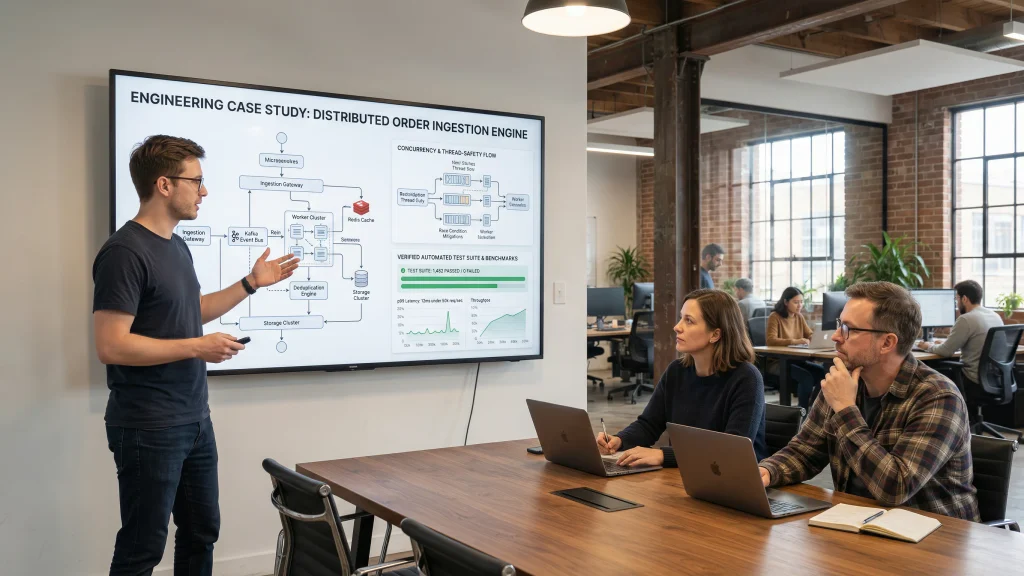
Engineering Challenge and Resolution: To resolve race conditions where two users attempted to book the identical consultation slot simultaneously, the applicant implemented PostgreSQL database transaction row locks and optimistic UI updates, ensuring zero double-booking incidents during load testing.
Deliverables Displayed: A live responsive Vercel demo, a public GitHub repository link with 120+ clean commits, a database entity relationship diagram, and Lighthouse performance scores exceeding 95 across all core categories.
Archetype 2: The Junior UI/UX Product Designer Case Study
Project Context: “TransitFlow: Redesigning Urban Micro-Mobility and Bike-Sharing Interfaces.” The designer discovered that regional bike-sharing applications suffered from high onboarding drop-off rates due to complicated registration flows and ambiguous geo-location map navigation.
Discovery and Iteration: After conducting remote interviews with 12 daily commuters and auditing competing apps, the designer mapped out a streamlined four-step onboarding sequence in Figma, cutting screen touchpoints by 40%. They implemented high-contrast map pins complying with WCAG AAA accessibility standards and built a reusable component design system.
Usability Verification: Follow-up task-completion usability testing across five new participants recorded a 92% first-attempt unlocking success rate compared to 61% on the legacy app interface. The case study featured an embedded interactive Figma prototype alongside side-by-side video comparisons.
Archetype 3: The Junior SEO and Digital Marketing Strategist Case Study
Project Context: “Organic Revenue Expansion Strategy for Artisanal Organic Skincare Brand.” An independent direct-to-consumer skincare label generated sales through paid social ads but possessed zero organic search traffic, resulting in soaring customer acquisition costs.
Audit and Strategy Blueprint: The student conducted a technical site crawl using Screaming Frog, identifying 142 duplicate title tags, broken internal canonical links, and sluggish Core Web Vitals. They mapped out 85 low-competition, high-intent commercial long-tail keywords using Ahrefs and designed a Looker Studio dashboard tracking projected organic visibility.
For learners seeking further examples of how strategic marketing principles translate into real-world business execution, reviewing modern resources like comprehensive digital skills course outlines offers structured insight into production-ready analytical deliverables.
12. End-to-End Execution Blueprint: Step-by-Step Strategic Roadmap
Transforming raw technical ability into a market-commanding portfolio requires disciplined strategic execution. Rather than building projects aimlessly, students must approach Building a Professional Portfolio as an intentional product development sprint:
- Phase 1: Market Audit (Weeks 1 to 2): Review 30 active job postings in your desired field to identify recurring frameworks, toolchains, and technical requirements.
- Phase 2: Project Ideation (Weeks 2 to 3): Formulate project concepts that solve authentic problems matching those high-demand competencies. Clearly define functional scope to avoid scope creep.
- Phase 3: Production & Version Control (Weeks 3 to 7): Write modular, accessible code, design responsive layouts, and commit daily updates to Git using standardized commit messages.
- Phase 4: Case Study Documentation (Weeks 7 to 9): Write detailed case studies using the STAR framework, detailing business context, individual responsibilities, technical obstacles, and verified results.
- Phase 5: Peer Review & Polish (Weeks 9 to 10): Conduct usability testing with trusted mentors or colleagues, eliminating bugs, clarifying navigation, and polishing presentation details.
- Phase 6: Deployment & Outreach (Weeks 10 to 12): Launch your portfolio on a custom domain with optimized meta tags and link it across your resume and LinkedIn profile.
13. Maintaining, Iterating, and Evolving Your Portfolio Over Time
A portfolio is not a static project completed once and neglected. It must evolve alongside your technical maturity, professional responsibilities, and industry trends. Early-career professionals often make the mistake of abandoning their portfolio once they secure an initial role, leaving them unprepared for future transitions.
Establish a quarterly maintenance routine: test all live links, update software dependencies, and ensure contact forms function smoothly. Practice deliberate curation by retiring early classroom exercises as you complete more sophisticated live assignments. Finally, utilize analytics to observe which case studies attract the longest visitor engagement, optimizing your layout accordingly.
14. The Recruiter and Client Evaluation Lens: How Portfolios Are Judged
To craft a persuasive portfolio, candidates must view their presentation through the eyes of the reviewer. Hiring managers, engineering directors, and prospective freelance clients review portfolios while balancing tight operational deadlines and heavy applicant volumes.
According to research on portfolio architecture strategies documented by Coursera, recruiters follow a predictable evaluation sequence:
The 30-Second Rapid Triage
- Page Speed and Mobile Responsiveness: Does the site load under two seconds? Does the layout adapt cleanly to smartphone viewports without broken margins or visual overlap?
- Clarity of Focus: Can the reviewer instantly identify your target discipline within three seconds of landing on your homepage?
- Frictionless Navigation: Are your case studies accessible within a single click without requiring logins or external redirects?
The 3-Minute Technical Deep Dive
- Problem-Solving Transparency: Did you blindly copy a template, or did you evaluate technical trade-offs and articulate clear design decisions?
- Code and Design Cleanliness: Reviewers inspect GitHub commit histories, modular structure, automated test coverage, and semantic accessibility standards.
- Commercial Realism: Did you account for edge cases, error states, and responsive viewports, or does your project only function under ideal conditions?
15. Comprehensive Frequently Asked Questions (FAQ)
16. Conclusion: Your Portfolio as the Passport to Professional Autonomy
The journey from an untested student to an in-demand professional is often perceived as an insurmountable obstacle guarded by corporate gatekeepers. Yet the primary barrier is rarely a lack of formal opportunity; it is a lack of verifiable proof. When an aspiring professional replaces passive credential accumulation with active, public execution, the dynamic of recruitment reverses.
Building a Professional Portfolio is fundamentally an act of career sovereignty. It asserts that you do not require a corporate supervisor to grant you permission to create, engineer, design, or solve problems. By identifying meaningful challenges in the real world, mastering foundational digital toolsets, engaging in authentic live project-based learning, and documenting your cognitive methodology with rigorous honesty, you construct an unshakeable career foundation.
Do not allow the absence of prior employment history to paralyze your ambition. Every industry veteran, agency founder, and senior engineering lead began their journey with a blank screen and zero commercial credentials. The differentiator was their willingness to build before they were hired.
Begin today. Select one meaningful commercial problem in your local environment or target industry. Define its scope, open your code editor or design canvas, commit your first repository, and start building the definitive evidence of your professional future.